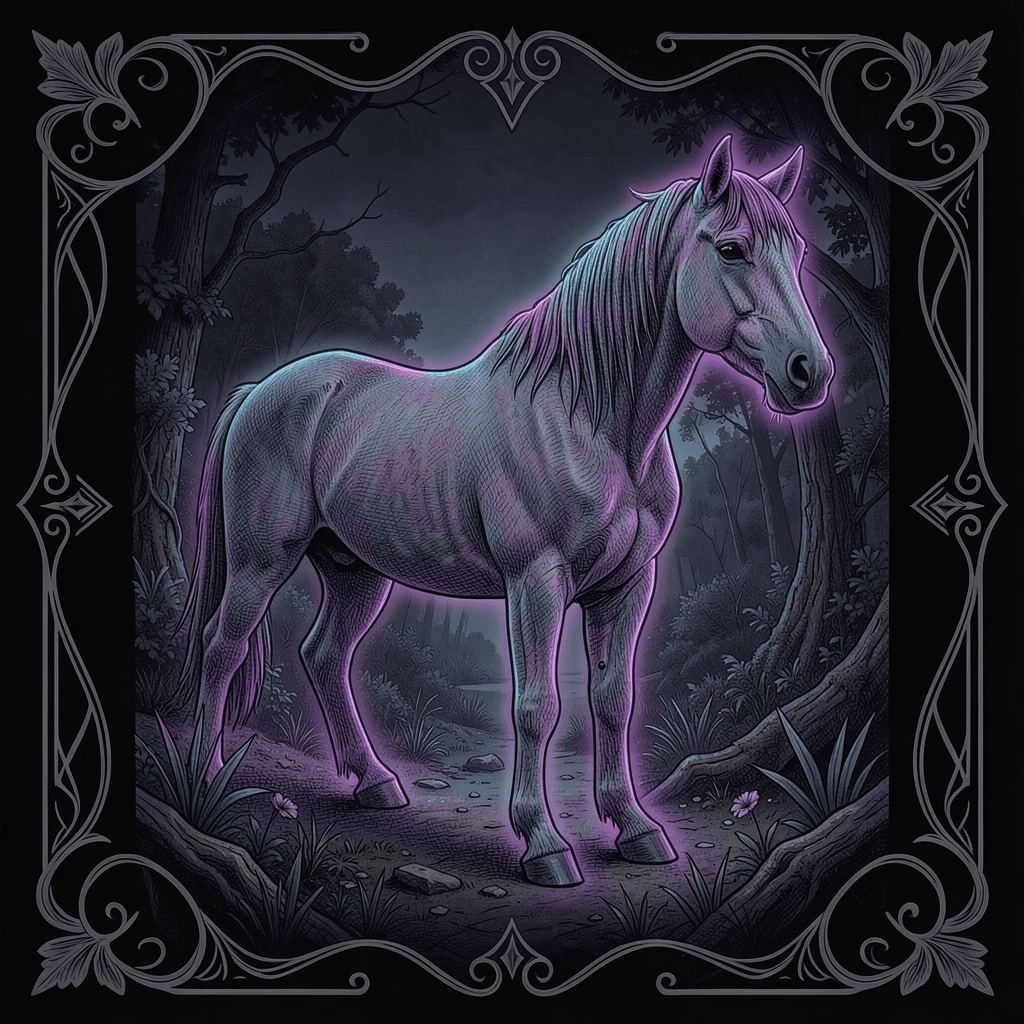
Horse dream meaning — interpretation
What it means to dream about a horse: raw energy, freedom, or a runaway force — and how different traditions read it.
Somnovis editorial team
A horse in a dream is closely tied to drive and momentum — an animal built for travel and effort, and one that carries the dreamer rather than being carried. That is why horse dreams so rarely turn on the horse itself and so often turn on the relationship: whether the energy is being ridden well, is running loose, or has stopped dead. Almost every tradition below reaches the same place by a different route, treating the mount as the means by which a life actually moves.
Riding a strong, cooperative horse. Generally read as a sign that the dreamer's ambition or vitality is currently well-directed — force under their own hand, taking them somewhere they genuinely want to go. Dreamers often report this one as physically pleasurable, and that feeling is part of the reading rather than incidental to it.
A wild or bolting horse. A horse that throws its rider, bolts, or simply cannot be held points to drive or urgency that has outpaced the dreamer's ability to manage it. Being thrown is a distinct image from watching a horse run loose in a field: the first is a loss of control the dreamer was inside of, the second something they are outside of and possibly envious of.
A horse that won't move, or one that is hurt. The stalled horse is less dramatic and often more troubling to the dreamer — energy that is present but unreachable, effort that produces nothing. A wounded, starving or dying horse is read across traditions as vitality itself being damaged, and dreamers usually wake from it flat rather than frightened.
What changes the reading. Who is on the horse, whether the dreamer has a rein at all, and whether the animal is theirs are the three details that do the most work. Pace matters too — a walk, a canter and a bolt are three different answers to the same question. The horse's colour attracts a lot of confident interpretation online; treat it as much less reliable than the relationship between horse and rider.
What this dream does not mean. A falling or injured horse is not a warning about the dreamer's health or anyone else's, and a bolting horse does not predict an accident. It is also worth saying that for people who ride, horses turn up in dreams for the ordinary reason that they occupy a lot of waking attention — and a dream drawn straight from the week does not owe anyone a meaning.
Perspectives across traditions
The horse is a major image in the classical Islamic dream-interpretation tradition, read as standing, honour, and the means by which the dreamer's affairs advance — a noble mount rather than merely an animal. A fine, well-kept horse under the dreamer's control is read as elevated status, capability and good fortune in what they have undertaken. A horse that bolts or throws its rider is read as affairs escaping the dreamer's command, and falling from one as a fall in standing, which is the same reading the tradition gives to falling generally. Owning a horse, or being given one, is read as authority or means being conferred on the dreamer by someone with the power to confer it.
Not every reading points at the individual's rank. Some classical material attaches the horse to a wife or to the household's fortunes rather than to the dreamer's own position, and where a dream places the horse in the household rather than on the road that strand is worth weighing. This entry is also the source the tradition's reading of a car borrows from: the mount is whatever carries a person through life, and the older material develops that idea here and lends it to modern vehicles rather than the other way round. One deliberate omission is worth flagging. The classical material does distinguish horses by colour and attaches particular readings to particular colours, but those specifics are not stated here, because reporting them confidently would mean supplying detail this site cannot verify.
This is one of the genuinely safe places to name Jung on a specific image. In Symbols of Transformation he treated the horse as a symbol of libido in his own broad sense — instinctual psychic energy, the non-human force that carries the ego and is not identical with it. That is his reading rather than something the later tradition has attributed to him, and it is the exception to the rule that governs the rest of this site: Jung rejected fixed dream dictionaries and assigned almost no image a settled meaning.
What follows for dream work is that the relationship between horse and rider is the whole subject. A horse obedient to the rein is instinct in working relationship with consciousness. A bolting horse is instinct that has taken the bit, going where it will and taking the ego with it. A horse that will not move is energy the ego cannot reach at all, which is a different and often heavier dream than the runaway. A wounded, starved or dying horse is read as vitality damaged, and analytical psychology takes that seriously as an image of exhaustion rather than as an omen about the body. The horse is also older in the psyche's imagery than any vehicle, and it carries a body that a machine does not — which is precisely what distinguishes this image from the dream of a car, where the same questions about control are asked of something manufactured rather than something alive.
In the Zhou Gong Jie Meng folk material the horse is broadly auspicious, with the readings attaching to speed, advancement and vigour. The phrase behind most of them says that success arrives the moment the horse does, used of a swift and certain result, and a horse in a dream is read towards exactly that — an undertaking that comes off quickly. The expression about the spirit of the dragon-horse supplies the vitality reading and is standard usage for vigour, particularly in an older person. Riding is read as advancement in career or reputation, with the pace suggesting how soon; a horse running free as an opportunity not yet taken hold of; a fallen or lame horse as a setback in whatever domain the horse stood for — and Chinese has an exact phrase for that last case, about a horse losing its forefooting, said of a capable person who stumbles unexpectedly. The horse is also one of the twelve zodiac animals, which gives it a weight in Chinese reckoning that a European reader will not assume.
But an entry that stops at swift success misrepresents the language, because the most famous horse proverb in Chinese (塞翁失马,焉知非福) is about a reversal of fortune rather than about winning. It tells of an old man on the frontier whose horse runs off, which is a loss; the horse returns bringing a wild horse with it, which is a gain; his son is crippled falling from that horse, which is a loss; and for that reason the son is not conscripted and not killed, which is a gain. Its refrain asks how you know a misfortune is not a blessing, and it is the standard Chinese formulation of the principle that fortune and misfortune cannot be read at the time. A horse gained or lost in a dream is the paradigm case of an event whose sign is not yet legible, and that cuts squarely against a flat auspicious reading. Two further idioms round out the register: an old horse knows the road, said of experience finding a way where planning cannot, and the phrase describing a mind like a monkey and a will like a horse, a Buddhist-derived expression for intention that will not be held still. That last converges strikingly with the Jungian reading above, where the horse is energy that carries the ego without belonging to it — two traditions independently choosing the same animal for the part of a person that will not take direction. The parallel is worth noticing; the two readings should not be merged.
The manual register is narrower than any of that, and often unrelated to success. The folk dream books give readings of the shape: riding a horse portends news arriving from a distance, a horse going at a walk portends delay in one's affairs, horses scattering portends misfortune, and a horse entering a room portends a wife's unfaithfulness — an entry that shows how little this corpus generalises and how bluntly it judges. Against that background the optimistic phrase deserves both its characters and its limits: 「马到成功」 (mǎ dào chéng gōng), the horse arrives and the thing succeeds, is the commonest good-luck formula involving a horse and the one most likely to be over-applied here, since the entries above give no support for reading every horse dream through it.
Sources
The tradition sections draw on these works. That is not a claim that every sentence is a quotation from them. Authorship of the treatise attributed to Ibn Sirin is disputed. The Chinese dream manual is paraphrased: its wording differs by version, so no edition, chapter, or date is named.
- Artemidorus of Daldis, Oneirocritica (2nd century).
- Muntakhab al-Kalām fī Tafsīr al-Aḥlām, the dream book attributed to Ibn Sirin.
- Zhou Gong Jie Meng (周公解梦).
- C. G. Jung, Man and His Symbols (1964), and the Collected Works.
Was your dream different?
Tell us exactly what you saw — our deeply trained AI will work through every detail and nuance of your specific dream.
Get a personal reading