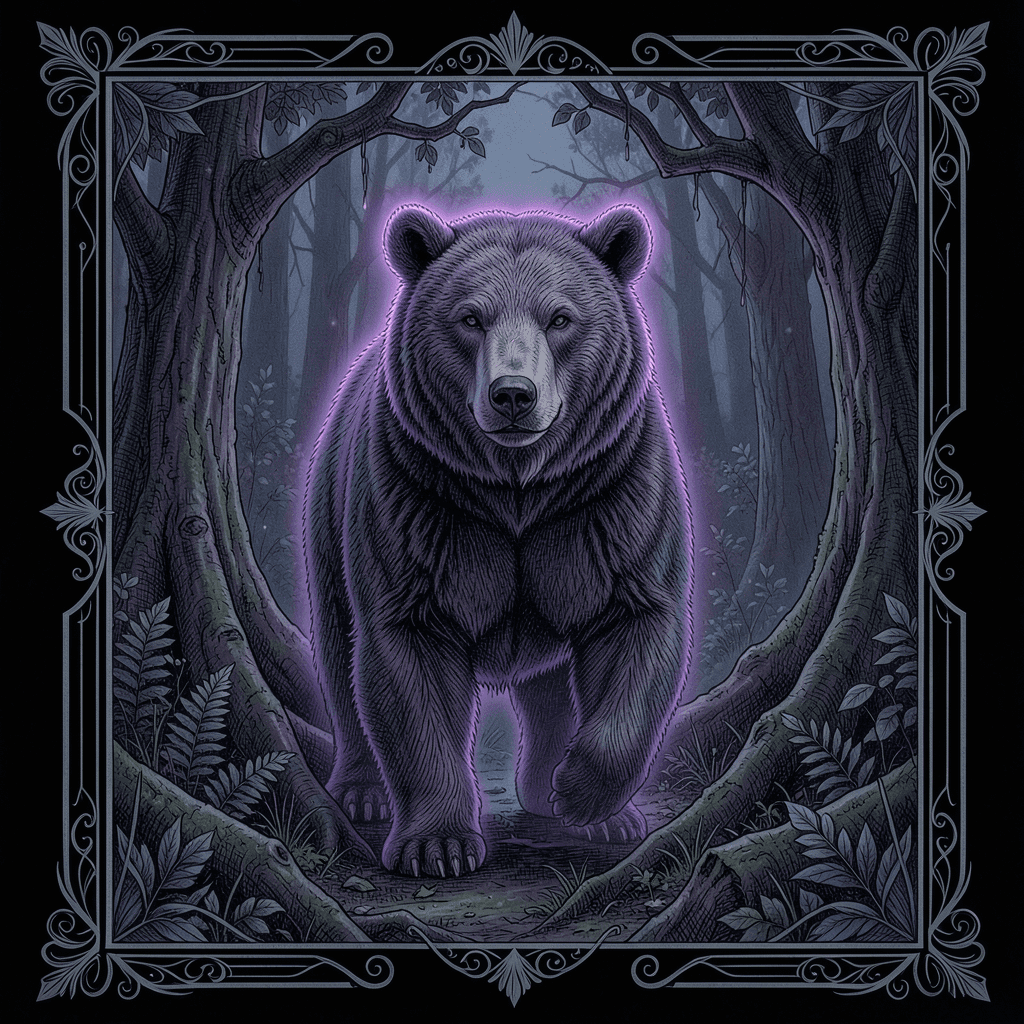
Bear dream meaning — interpretation
What it means to dream about a bear: protective strength or a warning of aggression — and how traditions interpret it.
Somnovis editorial team
A bear rarely appears as a background detail in a dream — its sheer size and unpredictability tend to put it at the center of the story, carrying a double meaning of protective strength on one hand and barely-contained aggression on the other.
A bear that guards, watches, or leaves the dreamer alone. A bear that keeps its distance, or seems to be standing guard, is often read as a sign of formidable inner strength the dreamer has but hasn't fully drawn on yet.
A bear that attacks or chases. An aggressive bear more often points to a looming confrontation, or to someone in the dreamer's life whose temper or power feels difficult to predict or contain.
What changes the reading. Distance and season carry more than they seem to. A bear that keeps to its own ground differs from one inside the dreamer's space, and a bear denned up for winter is a different image again — withdrawal rather than threat. A mother bear with cubs sharpens everything towards protection, and what the dreamer was doing near the cubs usually decides the tone.
What it does not mean. A bear dream is not a verdict on anyone's temper, and none of the traditions below reads it as a forecast about family or children — where old material touches birth omens, it is reported here as what a tradition held, not as something a dream can know.
Perspectives across traditions
This is one of the places where the classical corpus is honestly thin. The bear was not a central animal for the tradition's interpreters, and the entries that do exist are brief and unflattering: one strand reads the bear as a foolish or treacherous enemy — power without judgement. That strand is worth reporting but not building on; its weight in the material is modest, and it is hedged here accordingly.
What the tradition does supply reliably is its general predator register, and it applies cleanly: the encounter carries the reading. Being attacked by a powerful animal points to harm from a powerful quarter; overcoming it, to prevailing; escaping it, to a danger passed. A dreamer inside this tradition loses nothing by reading a bear that way — as a strong, unsubtle adversary whose significance lies in how the meeting went — while knowing that the corpus itself spent its precision elsewhere, on the lion, the snake and the wolf.
In a Jungian reading the bear belongs to the fierce face of the Great Mother — the archetype is Jung's concept, though the bear reading itself is the school's rather than his. This is protective power that mauls what threatens what it loves: not aggression for its own sake but ferocity in the service of care, which is why a mother bear with cubs is the version of this dream people remember most exactly. A dreamer met by that bear does well to ask what, in their life, is being guarded that fiercely — and by whom.
The other half of the reading is introversion. The hibernating bear is the psyche's capacity to withdraw, live off its reserves, and return — disappearance that is not defeat but season. A bear seen denned up, sluggish, or emerging in the dream's spring reads towards exactly that rhythm: energy pulled inward for a stretch that the dreamer's waking schedule may be refusing to allow. Neither strand is a fixed meaning; both are directions of attention — towards fierce care, and towards the legitimacy of retreat.
The anchor here is textual, and this site has already verified it at the snake article: the Book of Songs, in the Si Gan poem (斯干), contains a dream-divination scene in which bears augur the birth of a son — 「維熊維羆,男子之祥」 (wéi xióng wéi pí, nán zǐ zhī xiáng, bears and brown bears, the auspicious sign of a boy) — as vipers and snakes augur a daughter. The snake article gives the full scene; what matters here is the bear's half, and the afterlife it had: 熊罴入梦 (xióng pí rù mèng, bears entered the dream) became the set phrase of congratulation on the birth of a son, drawn from exactly this source. All of it is reported as what the tradition holds — nothing in it claims a dream reveals anything about a real pregnancy or the sex of any child.
Around that classical omen sits a much less dignified modern register: in colloquial and regional usage, calling a person a bear (熊) is calling them hapless or spineless (窝囊, wōnang — put-upon, ineffectual) — clumsy strength that fails at the moment it is needed. How folk dream reading treats that register is unknown, and no ruling is claimed from it; it is simply the case that a modern Chinese reader hears both at once — the classical bear that announces a son, and the colloquial bear that cannot get out of its own way — and the distance between the two is part of what the animal now carries.
Sources
The tradition sections draw on these works. That is not a claim that every sentence is a quotation from them. Authorship of the treatise attributed to Ibn Sirin is disputed. The Chinese dream manual is paraphrased: its wording differs by version, so no edition, chapter, or date is named.
- Artemidorus of Daldis, Oneirocritica (2nd century).
- Muntakhab al-Kalām fī Tafsīr al-Aḥlām, the dream book attributed to Ibn Sirin.
- Zhou Gong Jie Meng (周公解梦).
- C. G. Jung, Man and His Symbols (1964), and the Collected Works.
Was your dream different?
Tell us exactly what you saw — our deeply trained AI will work through every detail and nuance of your specific dream.
Get a personal reading