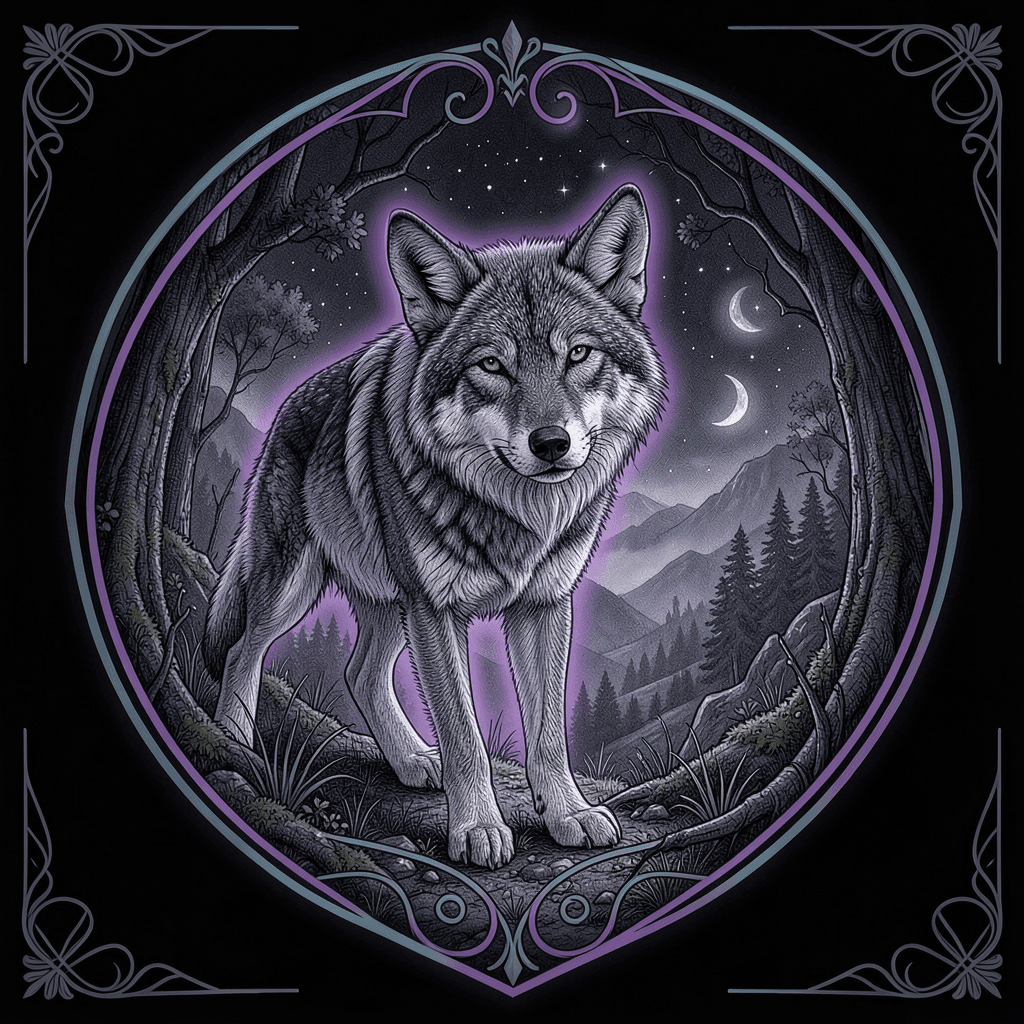
Wolf dream meaning — interpretation
What it means to dream about a wolf: a lone predator, a pack, or a hidden threat — and how traditions interpret it.
Somnovis editorial team
Unlike the dog, its domesticated relative, the wolf in a dream represents instinct that hasn't been tamed or bonded to anyone — cunning, self-sufficient, and often read as a warning rather than a comfort.
A lone wolf watching or stalking. A solitary wolf that observes from a distance is frequently linked to a hidden rival or a threat the dreamer senses but can't yet name — someone circling a situation rather than confronting it directly.
Running with a wolf pack. Being accepted by, or running alongside, a wolf pack tends to carry the opposite meaning: belonging to a fiercely loyal group, or embracing a wilder, less socially constrained part of the dreamer's own nature. Being hunted by the pack reverses it again — the group itself, its expectations or its appetite, has become the danger.
What changes the reading. The wolf's behaviour carries more weight than its presence: a wolf that attacks is a different dream from one that watches, and a wolf near what the dreamer is responsible for — children, animals, a household — sharpens the reading towards protection. Whether the dreamer confronts the animal, flees it, or is accepted by it usually decides which of the traditions' readings below actually fits.
What it does not mean. A wolf dream does not identify a treacherous person, and it is not evidence that anyone in the dreamer's life deserves the suspicion the image arrives with. The traditions collected below consistently read the wolf as a figure standing for someone or something — but they describe a shape of threat, and leave the recognition to the dreamer.
Perspectives across traditions
The classical Islamic dream-interpretation tradition has an unusually strong textual anchor for this animal: in Surah Yusuf, Joseph's brothers tell their father that a wolf ate him — and the claim is a lie, covering what they themselves had done. The tradition reads the wolf accordingly, as the figure of a hostile, deceitful or plundering man: an enemy who takes by force or by pretext. A dreamer pursued or attacked by a wolf is read as facing an adversary of that kind, and a wolf entering a flock is read as harm reaching people under the dreamer's care.
The sura gives the image a second, sharper edge that most readers miss: the wolf is also what a wrong gets blamed on. A wolf accused in the dream, or one that turns out not to have done the thing, sits closer to the sura's own sense — the danger in that version is not the animal but the story told about it. Throughout, the tradition is consistent that the wolf stands for a person, not for a mood; the reading does not turn on the animal being frightening, but on who in the dreamer's affairs behaves like this.
In a Jungian reading the wolf is instinct that has not been brought into relationship — the same drive the dog represents once it has, which is why the two animals are read against each other rather than separately. The wolf belongs to shadow material in the specific sense that concept carries: the shadow is Jung's term for what a person has disowned, not for what is evil, and the wolf is dangerous in a dream mainly because it has been left outside. A wolf that stalks rather than attacks is often read as material the dreamer has been keeping at exactly the distance where it cannot be dealt with — close enough to watch, too far to meet.
Being part of a pack, or running with wolves, is a different dream from being hunted by one. The first touches belonging and the loss of individual outline — the pull of a group that asks the dreamer to stop being distinct; the second is the encounter proper, the disowned drive turning towards its owner. None of this is a fixed ruling: analytical psychology declines to say what a wolf means, and asks instead what, in this dreamer's life, lives untamed and unacknowledged at the edge of the picture.
The popular Zhou Gong Jie Meng folk tradition — folk material, not a scholarly text — rules on the wolf plainly and unfavourably. The dream books give readings of the shape: a wolf portends quarrels and disputes, a wolf that bites portends being harmed by someone, a wolf entering the house portends an unquiet household. The wolf here stands broadly for danger, greed and treachery rather than for one specific vice, and the dream's own detail — biting, entering, blocking the way — does the interpretive work.
Behind the rulings sit the associations a Chinese reader brings to the animal, and they are distinct themes rather than one. 「引狼入室」 (yǐn láng rù shì, to invite the wolf into the house) is about bringing a calamity on yourself by your own act; 「狼心狗肺」 (láng xīn gǒu fèi, a wolf's heart and a dog's lungs) is about someone else's ingratitude; and 「狼子野心」 (láng zǐ yě xīn, a wolf cub's savage nature) is about a nature that does not change. None of these is a dream ruling — a wolf at the door in a dream is not decoded through the idioms — but they are what a reader hears behind the manual's entries, and they explain why the wolf's register in this material stays so consistently dark.
Sources
The tradition sections draw on these works. That is not a claim that every sentence is a quotation from them. Authorship of the treatise attributed to Ibn Sirin is disputed. The Chinese dream manual is paraphrased: its wording differs by version, so no edition, chapter, or date is named.
- Artemidorus of Daldis, Oneirocritica (2nd century).
- Muntakhab al-Kalām fī Tafsīr al-Aḥlām, the dream book attributed to Ibn Sirin.
- Zhou Gong Jie Meng (周公解梦).
- C. G. Jung, Man and His Symbols (1964), and the Collected Works.
Was your dream different?
Tell us exactly what you saw — our deeply trained AI will work through every detail and nuance of your specific dream.
Get a personal reading