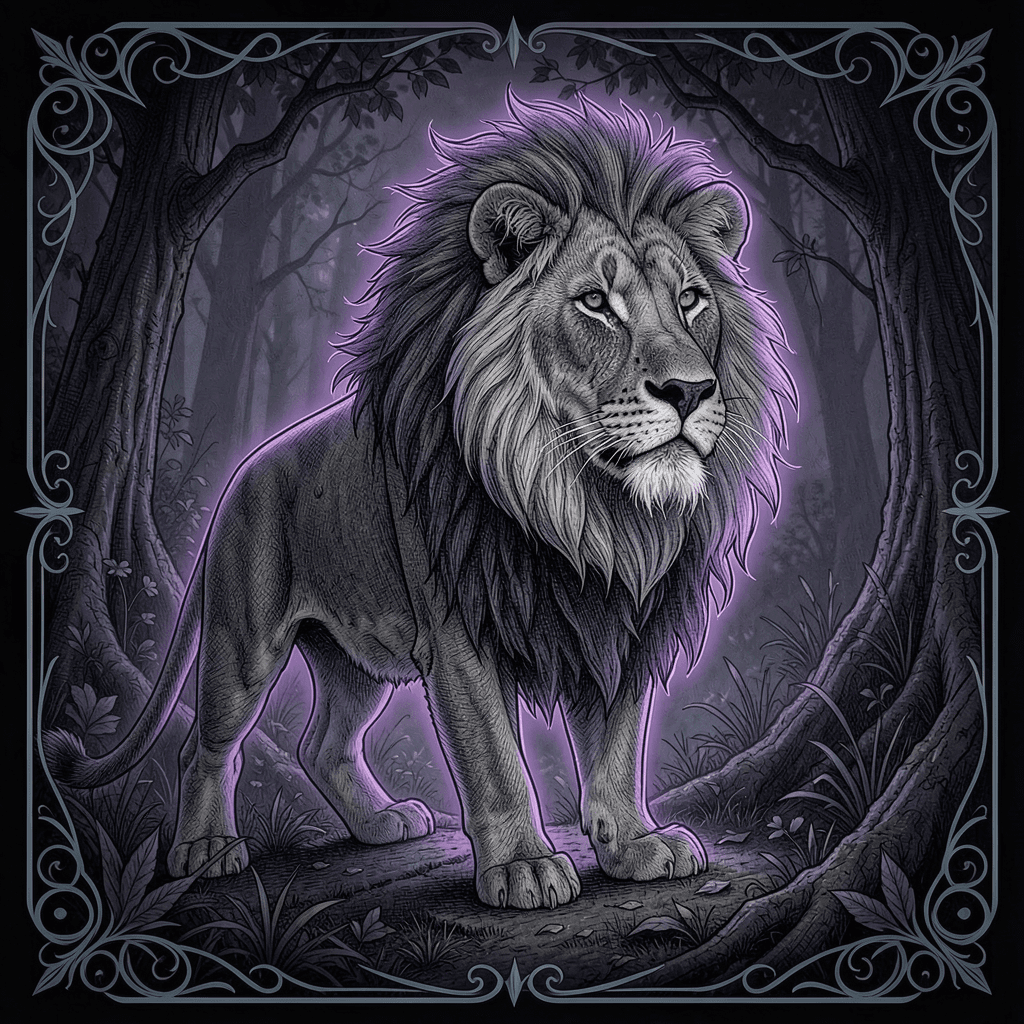
Lion dream meaning — interpretation
What it means to dream about a lion: authority, courage, or a dominant force — and how traditions read this symbol.
Somnovis editorial team
A lion in a dream almost always concerns power in some form — the dreamer's own, or someone else's — and the emotional tone of the dream usually tells you which side of that the dream is really about.
A calm, majestic lion. A lion that rests or moves with quiet authority, without threatening the dreamer, is generally read as a sign of the dreamer's own untapped confidence or leadership, ready to be claimed.
A roaring or attacking lion. A lion that roars, charges, or attacks tends instead to point to an authority figure the dreamer feels dominated by, or to their own suppressed anger finally demanding to be heard.
What changes the reading. The dreamer's position relative to the animal matters more than the animal itself: approaching a lion and coming away unharmed, being seized by one, keeping a lion behind bars, or being watched by one across open ground are four different dreams. A caged or tame lion raises its own question — what the containment is costing — while a lion that simply ignores the dreamer often reflects power that is present in their life without currently being aimed at them.
What it does not mean. A lion dream is not a verdict on the dreamer's courage, and none of the traditions below reads it as flattery. The image is about power and the dreamer's relation to it — claimed, resisted, or submitted to — and the dream's usefulness lies in noticing which of those three the dreamer was actually doing.
Perspectives across traditions
The classical Islamic dream-interpretation tradition reads the lion as a powerful man — a ruler, a commander, or an enemy of real standing — and the reading turns on the encounter rather than on the animal. Approaching a lion and being unharmed is read favourably, as access to power without cost; being seized by one is read as being overpowered by an authority the dreamer cannot resist (a logic one strand of the corpus also extends to illness, as something that seizes and does not let go — reported here as that strand's reading, nothing more); fleeing from one, as distance kept from a power that would otherwise overwhelm.
What is striking is how unromantic the tradition is about this animal. The lion is not admired in these readings; it is measured. Nothing in the material treats the encounter as ennobling, or the animal as a portrait of the dreamer's own courage — the lion is somebody else, somebody with weight, and the entire question is the dreamer's position relative to it: safe, seized, or out of reach.
In a Jungian reading the lion carries sovereign, self-assured power — instinct that has become ordered rather than raw, which is why this tradition reads it against the wolf rather than alongside it. A lion encountered in a dream is commonly read as a confrontation with the dreamer's own authority: either authority not yet claimed, or authority claimed too completely, and the dream's details usually say which. A tame or caged lion and a free one are different dreams — the first asks what the taming has cost, the second whether the dreamer can stand in the same field as their own strength.
Jung himself worked at length on alchemical symbolism, and the lion is a recurring figure in that material — the green lion in particular, an alchemical motif of a raw force that must be worked rather than destroyed. The connection is worth naming carefully: what belongs to Jung is the engagement with the alchemical images, not a fixed reading of what a dream lion means. Analytical psychology offers no such ruling here, only the recurring question of where the dreamer's own sovereignty currently sits — exercised, borrowed, or waiting.
The lion is not native to China — it arrived as tribute from the Western Regions and was reinforced later as a Buddhist guardian motif — which is why its Chinese register runs protective rather than predatory. The stone lions (石狮子, shí shīzi) set in pairs at gates guard the threshold, and the lion dance (舞狮, wǔ shī) at New Year and at openings drives off harmful influence. A pun carries most of the animal's auspicious weight: 狮 (shī, lion) is homophonous with 师 (shī), as in the historical titles of the highest offices of state — which is why paired lions in decoration read as rank passed down a family, and why a dream of lions, cubs especially, can be read towards office or academic success. The customs, it should be said, are the association a Chinese reader brings, not dream rulings in themselves.
The dream books are not uniformly favourable, though. They also give readings of the shape: a lion that bites portends litigation or disputes. So the contrast with the Islamic and Jungian material runs the other way rather than being its opposite — where those traditions measure the lion as a power over the dreamer, the Chinese material mostly reads it as protection and standing, yet a hostile lion is a bad sign in all three. That three-way divergence on a single animal is the most useful thing this page has to show.
Sources
The tradition sections draw on these works. That is not a claim that every sentence is a quotation from them. Authorship of the treatise attributed to Ibn Sirin is disputed. The Chinese dream manual is paraphrased: its wording differs by version, so no edition, chapter, or date is named.
- Artemidorus of Daldis, Oneirocritica (2nd century).
- Muntakhab al-Kalām fī Tafsīr al-Aḥlām, the dream book attributed to Ibn Sirin.
- Zhou Gong Jie Meng (周公解梦).
- C. G. Jung, Man and His Symbols (1964), and the Collected Works.
Was your dream different?
Tell us exactly what you saw — our deeply trained AI will work through every detail and nuance of your specific dream.
Get a personal reading