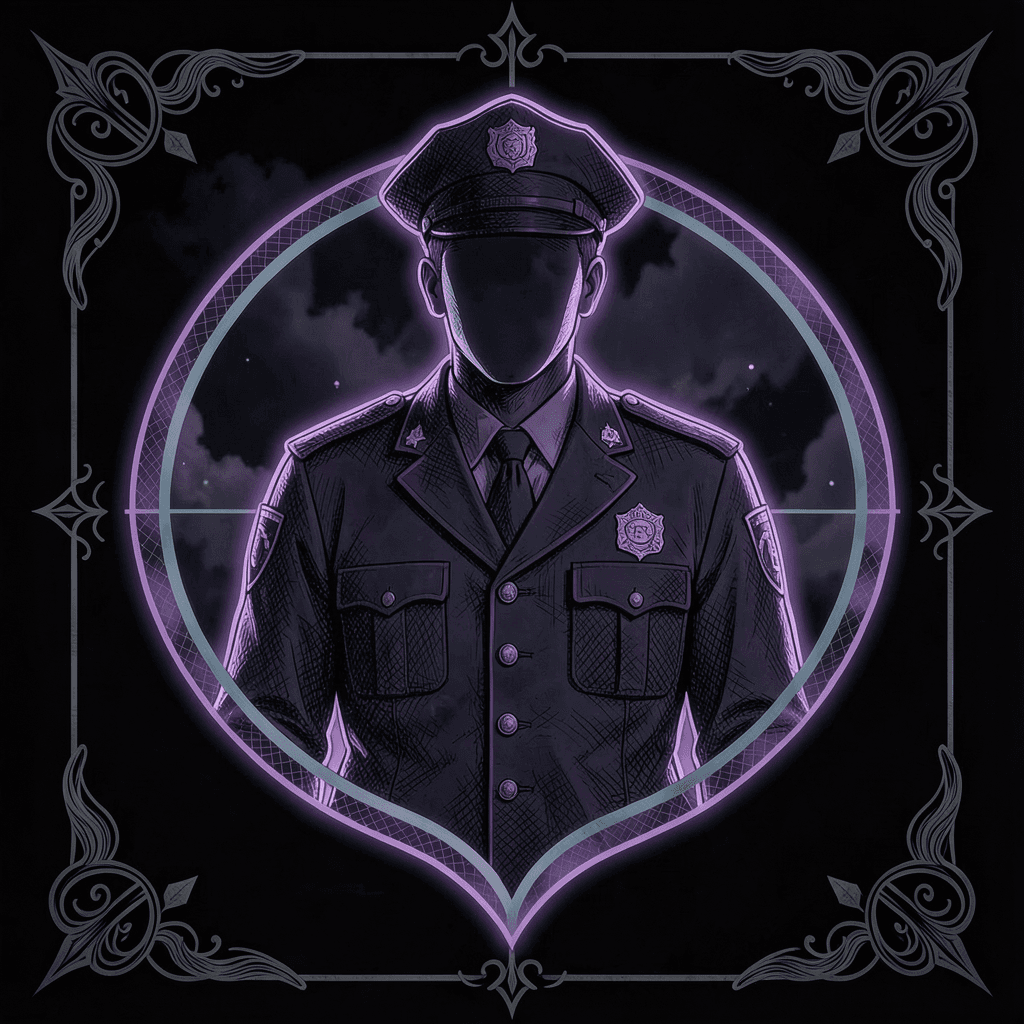
Police officer dream meaning — interpretation
What it means to dream about a police officer: guilt, protection, or fear of consequences — and how traditions interpret it.
Somnovis editorial team
A police officer in a dream concerns rules and consequences — the comfort of being protected by them or the anxiety of having broken one — which makes the dreamer's own feeling inside the dream unusually important to the reading. The traditions below agree on one thing worth stating early: the register runs in two directions, and a reading that treats every police dream as guilt has taken one side of it.
An officer who protects or helps. Generally read toward reassurance — a structure the dreamer relies on working as it should, at the moment it was needed.
Being chased, arrested, or questioned. Often the dreamer's own anxiety about being found out, even where nothing has been done. What the lawful pursuer adds to pursuit in general is that the dreamer's own verdict on themselves is already contained in the dream. Pursuit as an experience belongs to the chased article.
An officer who is corrupt, indifferent, or cannot be appealed to. The other half of the register, and the half usually left out: authority doing wrong under colour of authority.
Dreaming oneself as the officer. Reads toward self-surveillance — the policing function occupied rather than met.
What changes the reading. Whether the dreamer believes themselves in the right, and whether the authority in the dream can be reached at all.
What it does not mean. A figure. Nothing here is a statement about real policing, and no reading on this page implies the dreamer has done anything.
Perspectives across traditions
The uniformed civil police force is a nineteenth-century institution and the classical corpus has no entry for it. The tradition is not without an enforcement figure, though: the shurṭa, the ruler's policing and security arm, existed in the early Islamic polity, and the corpus's figure of the one who enforces on another's behalf is real. The distinction is worth marking precisely — an enforcement register exists, and the modern institution is an extension of it rather than an entry of its own.
What the register carries is that the enforcement figure is read against whether the dreamer is in the right, which is why the dreamer's own state inside the dream does so much of the work here. The second pole matters as much as the first: this tradition places heavy weight on justice and is sharply critical of the unjust official, so an oppressive or corrupt enforcer reads toward wrong being done under colour of authority rather than toward the dreamer's guilt. A reading that keeps only the first pole has quietly taken a side the tradition itself does not take.
The police figure is read toward the collective moral order internalized — a rule the dreamer did not make and is measured by anyway, which is a different thing from personal conscience and is exactly what a uniform depicts.
Three forks. Pursuit as an experience belongs to the chased article; what the lawful pursuer adds is that the dream already contains the dreamer's own verdict on themselves — someone in the dream holds that a rule was broken, and it is the dreamer who staged them. The officer as a carrier of shadow material is named here rather than developed, since the shadow article owns the disowned as such: what the uniformed figure is after is frequently exactly that material. And the dreamer as the officer — the policing function occupied rather than encountered — reads toward self-surveillance, and is the fork most often left out entirely. None of this is a statement about real policing, or evidence that the dreamer has done anything at all.
This section is not thin, and the reason is worth stating: the culture has a deep and continuous register for being brought before authority, far older than any police force. The folk books run both ways inside it. There are shapes reading an encounter with an official favourably, toward a happy matter or a gain; and shapes reading being taken into an official's presence, or finding oneself at the magistrate's court, toward entanglement, litigation and dispute. Both are ordinary in the material, and the register is genuinely two-sided rather than ominous.
The vocabulary shows what the register is made of: 「官司」 (guānsī) is the everyday word for a lawsuit, and the 「衙门」 (yámen) is the magistrate's office the folk imagination pictures — furniture of the register rather than the mechanism by which a dream is read. The language then supplies both poles. 「官官相护」 (guān guān xiāng hù, officials shield one another) and 「民不与官斗」 (mín bù yǔ guān dòu, the common person does not contend with the official) are what the culture says about officials, and a dreamer who woke unable to appeal to anyone may recognize the feeling in them. Sharpest of all is the yamen couplet, whose wording varies from telling to telling while its sense does not: 「衙门八字开,有理无钱莫进来」 (yámen bā zì kāi, yǒu lǐ wú qián mò jìn lái, the yamen gates open wide — with right on your side and no money, do not come in). Beside it 「屈死不告状,饿死不做贼」 (qū sǐ bù gào zhuàng, è sǐ bù zuò zéi, die of a grievance rather than go to law, starve rather than turn thief) states the depth of the folk aversion to litigation in a single line. Against them all stands the confident pole: 「天网恢恢,疏而不漏」 (tiān wǎng huī huī, shū ér bù lòu, heaven's net is vast — wide-meshed, and nothing slips through), which is the current set phrase; the received classical wording, a line from the Daodejing, differs in its last two characters.
Sources
The tradition sections draw on these works. That is not a claim that every sentence is a quotation from them. Authorship of the treatise attributed to Ibn Sirin is disputed. The Chinese dream manual is paraphrased: its wording differs by version, so no edition, chapter, or date is named.
- Artemidorus of Daldis, Oneirocritica (2nd century).
- Muntakhab al-Kalām fī Tafsīr al-Aḥlām, the dream book attributed to Ibn Sirin.
- Zhou Gong Jie Meng (周公解梦).
- C. G. Jung, Man and His Symbols (1964), and the Collected Works.
Was your dream different?
Tell us exactly what you saw — our deeply trained AI will work through every detail and nuance of your specific dream.
Get a personal reading