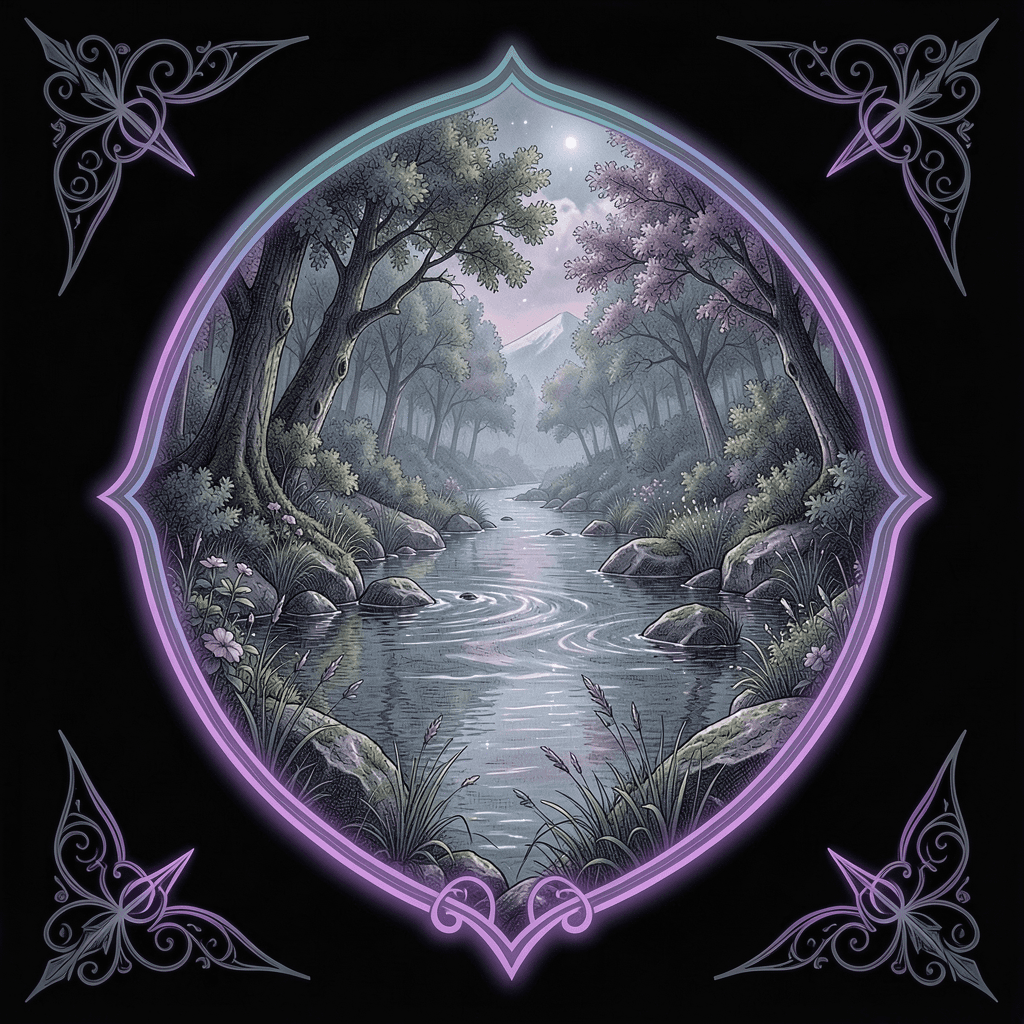
River dream meaning — interpretation
What it means to dream about a river: following life's current or struggling against it, and how traditions read this symbol.
Somnovis editorial team
A river in a dream almost always marks the passage of time or the course of a life already in motion — not water's emotional charge in general, but specifically its direction, current, and destination, the sense of being carried along a path rather than standing still.
Following a river's calm, steady current. This tends to reflect being in harmony with the natural direction of one's life — an ability to move with change rather than resist it — often appearing once the dreamer has stopped fighting where things are already headed.
A river that changes course, floods, or that the dreamer struggles to cross. This points to a fork or decision point about which direction to take, or a fear that circumstances are moving faster than the dreamer's own pace can keep up with.
What changes the reading. Crossing and course are this symbol's own territory: standing on the bank, being carried by the current, swimming against it, and reaching the far side are four different relations to the same water. Clarity and fullness matter as they do for all water dreams — clear or muddy, in flood or run dry — and two rivers meeting is its own image in the folk material below.
What it does not mean. A river dream is not a verdict that the dreamer's life is on or off course, and a dried or turbulent river is not a forecast. The water's emotional register in general belongs to the water article, and the sea's scale to the ocean article; what this page reads is the course — the water that must be followed or gotten over — and every tradition below reads it as a question, not a sentence.
Perspectives across traditions
Rivers run through this tradition's image of reward itself — the gardens beneath which rivers flow, an image every reader of the Qur'an knows, so pervasive is it — and that background colours every river dream read inside the tradition: a river is provision and mercy in motion before it is anything else. The corpus's working readings follow: crossing a river reads as passing through a hardship or a stage — the far bank as the state after the trial; drinking from clear water as lawful gain, the water register treated at the water article applying in full; and a river run dry as provision cut — the mercy in motion stopped at its source.
The tradition's rivers are, in short, roads of provision: what matters in the dream is the dreamer's relation to the flow — beside it, in it, across it, or watching it fail. A dreamer inside this register does well to note which of those the dream staged, and the water's own condition as it passed: clear and moving reads towards provision on its way, obstructed or fouled towards provision entangled — and, as everywhere in this corpus, the reading describes the dreamer's circumstances, not a decree about them.
The river is directed flow: psychic energy moving along a course — libido in Jung's broad sense of the term, which this site has noted elsewhere: energy of life in general, not the narrow sense the word carries in common speech. That directedness is what distinguishes the river from every other water in the dream vocabulary — a lake holds, a sea surrounds, but a river goes, and the dream's information is the dreamer's current relation to their own momentum. Three positions organise nearly every version: carried by the current — moving with one's own energy, or swept by it; swimming against it — effort spent opposing a direction that may be one's own; and standing on the bank — momentum observed from outside, the dreamer temporarily not in their own life's flow.
Crossing is the fourth position and the deepest: transition, the deliberate passage from one state to another through the medium of everything that moves. The far bank is the state after — and dreams are often more interested in it than dreamers are, furnishing it with detail while the crossing itself blurs. The school's questions for a river dream are a short list: which way was it flowing, how fast, what was the dreamer's position in or beside it — and, if there was a crossing, what stood on the other side.
The manual register is not thin here. The folk dream books give readings of the shape a great river portending good fortune, crossing a river a joyful matter, and a river run dry calamity — with the clear-and-muddy axis treated at the water article governing throughout: the same crossing reads differently through clean and through fouled water. A homophone underwrites one further shape: 河 (hé, river) sounds with 合 and 和 (hé, union and harmony), so two rivers meeting reads towards a match or a partnership coming together — the confluence as the meeting of parties.
The sayings are where the river earns its place in the language. 「过河拆桥」 (guò hé chāi qiáo, cross the river, dismantle the bridge) is ingratitude the moment help is no longer needed — the standing phrase for betrayal after a crossing, and it lives on this page because it is about the river-crosser's conduct. 「摸着石头过河」 (mō zhe shí tou guò hé, cross the river by feeling the stones) is a modern phrase, marked as such, and so current every reader brings it: proceeding carefully where no path exists — the association a reader carries to any dream of a cautious crossing, with no dream ruling claimed for it. 「三十年河东,三十年河西」 (sān shí nián hé dōng, sān shí nián hé xī, thirty years east of the river, thirty years west) reads the river's habit of shifting its banks as the shape of fortune itself — the family the channel once favoured left on the dry side a generation later — and it is the association a dream of a river changing course calls up: not disaster but reversal, on time scales longer than anyone's patience. 「跳进黄河也洗不清」 (tiào jìn Huáng Hé yě xǐ bù qīng, you could jump in the Yellow River and still not wash clean) is suspicion no demonstration can remove — made for dreams of muddy water that will not rinse off. And 「井水不犯河水」 (jǐng shuǐ bù fàn hé shuǐ, well water does not trouble river water) names spheres kept deliberately apart — the reading for dreams in which two waters refuse to mix.
Sources
The tradition sections draw on these works. That is not a claim that every sentence is a quotation from them. Authorship of the treatise attributed to Ibn Sirin is disputed. The Chinese dream manual is paraphrased: its wording differs by version, so no edition, chapter, or date is named.
- Artemidorus of Daldis, Oneirocritica (2nd century).
- Muntakhab al-Kalām fī Tafsīr al-Aḥlām, the dream book attributed to Ibn Sirin.
- Zhou Gong Jie Meng (周公解梦).
- C. G. Jung, Man and His Symbols (1964), and the Collected Works.
Was your dream different?
Tell us exactly what you saw — our deeply trained AI will work through every detail and nuance of your specific dream.
Get a personal reading