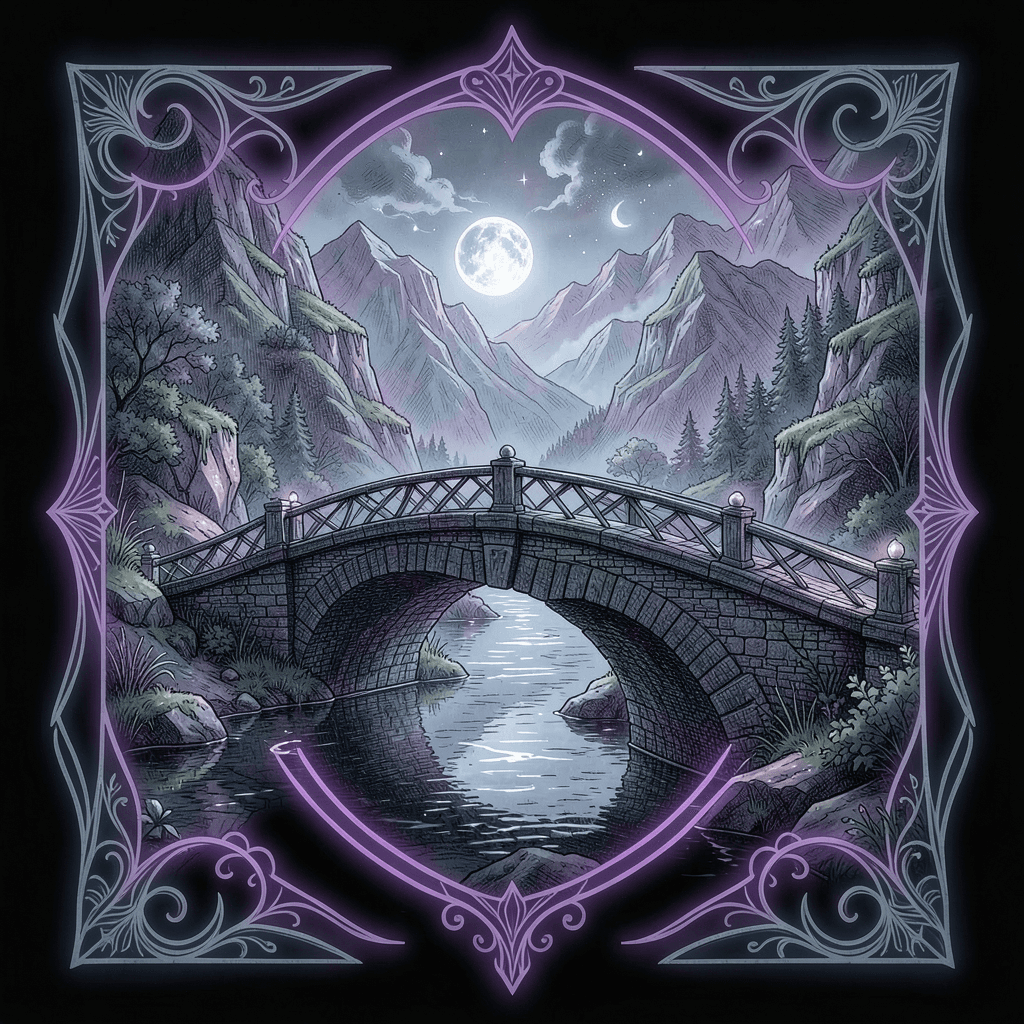
Bridge dream meaning — interpretation
What it means to dream about a bridge: crossing safely versus a bridge that collapses, and how traditions read this symbol.
Somnovis editorial team
A bridge in a dream marks a transition — a deliberate passage from one state of life to another, over something the dreamer couldn't otherwise cross. Unlike a door, which simply opens or closes, a bridge implies the crossing itself takes time and carries some risk.
Crossing a sturdy bridge successfully. Walking across a solid bridge and reaching the other side cleanly is usually read as a sign of a life transition going well — a change already largely completed, even if it isn't fully behind the dreamer yet.
A bridge that collapses, sways, or can't be reached. A bridge that fails partway across, or one the dreamer can't get onto at all, tends to point instead to real doubt about whether a current transition can be completed safely.
What changes the reading. Three questions organise nearly every version: what the bridge crosses over — the gap is usually the point; whether it holds — a sway underfoot is a different dream from a collapse; and where on it the dream takes place, since being unable to start, stalling at the middle, and reaching the far side are three distinct positions in a transition. Building a bridge, rather than crossing one, is its own image.
What it does not mean. A bridge dream is not a prediction that a current change will fail or succeed, and a collapsing bridge is not a sentence passed on the dreamer's plans. The image describes a crossing's structure — what it spans, what carries it, who built it — and the traditions below read that structure, not an outcome.
Perspectives across traditions
The classical corpus reads a bridge as a means of passage over danger: what lets the dreamer cross a thing that could not be waded — a river, a gorge, a hardship — towards relief on the far side. Crossing safely is read as passage through the difficulty; a bridge that collapses is a means failing, the arrangement or support that was carrying the dreamer over giving way mid-crossing. The reading is practical and structural: the corpus's interest is in what the bridge is made of in the dreamer's affairs — a person, a position, a plan — and whether it bears weight.
The tradition itself also knows a greater crossing: the Sirat, the bridge of the last day, which every soul must cross. A dreamer formed inside this tradition may hear that resonance behind any dreamed bridge, and it is reported here as the tradition's own background — the register that makes a bridge more than infrastructure in this material — rather than as a dream ruling; the corpus's working readings stay with the worldly crossing, the danger beneath it, and the far bank's relief.
In a Jungian reading — school-level transition material — the bridge is spanned discontinuity, and the contrast with the staircase treated elsewhere on this site is the cleanest way to see it: a stair is graded ascent, ground connected to ground by steps, while a bridge joins two grounds that do not touch at all except by the built thing. What the dream puts in question is the span. The gap is usually the point — what the two sides are, and why nothing natural connects them: a life before and after a loss, a self at home and a self at work, a decision's two futures.
Then the structure's own questions. Whether it holds: a bridge that sways or thins underfoot reads towards a transition whose means the dreamer does not fully trust — the new job, the new story about oneself, bearing more weight than it was tested for. And who built it: a bridge the dreamer built differs from one found already standing — inherited crossings, other people's arrangements — and the dream usually knows which it is. The school reads the far bank as the state after, and the crossing itself, with its refusal to let the dreamer stand still over the gap, as the transition's actual texture.
The folk dream books' own bridge shapes are hedged here as paraphrase — crossing safely favourable, a broken bridge an obstruction in one's affairs — but the strong material lies elsewhere. The underworld crossing 奈何桥 (Nàihé qiáo) gives the bridge a weight at the edge of life that no Western reader would guess: the bridge every soul crosses after death, where Meng Po's broth erases the memory of the life just ended. A bridge dream that brushes death imagery — a figure seen across a bridge, a crossing that cannot be recrossed — belongs to this register, and is reported calmly for what it is: folk cosmology, the culture's furniture for thinking about the irreversible, not a prognosis of any kind.
On the living side sit two phrases. 「船到桥头自然直」 (chuán dào qiáo tóu zì rán zhí, the boat straightens itself when it reaches the bridge) is the standing answer to premature worry — things resolve when the moment comes — and the natural reading for a dream of a crossing feared in advance and managed in the event. And 修桥补路 (xiū qiáo bǔ lù, building bridges and mending roads) is the proverbial good deed, which makes building a bridge in a dream its own favourable image, distinct from crossing one — an association drawn from the merit register rather than a book ruling, and marked as such. Two further images complete the living register. 鹊桥 (què qiáo, the magpie bridge) is the bridge the magpies form across the Milky Way one night a year so the separated Cowherd and Weaver Girl can meet — the bridge as reunion, and the reading for a crossing that joins two people rather than two banks. And the standing formula for parting ways runs through two roads: you take your 阳关道 (Yángguān dào, the broad Yangguan high road), I cross my 独木桥 (dú mù qiáo, single-log bridge) — separate futures accepted without malice, the natural reading for a dream of turning away from a wide crossing to take one's own narrow one. The river article holds the crossing's darker phrase, the bridge dismantled behind the crosser.
Sources
The tradition sections draw on these works. That is not a claim that every sentence is a quotation from them. Authorship of the treatise attributed to Ibn Sirin is disputed. The Chinese dream manual is paraphrased: its wording differs by version, so no edition, chapter, or date is named.
- Artemidorus of Daldis, Oneirocritica (2nd century).
- Muntakhab al-Kalām fī Tafsīr al-Aḥlām, the dream book attributed to Ibn Sirin.
- Zhou Gong Jie Meng (周公解梦).
- C. G. Jung, Man and His Symbols (1964), and the Collected Works.
Was your dream different?
Tell us exactly what you saw — our deeply trained AI will work through every detail and nuance of your specific dream.
Get a personal reading