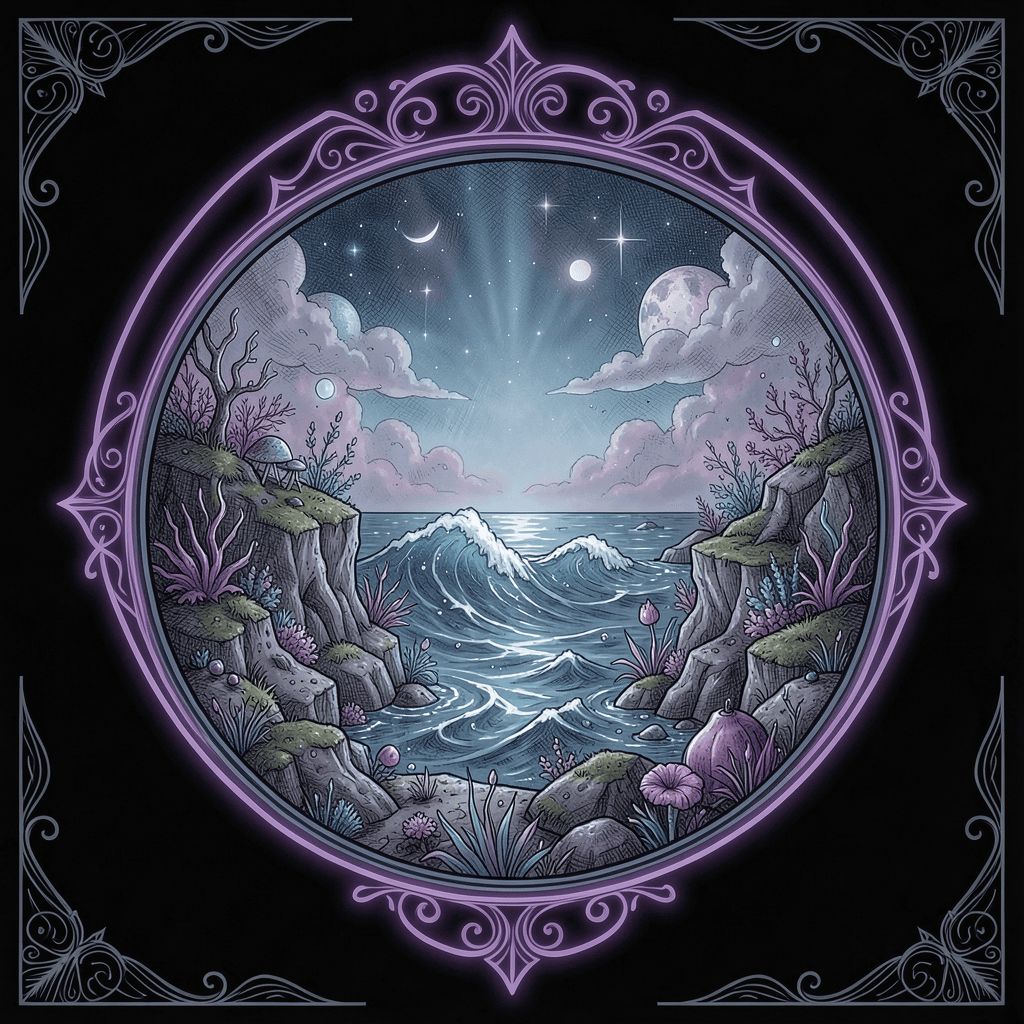
Ocean dream meaning — interpretation
What it means to dream about the ocean: standing before something vast, feeling small, and how traditions read this symbol.
Somnovis editorial team
Distinct from ordinary water, an emotional mirror, or drowning, a specific panic, the ocean is about scale — an immensity the dreamer cannot fully take in, standing before or within something far larger than themselves, whether that's awe, insignificance, or the unknown itself.
Standing at the edge of a vast, calm ocean. This tends to reflect confrontation with something genuinely larger than the dreamer's own life — a major decision, mortality, the scope of the future — and often brings a strange humility rather than fear.
Being far out at sea, alone, with no land in sight. This points to a specific fear of being untethered from everything familiar, facing an unknown this large without support or a clear way back — disorientation about scale itself rather than a fear of drowning specifically.
What changes the reading. The dreamer's action and the sea's state carry the reading: entering, crossing, standing at the shore, or being far out with no land in sight; the water calm, raging, rising in a tide, or run dry. Something surfacing from deep water is its own event — the traditions below treat what comes up out of the sea very differently from the sea itself.
What it does not mean. An ocean dream is not a drowning dream — being taken by the water is a separate scenario with its own article — and it is not a verdict on the dreamer's smallness. Every tradition below reads the sea as something of a different order from the dreamer; the dream's information is about the relation between the two, not about the dreamer's insignificance.
Perspectives across traditions
The classical Islamic dream-interpretation tradition reads the sea as a great power — a ruler, or the world itself — and the dreamer's relation to it is the reading. Entering the sea and emerging safely is read as benefit obtained from something formidable; drowning, or being unable to reach shore, as being overcome by it. Calm water is read favourably, turbulent water as trouble in the matter concerned. Drinking from the sea appears in the corpus too, read by whether the water is palatable — a reading about what the dreamer takes from a power, and in what condition it reaches them, rather than about thirst.
The scale is what distinguishes this entry from ordinary water, which the tradition reads by clarity and depth. The sea is not a large amount of water in this material; it is a different order of thing — the one image whose size exceeds every dreamer's affairs, which is why its readings so consistently concern rulers, undertakings and the world rather than the household.
This is the one article on this site where the collective unconscious belongs at full length, and the concept is genuinely Jung's: the sea is his standing image for the layer of the psyche that is not personal — shared, impersonal, far older than the dreamer's own history. Ordinary water can carry personal feeling; the ocean's scale and otherness are what make it the natural image of the layer beneath that, the part of psychic life no individual made and no individual exhausts.
Read this way, the classic scenarios are different relations to that layer rather than different symbols: standing at the shore is consciousness at its own boundary; setting out is a deliberate venture onto what cannot be mapped from land; being far from land is the personal standpoint out of sight; something surfacing from deep water is content arriving from below on its own schedule. The night-sea journey and the nekyia — the descent that precedes renewal — are images Jung genuinely used, and they attach here. What may not be attached to him is a ruling on what a dream of the sea means; the concept is his, the decoding is not.
Two associations pull apart here, and the folk material does not resolve them. 「福如东海」 (fú rú dōng hǎi, fortune as vast as the Eastern Sea), half of a standard birthday greeting, makes the sea the measure of abundance without limit. Against it stands the Buddhist-derived 苦海 (kǔ hǎi, the sea of bitterness) — worldly existence itself as an ocean to be crossed — with 「苦海无边,回头是岸」 (kǔ hǎi wú biān, huí tóu shì àn, the sea of bitterness is boundless; turn back and there is the shore) as its familiar form. A vast dream sea can be read as boundless fortune or boundless difficulty, and reporting that the material leaves the question open is more honest than forcing a resolution.
The dream books rule on action and state rather than on the sea as such: readings of the shape that entering the sea portends gain, that a sea tide portends a happy matter, and that the sea run dry portends great misfortune. One further phrase is a natural fit for a specific dream: 「石沉大海」 (shí chén dà hǎi, a stone sunk in the sea) — something that disappears without trace or reply — which is exactly the image for an object lost in a dream sea, or a message sent into one.
Sources
The tradition sections draw on these works. That is not a claim that every sentence is a quotation from them. Authorship of the treatise attributed to Ibn Sirin is disputed. The Chinese dream manual is paraphrased: its wording differs by version, so no edition, chapter, or date is named.
- Artemidorus of Daldis, Oneirocritica (2nd century).
- Muntakhab al-Kalām fī Tafsīr al-Aḥlām, the dream book attributed to Ibn Sirin.
- Zhou Gong Jie Meng (周公解梦).
- C. G. Jung, Man and His Symbols (1964), and the Collected Works.
Was your dream different?
Tell us exactly what you saw — our deeply trained AI will work through every detail and nuance of your specific dream.
Get a personal reading