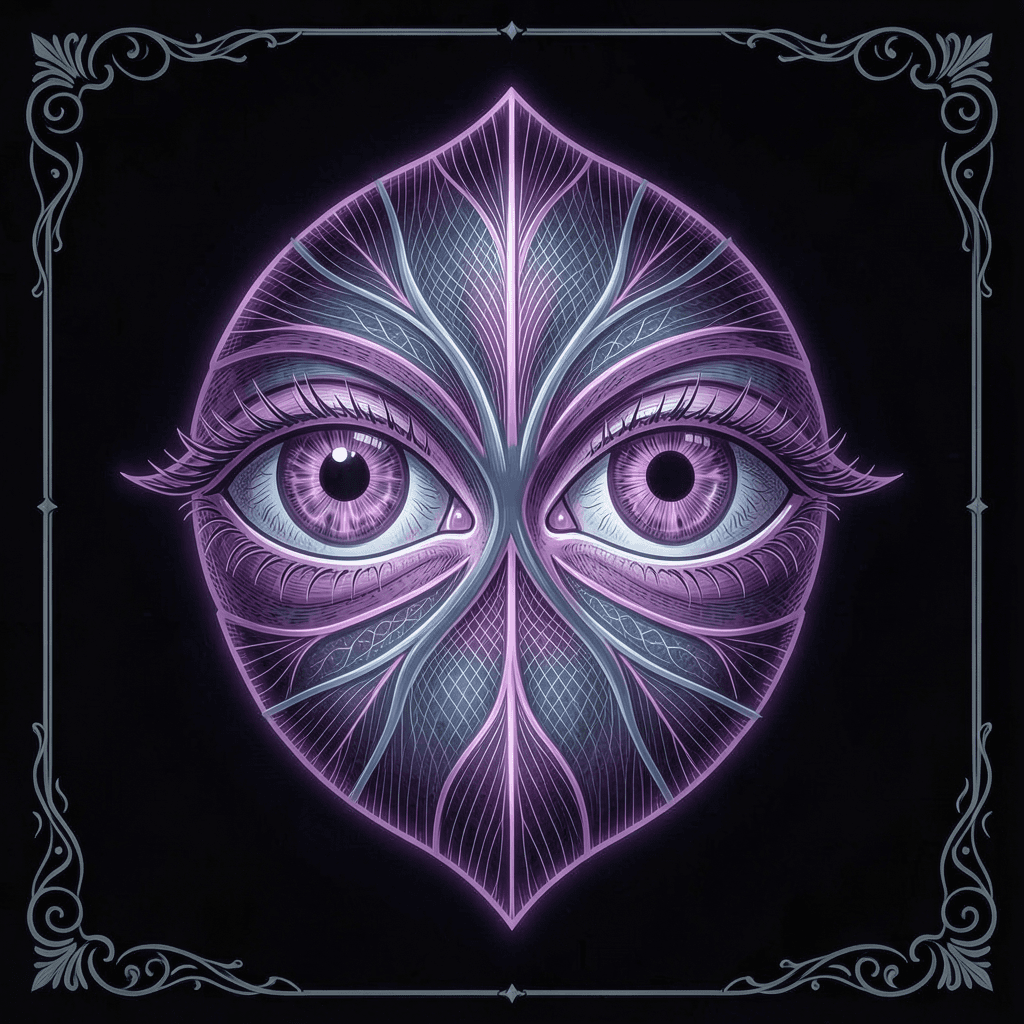
Eyes dream meaning — interpretation
What it means to dream about eyes: perception and insight, and how different traditions interpret this symbol.
Somnovis editorial team
Eyes in a dream are tied to perception and to understanding rather than to sight. That is consistent across otherwise unrelated traditions: what the eye does in these readings is comprehend, and what goes wrong with it is comprehension rather than vision. A dream centred on the eyes — the dreamer's own or somebody else's — is therefore usually about clarity, or about its absence, in some part of waking life that the dreamer is already halfway to admitting.
Clear, sharp, or unusually perceptive eyes. Eyes that see with unusual clarity, or that notice what would ordinarily be missed, read as insight the dreamer has or is close to having about something that has been murky.
Eyes that are damaged, blurred, or will not open. Eyes that cannot focus, or that refuse to open at all, point towards something the dreamer is not yet able or willing to look at. The refusing-to-open version is worth separating out: the eyes are intact and the dreamer still cannot see.
Being watched. A very common variant, and arguably a different symbol. Who is watching, and whether they are hostile, indifferent or simply present, does more work than anything else in the dream.
Meeting another figure's gaze. Distinct from being watched, and treated below as a genuine turning point: the moment something in the dream stops being observed and becomes a relationship.
Eyes where they do not belong. Eyes in a wall, in an object, in an animal, or too many of them. Disturbing to wake from, and read below as something considerably more interesting than a threat.
Someone else's eyes changing. A familiar person whose eyes are wrong — the wrong colour, empty, or somebody else's — is one of the most reported unsettling images in this family.
What changes the reading. Whose eyes they are, first of all. Then whether the trouble is with seeing or with being seen, which splits this symbol into two halves that have little in common.
What this dream does not mean. This needs saying without hedging: nothing on this page is about the dreamer's eyesight. No tradition collected here reads an eye dream as a report on, or a warning about, anybody's vision or health, and a dream of blindness is not a medical sign. What these readings describe is understanding — whether the dreamer can see their situation, not whether they can see.
Perspectives across traditions
The classical Islamic dream-interpretation tradition reads the eyes as insight and guidance, and maps them onto the dreamer's religion and their capacity to see their own situation truly — which makes sight a moral and intellectual faculty here rather than a physical one. Clear, sound sight is read as guidance and correct understanding. Impaired sight, darkness, or blindness is read as misguidance, confusion, or an inability to perceive a matter the dreamer is in the middle of. The tradition also distinguishes losing one eye from losing both, and reads a partial loss as a partial failure of understanding rather than a total one, which is a finer-grained reading than most summaries preserve.
There is a further association running through the Arabic that is worth mentioning with its status attached. Children are described in the Qur'an as a coolness of the eye, so the eye carries a link in the language to offspring and to what one delights in; whether the classical dream corpus actually derives its readings from that expression is a separate question, and this page does not claim that it does. The health guardrail is at its sharpest on this page and deserves to be stated rather than assumed. What the tradition is reading here is the dreamer's understanding — their grasp of a matter and their conduct within it — and nothing in it should be taken, even by implication, as a statement about anyone's eyesight.
In a Jungian reading eyes are consciousness itself — the capacity to see, and the dreamer's relation to whatever can be seen. Blindness in a dream is therefore approached as a question rather than as a ruling: what is the dreamer not looking at, and is the not-looking chosen. That second half is the part worth sitting with, since a great many of these dreams are about an averted gaze rather than a damaged one.
Being watched is read as the internalised observer — the audience the persona performs for — and the reading turns on whether the watching figure is hostile, indifferent, or merely present, three quite different inner situations. Eyes appearing where they do not belong, in objects, in walls, in numbers, are read not as threat but as the psyche's own scattered awareness: Jung wrote of the unconscious possessing multiple luminosities, points of consciousness that do not belong to the ego, and the many-eyed image sits in that territory. Meeting a dream figure's gaze is treated as a specific moment — where a content stops being something observed and becomes a relationship, which is often when a recurring dream changes. As everywhere in this framework, the reading is not diagnostic and not fixed. Jung rejected dream dictionaries, and an eye in a dream is offered here as an invitation to ask what is being looked at, and by whom.
The dominant Chinese folk material about eyes concerns the waking body rather than dreams, and since it is what a Chinese reader thinks of first, it should appear here with that framing rather than be quietly left out. The saying (左眼跳财,右眼跳灾) is that a twitching left eye portends wealth and a twitching right eye portends calamity. That is an omen read from the body while awake and not a dream ruling. It is also not canonical in any single form: an equivalent version substitutes blessing and disaster, the assignment of the two sides is reversed in some regions, and some variants condition it on the dreamer's sex, following the same men-left, women-right convention that governs palm reading. There is in addition a more elaborate almanac tradition of reading eye-twitching by the hour of the day rather than by side, which survives in popular almanacs — worth knowing exists, and not worth reproducing, since no hour-by-hour table can be verified.
Bright clear eyes are popularly connected with discernment and good judgement, and injured, clouded or closed eyes with failing to see a situation for what it is, being deceived, or misjudging someone — and the idiom for that is having eyes and failing to recognise Mount Tai, said of a person who does not know what is in front of them. These are common cultural associations rather than dream-manual rulings. The manual register is a great deal simpler than any of it, and gives little beyond bright eyes auspicious and dim eyes not, as set out below. Three further expressions belong on this page. That what the eye sees is real and what the ear hears is empty is the ordinary Chinese proverb for trusting sight over report, and it converges directly with the classical Islamic reading of sound sight as correct understanding. Fiery eyes and golden pupils is the standard phrase for the ability to see through a disguise, and it is the precise Chinese register for the reading about being deceived. It originates with the Monkey King, whose eyes were hardened in a furnace and who alone perceives a demon behind a human face, but it has long since generalised well past him and is used of any sharp discernment at all — so the story is where the phrase comes from rather than what it now means. And dotting the eyes on the painted dragon, from the story of a painter whose dragons flew off the wall once their eyes were added, is the phrase for the final touch that brings a thing to life; it supplies a favourable reading for eyes being opened or given in a dream that folk material otherwise lacks. Folk interpretation here is less systematised than for animals and objects, and that is worth saying rather than smoothing over.
The dream material proper is thinner than the waking omen, and worth stating in its own words. The folk dream books give readings of the shape: bright eyes portend good fortune, dim or clouded eyes portend misfortune — very nearly the whole of it, which is why the idioms carry so much of this page. One more of them belongs here: 「有眼无珠」 (yǒu yǎn wú zhū), to have eyes but no pupils, said of someone who fails to recognise what is in front of them, whether a person's worth or a situation's danger. It is the everyday partner of the Mount Tai phrase above and slightly harsher, since the failure it names is not ignorance of something famous but an inability to see at all — which is the register a dream of clouded or missing eyes lands in.
Sources
The tradition sections draw on these works. That is not a claim that every sentence is a quotation from them. Authorship of the treatise attributed to Ibn Sirin is disputed. The Chinese dream manual is paraphrased: its wording differs by version, so no edition, chapter, or date is named.
- Artemidorus of Daldis, Oneirocritica (2nd century).
- Muntakhab al-Kalām fī Tafsīr al-Aḥlām, the dream book attributed to Ibn Sirin.
- Zhou Gong Jie Meng (周公解梦).
- C. G. Jung, Man and His Symbols (1964), and the Collected Works.
Was your dream different?
Tell us exactly what you saw — our deeply trained AI will work through every detail and nuance of your specific dream.
Get a personal reading