Night terrors: not the same as nightmares
Night terrors arise from deep non-REM sleep, mostly in children, and are not remembered afterwards. How they differ from nightmares and what to do.
Somnovis editorial team
- Night terrors are an NREM parasomnia arising from deep slow-wave sleep in the first third of the night.
- The sleeper may scream, sit up and appear terrified while being very hard to rouse — and typically remembers nothing afterwards.
- They occur mostly in children, are usually outgrown, and show a clear familial pattern with sleepwalking.
- The guidance is to keep the person safe rather than to wake them; waking mid-episode causes confusion without shortening it.
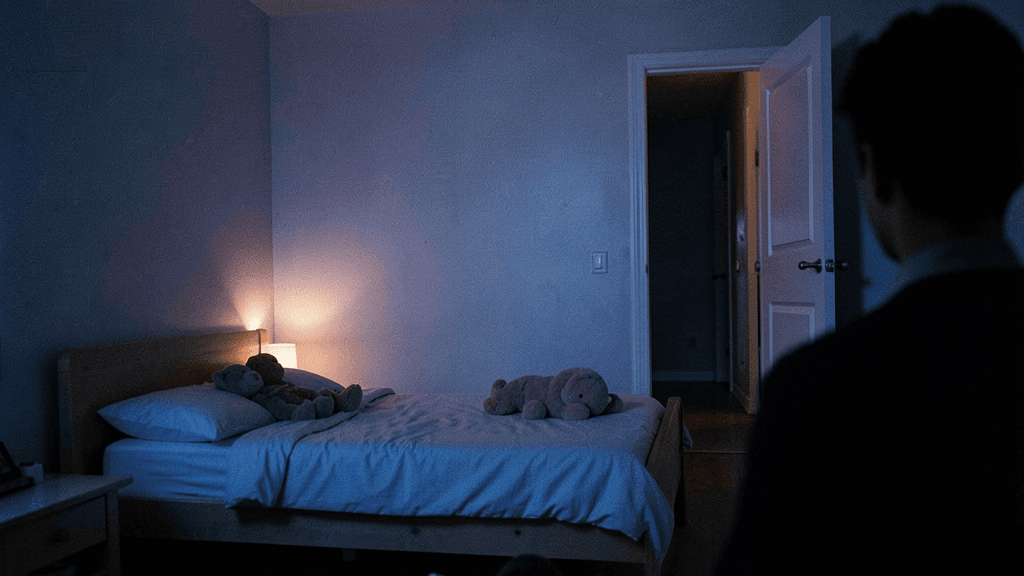
A parent hears screaming, runs to the bedroom, and finds a child sitting up with their eyes open, terrified, inconsolable, and apparently not recognising them. It lasts minutes. Attempts to comfort make no difference or make it worse. Then it stops, the child goes back to sleep, and in the morning they remember nothing at all. That last detail is what tells you this was not a nightmare.
Night terrors are a non-REM parasomnia, and everything unusual about them follows from that. They arise out of deep slow-wave sleep — N3, the stage described in this section's article on deep sleep — which is concentrated in the first third of the night. What happens is a partial arousal: part of the brain moves toward wakefulness while the rest remains in deep sleep. The result is a person who appears awake, with open eyes and intense emotional and physical arousal, but who is not conscious in any usable sense and is not experiencing a dream in the way a nightmare is experienced.
The contrast with nightmares is clean on every point, and worth holding onto. Nightmares come from REM sleep, so they happen in the second half of the night; night terrors come from deep sleep in the first third. A nightmare is a narrative you can describe afterwards; a night terror leaves no memory, or at most a vague impression of something oppressive. Someone waking from a nightmare is alert, oriented and often reluctant to go back to sleep; someone in a night terror is difficult to rouse, disoriented if woken, and typically falls straight back asleep afterwards. And nightmares are quiet from the outside, while night terrors are the loudest thing that happens in a house all night.
That last asymmetry is the practically important one. The person having a night terror is not suffering the way the episode looks. The distress is almost entirely on the observer's side — it is genuinely alarming to watch — while the child typically wakes in the morning perfectly fine and has no idea anything occurred.
Night terrors are mostly a childhood phenomenon and are usually outgrown. They occur most often in young children, and the great majority stop by adolescence without any intervention. There is a clear familial pattern: children with night terrors frequently have a parent or sibling with a history of them or of sleepwalking, which is the closely related non-REM parasomnia covered separately here. Adults can have them, less commonly. The known triggers are the same across parasomnias: insufficient sleep, irregular schedules, fever and illness, stress, and anything else that fragments deep sleep.
The practical guidance is more restrained than instinct suggests. Do not try to wake the person. Waking someone out of deep sleep mid-episode tends to produce confusion, prolonged disorientation and sometimes agitation, without shortening the episode. The useful thing is to keep them safe — clear obstacles, make sure they cannot fall or reach a staircase, and stay nearby without restraining them, since physical restraint often escalates the arousal. Then let it end, which it does on its own, usually within a few minutes to around half an hour. Speaking calmly and quietly does no harm even though it does not appear to register.
Prevention, where episodes are frequent, mostly means removing the triggers: making sure the child gets enough sleep, since overtiredness is the most common precipitant, and keeping bedtimes and wake times regular. Where episodes happen at a predictable time each night, some clinicians use scheduled brief waking shortly beforehand; that is an approach to discuss with a doctor rather than to improvise.
It is also worth knowing what night terrors are not. They are not a sign of psychological disturbance in a child, they are not evidence of trauma, and they do not indicate a frightening dream that needs to be uncovered. There is no content to interpret, because there is generally no remembered content at all.
If episodes are frequent, if they persist well into adolescence or begin for the first time in adulthood, if the person is being injured during them, or if the pattern is affecting the household's sleep and daily life, that is worth discussing with a doctor.
Frequently asked
Was your dream different?
Tell us exactly what you saw — our deeply trained AI will work through every detail and nuance of your specific dream.
Get a personal readingSources
- Sleep-medicine consensus on NREM parasomnias and disorders of arousal
- Paediatric sleep research on night terror prevalence and natural course
- Clinical guidance on managing parasomnia episodes safely
This article is for information only and is not a substitute for medical advice.