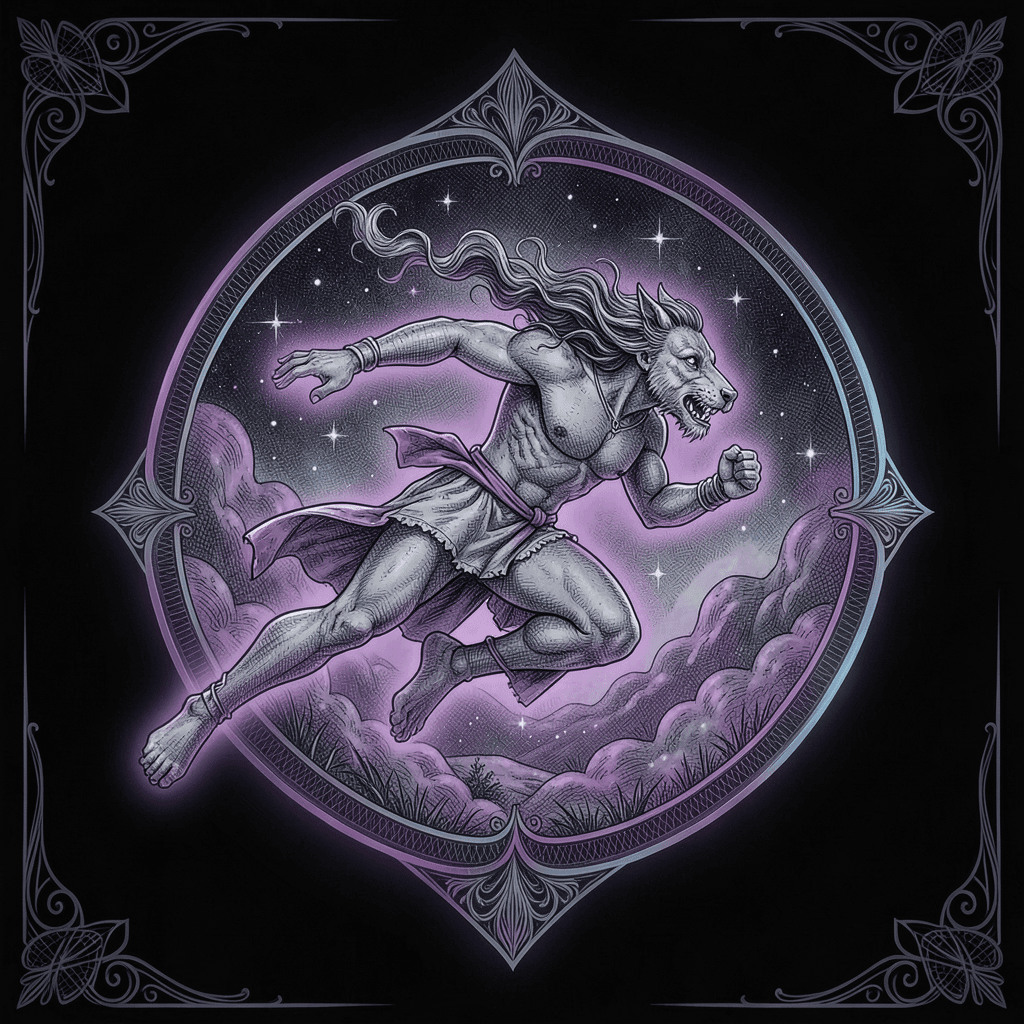
Dreaming about being chased — meaning and interpretation
What it means to dream about being chased in general: avoidance, and how different traditions read this scenario.
Somnovis editorial team
Being chased, without a specific pursuer identified, is one of the most widely reported dreams there is, and its defining feature is direction: something is behind the dreamer, and the whole dream is organised by that fact. The affect is urgency. That is what separates it from the dream of being lost, where nothing is behind you at all and the difficulty is that there is no direction to run in. A pursuer gives a dream an object, even an unseen one, and having an object is a large part of what makes this dream feel the way it does.
Being chased but escaping. Getting away, even narrowly, tends to read as anxiety that the dreamer still experiences as manageable. Whether the escape was earned — outrunning, hiding, reaching a door — or simply happened is worth remembering.
Being caught. Usually read as something that has stopped being avoidable rather than as a prediction of harm. Notably, dreamers who are caught often report the dream ending rather than turning violent, and several traditions treat the moment of contact as the point of the dream.
Legs that will not move. The most commonly reported detail in this whole family: running through treacle, legs that will not obey, a body that will not respond to obvious urgency. It is worth reading on its own, separately from the pursuit.
Not seeing the pursuer. Very common, and it changes the dream. An unseen pursuer is defined entirely by the dreamer's fear, which is a different situation from being chased by something identifiable.
Turning to face it. Less common, and dreamers almost always remember it. Traditions differ sharply about what that means, and one of them below treats turning round as precisely the wrong move.
What changes the reading. What is doing the chasing does most of the work — an animal, a person, a crowd, or nothing visible are four different dreams. The outcome does the rest: escaping, being caught, waking mid-chase, or the pursuit simply stopping.
What this dream does not mean. A chase dream does not predict that anyone is coming after the dreamer, and it does not identify a person. It is also one of the most common dreams reported after ordinary stress, illness, poor sleep, or a frightening film, and a dream that arrives on the back of a bad week does not owe anyone a hidden meaning.
Perspectives across traditions
The classical Islamic dream-interpretation tradition reads pursuit through two variables it treats as decisive: the identity of the pursuer, and the outcome of the flight. A pursuer that is an animal is read at the scale and character of that animal, and the tradition's readings for the specific beast carry over wholesale — being chased by a snake, a dog or a wild predator inherits those entries rather than acquiring a separate meaning of its own. That is a genuinely economical piece of interpretive machinery, and it means the most useful question this tradition puts to the dreamer is simply what was behind them.
Escape is read favourably, as a difficulty from which the dreamer is delivered. Being caught is read as a matter that will not stay avoided, and the counsel that follows is to face it directly — not as a prediction that harm is coming, which the tradition does not make and which a frightened reader deserves to be told plainly. The tradition also treats flight itself as meaningful independently of what is doing the chasing: fleeing is associated with seeking safety from something the dreamer already knows to be a danger to them, which turns the interpretation inward, towards what they have been putting off, rather than outward towards an external enemy. That last point is stated here in general terms rather than as a formal ruling, because it follows from the tradition's broader treatment of enemies and deliverance rather than from a specific classical statement about being pursued.
This is the strongest of the three readings on this page and where the weight belongs. In a Jungian reading the pursuer is not an external threat but a split-off content of the dreamer's own psyche — most often shadow material, which pursues precisely because it has been refused attention. The dream's insistence is the point rather than an unpleasant side effect: recurrence marks content that has not been dealt with, and the terror scales with the refusal rather than with any real danger. That explains something readers often notice about these dreams, which is that the fear is wildly out of proportion to whatever is actually behind them.
The characteristic move in this tradition is to turn towards the pursuer and ask what it wants, on the reasoning that what is met can be integrated while what is fled goes on chasing. Two clarifications keep that honest. It is not an instruction about what to do inside the dream — that is lucid-dreaming advice and belongs to a different discipline entirely. It describes what the dreamer does with the image afterwards, awake, and it is there that active imagination, a waking practice Jung genuinely developed, has its place. The common experience of legs that will not move fits this frame precisely: the ego's resources are unavailable to a problem it has decided not to look at. And the guardrail matters here more than on most pages, because the opposite is so often written. Jung assigned the chase dream no settled meaning and explicitly rejected dream dictionaries; this is a direction of attention, not a decoding.
Chinese folk material on being chased is genuinely thin, and the reason is structural rather than accidental, which is worth stating confidently rather than hedging. Folk dream material indexes on things — animals, objects, body parts, events with a fixed name — and being chased is a predicate rather than an entity, so there is nothing for a saying to attach to. There is no well-known Chinese proverb about dreaming of being pursued, and the pursuer's own entry carries the reading instead: a chasing dog, snake or rat brings its established folk meaning with it. The reading often offered here — that pursuit signals an unattended matter becoming urgent, with escape as trouble averted and capture as trouble that arrives — is a modern psychological inference rather than transmitted folk reading, and it should be labelled as one. What the folk material does is simpler: it sends the dreamer to the pursuer's own entry, or it applies the inverse principle. Some readings apply the inverse-dream principle and treat a terrifying chase as discharging the misfortune rather than announcing it — and in colloquial use that strand has a form any Chinese speaker will recognise instantly, the everyday remark that dreams are the opposite, which is the standard thing said to someone consoling themselves after a frightening night. Report it as one strand and as ordinary speech, not as a formal ruling.
What a Chinese reader does bring to this page is not a dream ruling but a set of idioms for the state of fear itself, and naming them gives the section its real register. A bird startled by the twang of a bowstring is the standard expression for someone still fleeing a danger that has already passed. Every tree and shrub looking like an enemy soldier is the expression for fear that populates the world with pursuers where there are none. Both describe the dreamer's condition rather than interpreting the dream, and the difference should be visible. One folk belief is worth giving because it collides interestingly with the psychological reading above rather than repeating it. Chinese folk belief holds that a person carries three flames, one above the head and one on each shoulder, and that on a night road one must not look back or answer when called, because turning extinguishes them and lets whatever is behind draw close. That is a belief about walking at night, not a dream interpretation, and it must be read as such. Its interest here is direct: one tradition's core move — turn and face what is chasing you — is the other's specific taboo.
One manual-register entry does exist for this scenario, and it is better set against the thinness described above than folded into it: the folk dream books give readings of the shape being chased portends a happy event, being pursued portends good fortune arriving. It is widely transmitted, and it is the flat form of the inverse strand already mentioned — the fright is the omen, and the omen is favourable. Where the language attaches is at the level of the predicament rather than the outcome, in 「跑得了和尚跑不了庙」 (pǎo dé liǎo hé shàng pǎo bù liǎo miào), the monk can run but the temple cannot — said of a problem that will not be outrun because it is anchored to something that stays. That is not a ruling either; it is what a Chinese reader has to hand for the situation.
Sources
The tradition sections draw on these works. That is not a claim that every sentence is a quotation from them. Authorship of the treatise attributed to Ibn Sirin is disputed. The Chinese dream manual is paraphrased: its wording differs by version, so no edition, chapter, or date is named.
- Artemidorus of Daldis, Oneirocritica (2nd century).
- Muntakhab al-Kalām fī Tafsīr al-Aḥlām, the dream book attributed to Ibn Sirin.
- Zhou Gong Jie Meng (周公解梦).
- C. G. Jung, Man and His Symbols (1964), and the Collected Works.
Was your dream different?
Tell us exactly what you saw — our deeply trained AI will work through every detail and nuance of your specific dream.
Get a personal reading