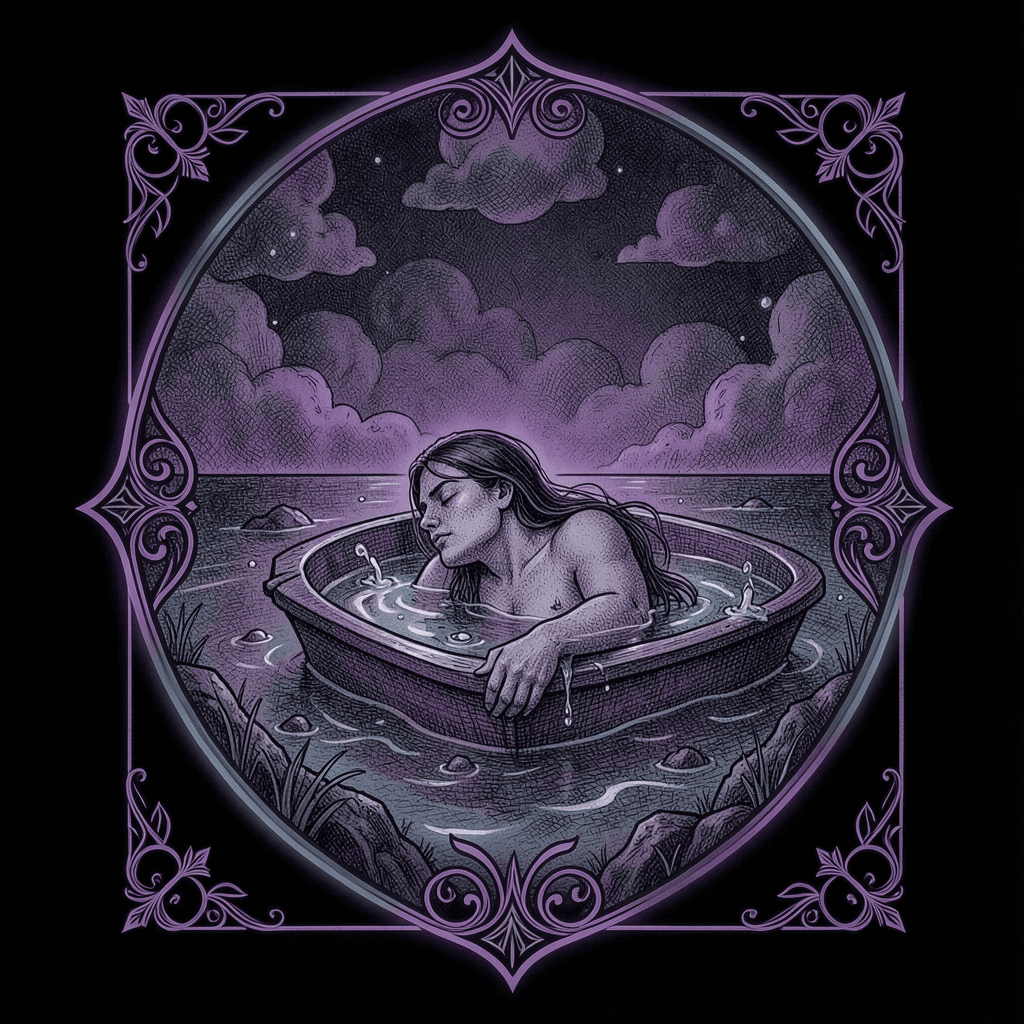
Dreaming about drowning — meaning and interpretation
What it means to dream about drowning: being overwhelmed by emotion, distinct from a general water dream.
Somnovis editorial team
Drowning is a more acute and more bodily dream than a general water dream. It is not about water's overall symbolism — clarity, depth, flow — but about one specific relationship to it: being taken by it. Where a water dream asks what the depths are like, a drowning dream asks whether the dreamer is still on top of them. That distinction runs through every tradition below, and it is why the same element can be among the most favourable images in one reading and among the heaviest in another.
Struggling but staying at the surface. Fighting the water without going under usually reflects a situation the dreamer experiences as overwhelming but still believes, if barely, they can stay ahead of. The exhaustion is often the memorable part rather than the fear.
Going under. Actually sinking below the surface reads as a threshold crossed — a sense of having reached a limit rather than of approaching one. Dreamers frequently report the moment of stopping the struggle as strangely calm, which is worth noting rather than pathologising.
Being pulled out. Rescue is one of the most consistently favourable turns in this whole family of dreams, across otherwise unrelated traditions. Who does the rescuing is worth remembering, and so is whether the dreamer called for help.
Drowning without dying. Many of these dreams simply end in the water. That is not an incomplete dream: several readings treat it specifically, as a situation still in progress rather than one concluded.
Watching someone else drown. Distinct from drowning oneself, and read differently everywhere — the dreamer is present, aware, and outside it, and the helplessness has a different quality from being in the water.
What changes the reading. The water's own character does a great deal: clear or murky, still or moving, sea or river or a domestic bath. Whether the dreamer entered it voluntarily is the second variable, and it separates this dream sharply from a dream of swimming.
What this dream does not mean. No tradition collected here reads a drowning dream as a prediction of drowning, and it is not a warning about swimming, travel or water. It is also not a diagnosis. If dreams of this kind are frequent and leave a person feeling worse rather than curious, that is worth raising with someone qualified rather than looking up a better symbol.
Perspectives across traditions
Water is one of the most favourably read images in the classical Islamic dream-interpretation tradition, associated with life, knowledge, provision and purification — and drowning is where that favourable reading reverses. The classical material reads submersion as immersion: being taken into something rather than drawing from it. The reading is severe, and it is specific about what one is overwhelmed by — a matter that has grown past the dreamer, entanglement in worldly affairs, or one's own appetites. The water's own character modulates this as it does everywhere else in the tradition: going under in murky or dark water is read considerably more heavily than in clear.
Two details change the reading substantially. Being rescued, or simply surfacing, is read as deliverance and relief from exactly the matter the water stood for, which makes it one of the more hopeful turns in the classical material rather than a mere softening. And drowning without dying — the dream that ends in the water rather than after it — is read as a situation still in progress rather than one already concluded, which is a genuinely useful distinction and one most modern summaries drop. The tradition does not read this dream as a prediction that the dreamer will drown, and that should be stated plainly on a page people arrive at frightened. What it describes is the shape of being overwhelmed, and its characteristic move is to ask what, in the dreamer's affairs, has been allowed to close over their head.
Water is the standard image of the unconscious in analytical psychology, and drowning is the specific case where the relationship to it has failed: the ego is not descending, exploring or being renewed, but inundated. The distinction that matters here is between the nekyia — the necessary downward journey that precedes renewal, which Jung did develop as an idea — and simply going under, which produces nothing. Entering water voluntarily and being taken by it are read as opposite relationships to the same element, and drowning sits at the far end of the second.
Several details are treated as informative. Whether the dreamer struggles or stops struggling is one, and neither is read as the better outcome; whether anyone else is present is another. Drowning experienced from outside — watching another figure go under while standing clear — is read quite differently, as a part of the personality being submerged while the ego looks on, which is a more precise account of that dream than any general statement about helplessness. Two things should be kept firmly in view. The language here stays psychological on purpose: analytical psychology is reading an image, not describing a condition, and nothing in this framework diagnoses anything. And Jung assigned drowning no settled meaning — he rejected fixed dream dictionaries — so what is on offer is a way of asking what has risen far enough to close over the dreamer's conscious position, not a ruling about what drowning means.
Folk readings here run through the wealth association Chinese material attaches to water generally: water signifies fortune in motion, and drowning is where that motion stops. The manual register puts it as gain blocked — a venture that does not come off — rather than as a reckoning for having reached too far. Overextension is a real strand on this page, but it belongs to the proverb quoted further down rather than to the dream books, and the two should not be run together. The folk register is explicit throughout that this is a caution rather than a forecast. Rescue reverses it favourably and is one of the more positively read outcomes in this whole family: being pulled out is read as help arriving from a quarter the dreamer had not counted on. Muddy water deepens the warning; clear water softens it.
The idiom the image sits in should be given, because it is the exact Chinese phrase for what a drowning dream feels like and it is built on submersion: a calamity that closes over the crown of the head (灭顶之灾) — a disaster that leaves nothing above the surface. It belongs to the same formulaic family as the calamity of bloodshed recorded on the page for blood, and, like it, it is a formula for the scale of a misfortune rather than a claim that one is coming. There is also a piece of folk belief that gives a drowning dream its particular dread for a Chinese reader, and it needs its status stated carefully. It is widely held that a drowned soul cannot be released until it draws a living person into the water in its place. That belief is about places — which stretch of river is dangerous, why a child is kept away from a particular pond, why a drowning site is said to keep taking people — and it governs waking life rather than dreams. It is not a dream ruling and is not offered as one. But water carries that charge in folk belief quite separately from the wealth reading, and for a Chinese reader the dread in a drowning dream lands there rather than in the financial register, which is why omitting it would misrepresent how the image is actually felt.
The manual register is more divided than the wealth reading alone suggests, and both halves belong here. The folk dream books give readings of the shape: drowning portends a venture that fails, and drowning portends wealth — the two sit side by side in the corpus without being reconciled. Pulling someone else out portends money gained; being pulled out is read simply as a good omen, help or relief arriving. The proverb that fastens onto the image is 「淹死的都是会水的」 (yān sǐ de dōu shì huì shuǐ de), the ones who drown are the ones who can swim, said of anyone brought down by confidence in his own competence. It is the exact caution the reading above describes, and it is worth having in its own words: the danger in this material is not the water, it is knowing the water.
Sources
The tradition sections draw on these works. That is not a claim that every sentence is a quotation from them. Authorship of the treatise attributed to Ibn Sirin is disputed. The Chinese dream manual is paraphrased: its wording differs by version, so no edition, chapter, or date is named.
- Artemidorus of Daldis, Oneirocritica (2nd century).
- Muntakhab al-Kalām fī Tafsīr al-Aḥlām, the dream book attributed to Ibn Sirin.
- Zhou Gong Jie Meng (周公解梦).
- C. G. Jung, Man and His Symbols (1964), and the Collected Works.
Was your dream different?
Tell us exactly what you saw — our deeply trained AI will work through every detail and nuance of your specific dream.
Get a personal reading