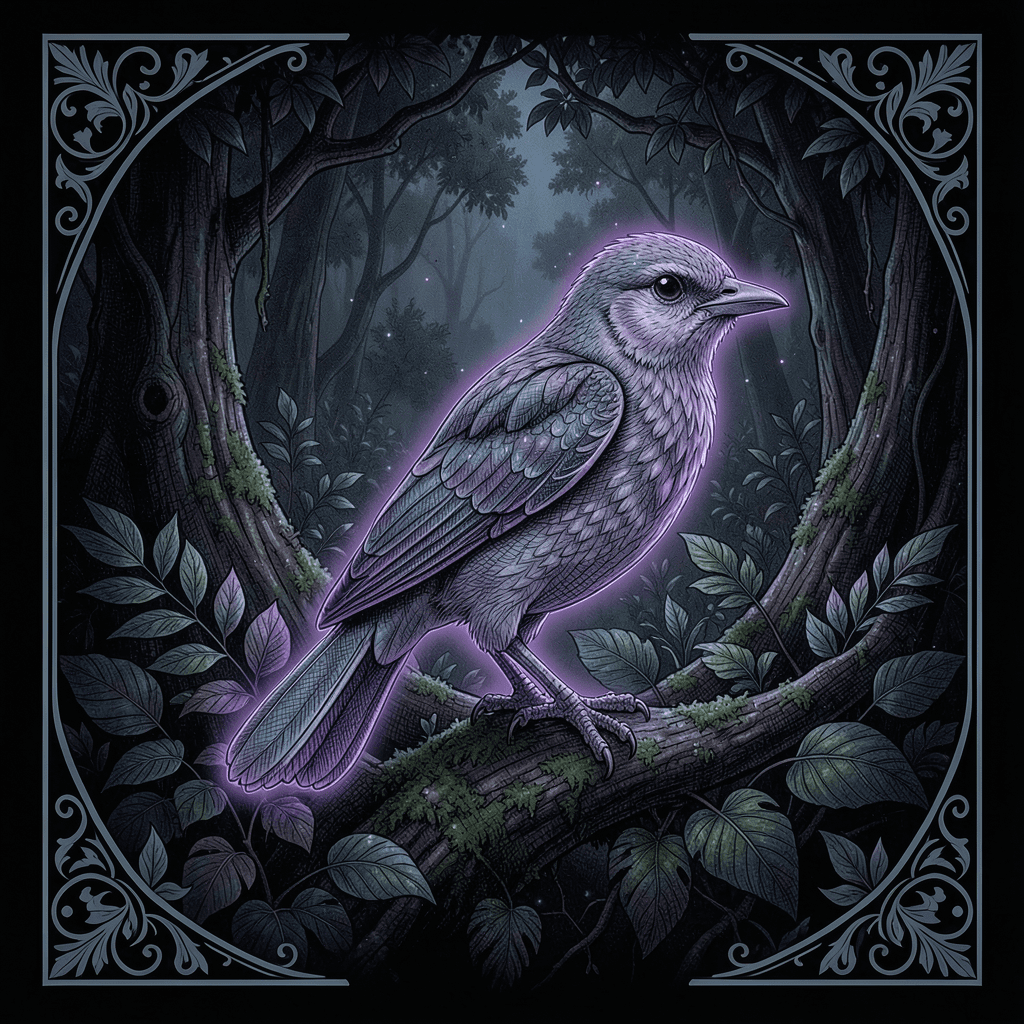
Bird dream meaning — interpretation
What it means to dream about a bird: freedom, a message, or an omen — and how different traditions interpret this symbol.
Somnovis editorial team
A bird in a dream usually arrives rather than confronts. Most dreamers describe it as a passing image — something at a window, crossing a patch of sky, briefly loose in a room — and that quality of arrival is most of the meaning. Across very different traditions the bird is read as a messenger: a visitor from somewhere the dreamer can't otherwise reach, bringing news rather than embodying a threat. Note that this is the dream of the creature, not of the dreamer's own flight, which is a separate symbol and reads differently.
A bird flying freely or singing. A bird in open flight, or one that sings where the dreamer can hear it, is usually linked to news on its way, or to a sense that something has finally been given room to move rather than being penned in. Where the song is the memorable part rather than the bird, dreamers often connect it to something they have been waiting to hear said out loud.
A bird that comes indoors. A bird inside the house is one of the most commonly reported versions of this dream, and nearly every tradition treats it as significant. The dreamer's own reaction is the informative part: delight, alarm at the flapping, or a careful attempt to get it back out through a window all push the reading in different directions.
A caged, injured, or dead bird. A bird that can't fly reverses the image. It points to a hope or an ambition the dreamer feels is being kept from taking off — or to one that has already quietly stalled without anyone announcing it. A bird held in the hand sits between the two, and dreamers usually remember clearly whether they were protecting it or preventing it from leaving.
What changes the reading. Kind and size do more work here than colour: a small garden bird, a bird of prey, a flock, and a single visitor are four different dreams. So does the dreamer's own action — catching a bird, releasing one, and watching one escape the hand are read as three distinct outcomes. A bird that speaks is remembered as unusual by almost everyone who dreams it, and is worth treating as the centre of the dream rather than as an oddity inside it.
What this dream does not mean. A bird in a dream is not a death omen, and a bird indoors is not a verdict on the household, whatever a particular tradition below reads into it. Birds are also simply common. They turn up in dreams after a day spent outdoors, after sleeping near an open window, or after a real bird hit a real pane of glass, and none of that needs decoding.
Perspectives across traditions
The classical Islamic dream-interpretation tradition reads birds first of all as people, with a bird's size, kind and bearing mapping onto a person's rank and character. Large birds of prey stand for powerful men, sometimes oppressive ones; small birds for people of lesser standing, or for children. The dreamer's own action is decisive in the tradition's usual way — catching a bird is read as obtaining something sought, while a bird escaping the hand is read as something that departs or is lost. Species carry settled associations: doves and pigeons are linked to women, to messages and to letters, while crows are read unfavourably, as a deceitful or corrupt man.
There is also a depth in the language worth knowing about, because it explains why this image sits so close to the idea of fate for a Muslim reader. The Arabic word for a bird, ta'ir, also carries the sense of a person's omen or their allotted portion of fortune, and the Qur'an uses that sense in Surah al-Isra, where a man's ta'ir is described as fastened to his neck. The two senses are joined in the language itself, which is not the same as saying that the dream corpus derives its bird readings from the verse — the honest statement is that in Arabic a bird and a person's portion are never far apart. What the tradition does not offer is a fixed table by species, and where it names a type of person it is describing a shape of character, not identifying anyone the dreamer knows.
In analytical psychology birds are read as images of spirit and of thought — what rises, what is not bound to the ground, and what moves between levels the dreamer cannot travel between directly. Amplification is a genuine part of the method here rather than decoration: the near-universal role of birds as messengers in myth is used to enrich the image and give the dreamer more to associate to, not to convert it into a fixed meaning. The reading then turns on the bird's condition and situation rather than on the bare fact that it is a bird.
A caged bird is approached as spirit constrained by circumstances the dreamer has, at some level, agreed to; a wounded or grounded bird as an aspiration that cannot currently rise; a flock as something collective rather than personal, belonging to the dreamer's situation more than to their biography. A bird that speaks is treated with particular attention, since a message delivered by a non-human figure is the psyche placing authority somewhere other than the ego. Keep this distinct from the dream of flying, where the dreamer is the one aloft — here the dreamer watches, and the distance between the watcher and the bird is part of what is being described. Jung assigned birds no settled meaning, and what this reading offers is a direction of attention rather than a decoding.
In the popular Zhou Gong Jie Meng folk tradition — folk material rather than a scholarly text — the species is very nearly the whole reading, and the associations are specific and widely known. The magpie is the bird of good news: its Chinese name carries the word for joy, and the everyday phrase is that the magpie announces joy, which makes it one of the most straightforwardly auspicious images in the corpus. The crow runs the opposite way as an omen of misfortune, an association strong enough to have produced an ordinary insult — a crow's mouth, said of someone whose words bring bad luck. The crane is read for longevity, mandarin ducks appearing as a pair for harmony between spouses, and the phoenix for high honour.
Two more birds belong to the household rather than to the news. The swallow is the domestic bird: a swallow nesting under the eaves is a strongly favourable sign for a family, destroying a swallow's nest is a real taboo, and a folk saying holds that swallows do not enter a poor and bitter household — the bird is understood to choose a prospering home, which is the mechanism behind the omen rather than a bare superstition. Wording varies by region, so the sense matters more than any single phrasing. The owl is its ominous counterpart, and the saying is that when the night-owl comes to the house it does not come without a reason; its call in particular is widely held to announce a death or a serious misfortune. Magpie, crow and owl together form the folk triad of announcing birds, and the idea that a bird is a messenger first, with the only real question being which news it carries, is how the culture organises the category. That is a cultural association rather than a rule the dream books state, and the manual register below is in fact organised quite differently, around what the bird is doing. Two further idioms supply register rather than a ruling: one cry and it startles everyone, said of a long-silent person who suddenly succeeds, and when the birds are gone the bow is stored away, said of being discarded once one's usefulness has ended.
The manual register adds a dimension the species readings miss, which is what the bird is doing. The folk dream books give readings of the shape: a bird flying into the house portends good news or a visitor of standing, a bird caged or caught portends obstruction and ability with nowhere to go, a rooster and particularly a crowing one portends good fortune, rank, or a quarrel, and a phoenix portends great luck or help from someone above. The sayings come in matched pairs: 「喜鹊叫,好事到」 (xǐ què jiào, hǎo shì dào), the magpie calls and the good thing arrives, against 「乌鸦叫,祸事到」 (wū yā jiào, huò shì dào), the crow calls and the disaster arrives; and, for the household bird, 「燕子归巢,家宅兴旺」 (yàn zi guī cháo, jiā zhái xīng wàng), the swallow returns to the nest and the household prospers.
Sources
The tradition sections draw on these works. That is not a claim that every sentence is a quotation from them. Authorship of the treatise attributed to Ibn Sirin is disputed. The Chinese dream manual is paraphrased: its wording differs by version, so no edition, chapter, or date is named.
- Artemidorus of Daldis, Oneirocritica (2nd century).
- Muntakhab al-Kalām fī Tafsīr al-Aḥlām, the dream book attributed to Ibn Sirin.
- Zhou Gong Jie Meng (周公解梦).
- C. G. Jung, Man and His Symbols (1964), and the Collected Works.
Was your dream different?
Tell us exactly what you saw — our deeply trained AI will work through every detail and nuance of your specific dream.
Get a personal reading