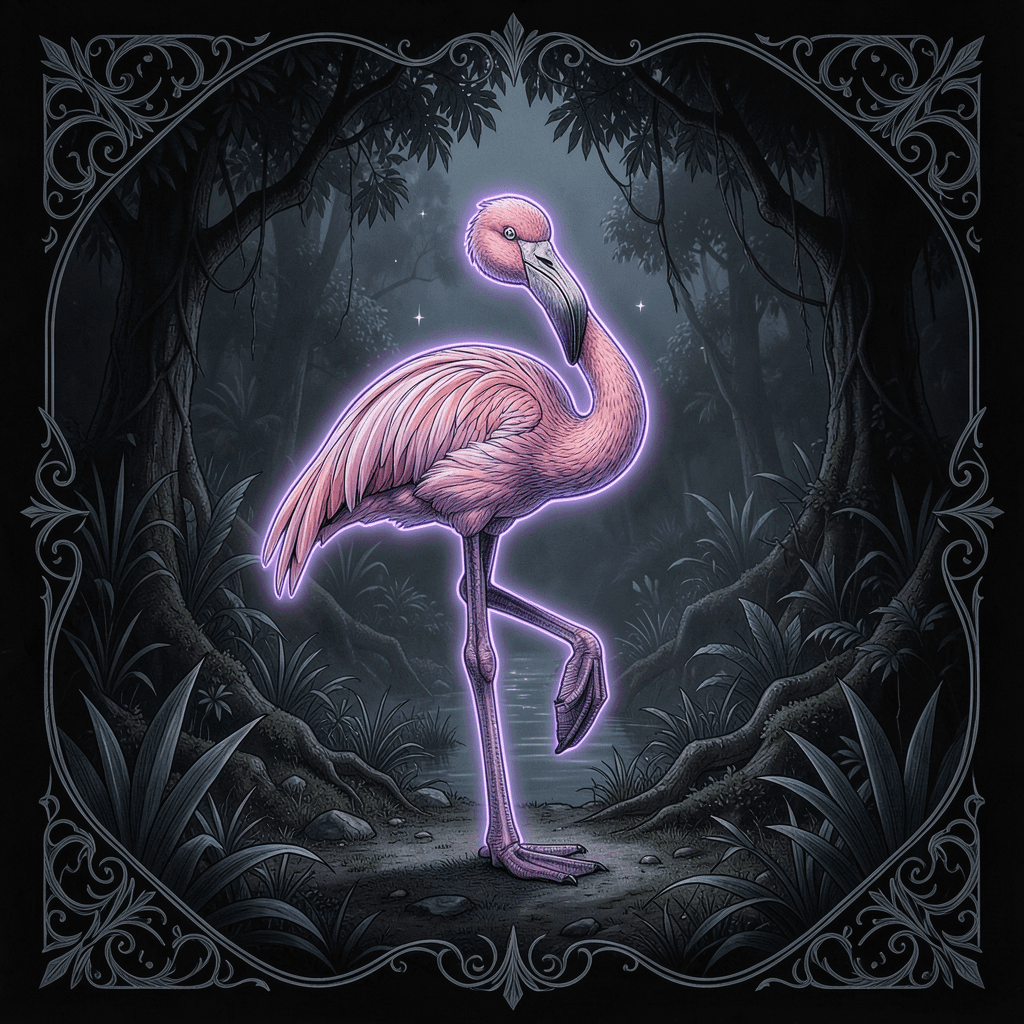
Flamingo dream meaning — interpretation
What it means to dream about a flamingo: one-legged poise, colour made of diet, flock belonging or faded isolation.
Somnovis editorial team
The flamingo brings two images into a dream that are worth distinguishing from the outset, because the traditions below read them separately. The first is the specific posture the bird holds for long stretches: standing balanced on one leg, motionless, in shallow water. The second is the colour: the flamingo is not born pink and does not become pink of its own — the pigment comes from carotenoids in its diet, and a captive flamingo fed a different food turns white. The bird is, quite literally, the colour of what it has eaten.
One-legged stillness. Belongs to a dream about poise held over time — patience through a long wait, balance maintained while the person around the dreamer would rather they moved.
A flock of flamingos, vividly pink. Belonging within a group whose distinctiveness is shared, and the specific comfort of being conspicuous within a company where being conspicuous is the point.
Alone, colour faded. Off from the group, pale — reads for a dreamer who has drifted from the setting that had been feeding them, and whose distinctness has begun to withdraw with the diet. That is a specific dream image and the traditions below read it consistently.
Perspectives across traditions
The classical Islamic corpus has no dedicated reading for the flamingo. The bird is present in the Persian Gulf and along the Red Sea coasts — a native winter visitor to the region the tradition was compiled in — but the dream manuals concentrate on the birds their compilers most often encountered, and the flamingo is not among them.
Extension from attested categories is where the reading lives. The tradition reads a bright-plumaged bird favourably as a distinction or a recognition — the specific case of standing out without being predatory — and reads a wading bird (طير الماء, ṭayr al-mā', "birds of the water") through the general water category, which reads toward provision and toward what a livelihood is being drawn from. The flamingo reads inside the intersection of the two: a bright bird at the water, and the reading extends from what a bright bird at the water carries rather than from a compilation entry. Modern Arabic terms (فلامنجو / النحام) are noted without inventing a classical ruling. No named compiler is cited.
Analytical psychology finds the flamingo unusually apt for a specific reading and it is worth having exact rather than gestured. The bird's stillness on one leg is genuinely distinctive: an image of balance not held by planting, but by staying in delicate contact with only one point of the ground — a poise the school reads as being about equilibrium maintained through fineness of touch rather than through force of stance. The dream that stages this image reads compensatorily for a dreamer who has been trying to hold their ground by planting both feet more heavily; the psyche is returning to them the fact that some things can only be held by not standing on them fully.
The colour is where the reading becomes precise. The flamingo is pink because carotenoids in its diet accumulate in the feathers — the animal is coloured by what it takes in — and this is a real biological fact the school can read directly. An image of identity that is a direct expression of what has been ingested is what analytical psychology means by the persona and by the wider question of what a life has absorbed. A flamingo whose colour has begun to fade is a specific dream image of an identity built on nourishment that is no longer being taken in, and the dream is not usually a warning about the specific food; it is a report on the diet in the broadest sense — the reading, the company, the work — the person has withdrawn themselves from.
The one-legged stance is thought by ornithologists to be primarily thermoregulatory — the bird conserves heat by tucking one leg against its body — and is not, in the animal's own terms, a symbolic posture. The dream image does not read it that way, and neither reading contradicts the other; the dream reads what the animal looks like it is doing, and the biological fact is a useful counter-note rather than a correction.
The Chinese classical tradition has no dream material on the flamingo. The bird's modern Chinese name 火烈鸟 (huǒ liè niǎo, "fire-fierce bird") is a modern coinage — descriptive rather than classical, and it does not carry a compilation entry. Traditional Chinese ornithology and dream reading centre on native water birds — cranes, storks, egrets — and the flamingo, which is not native to China, is absent from the material those birds occupy.
Saying so plainly is the honest section. What a Chinese reader may bring to the dream extends from the general favourable reading of bright water birds in Chinese folk material, without a specific compilation entry attached. The cranes' famous material on longevity, and the egret's association with scholarly detachment, belong on their own pages and do not transfer to the flamingo; borrowing them would be inventing coverage the tradition does not actually give the specific bird. The tradition's silence on a specific non-native bird is a fact about the tradition, not a gap for a writer to fill.
Sources
The tradition sections draw on these works. That is not a claim that every sentence is a quotation from them. Authorship of the treatise attributed to Ibn Sirin is disputed. The Chinese dream manual is paraphrased: its wording differs by version, so no edition, chapter, or date is named.
- Artemidorus of Daldis, Oneirocritica (2nd century).
- Muntakhab al-Kalām fī Tafsīr al-Aḥlām, the dream book attributed to Ibn Sirin.
- Zhou Gong Jie Meng (周公解梦).
- C. G. Jung, Man and His Symbols (1964), and the Collected Works.
Was your dream different?
Tell us exactly what you saw — our deeply trained AI will work through every detail and nuance of your specific dream.
Get a personal reading