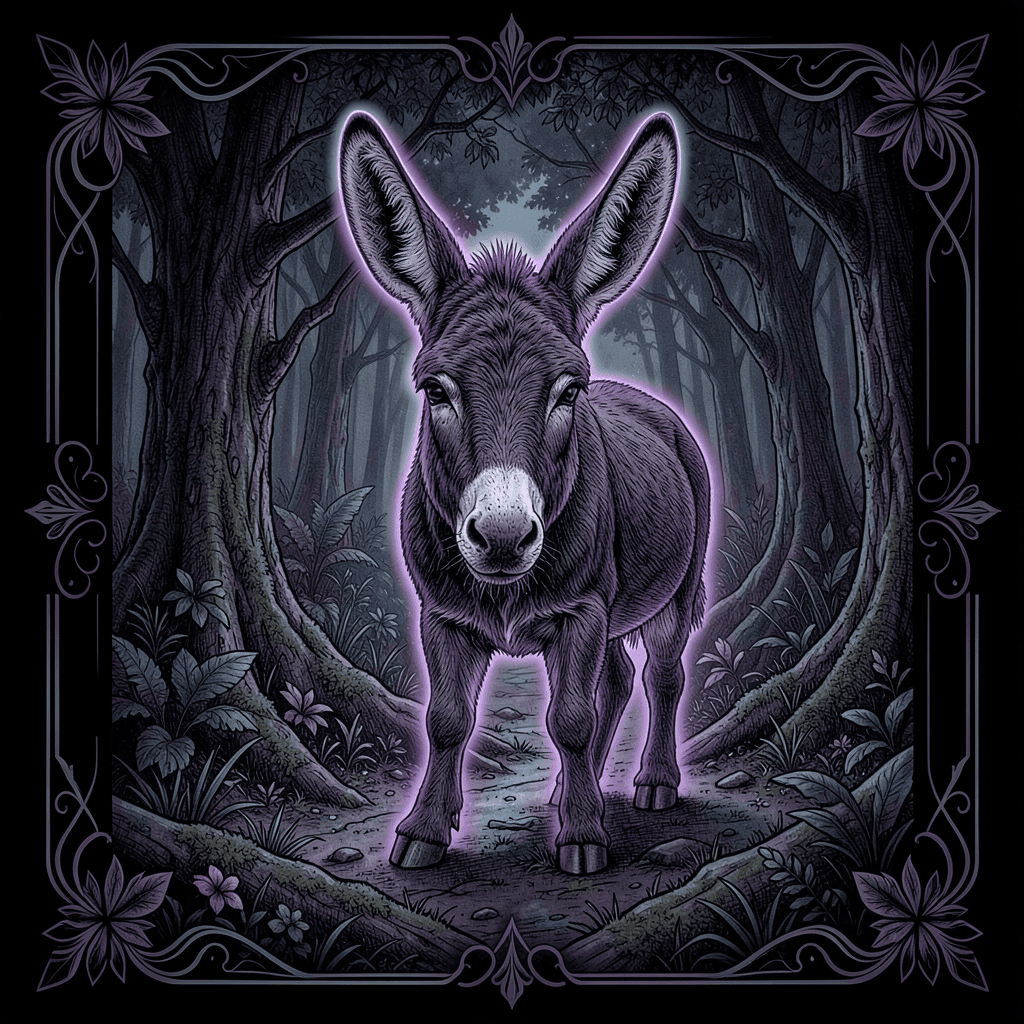
Donkey dream meaning — interpretation
What it means to dream about a donkey: steady burden-bearing, stubbornness, or being underestimated — and how traditions read it.
Somnovis editorial team
A donkey in a dream is closely associated with carrying weight without complaint — an animal known more for patient endurance than for speed or glamour, which makes this symbol less about ambition than about quiet, ongoing responsibility. It is also the clearest case in this dictionary of a symbol whose traditions say two things about it at once: the donkey is the dependable animal a household relies on, and the donkey is the standing figure of ridicule in the same languages that rely on it. Neither of those is a softened version of the other.
A donkey carrying a load steadily. A donkey calmly bearing a burden is often read as a sign that the dreamer is handling a real responsibility well, even if that effort isn't currently being noticed or praised by anyone else.
A stubborn donkey that won't move, or is mistreated. A donkey that refuses to budge more often points to the dreamer's own resistance to a task they know needs doing, while a mistreated donkey can reflect a feeling of being taken for granted.
A donkey braying. Worth its own line, because the sound rather than the animal is what the Islamic material below fixes on, and it is not read kindly there.
A donkey carrying something valuable. Also its own case in that tradition, and the reading is not about the cargo — it is about carrying what one does not understand.
What changes the reading. Whether the donkey is working or being discarded. Chinese supplies a specific expression for the second, and its force is closer to betrayal than to rest.
What it does not mean. A donkey in a dream is not a judgement on the dreamer's intelligence, whatever the word does in English.
Perspectives across traditions
The donkey, حمار (ḥimār), is genuinely in the classical dream corpus, and its readings there sit on livelihood. Readings of the shape of a healthy, docile donkey attach to the dreamer's worldly provision and to a dependable if unglamorous means of support; riding one attaches to a journey or an undertaking of modest scale that goes well; a sick, injured or immovable donkey attaches to obstruction in exactly that support, and losing one to the loss of it. The animal stands for the means, not for the ambition.
Running the other way, inside the same tradition, is a set of scriptural associations that are famous, quotable and unambiguously unflattering. The Qur'an says that the most disagreeable of sounds is the braying of donkeys (Q 31:19), and compares those entrusted with a scripture they do not act on to a donkey carrying books (Q 62:5) — the image of bearing something valuable without understanding any of it. A widely transmitted report adds that a donkey braying at night has seen a devil and that one should seek refuge, paired with the cock's crow, which has seen an angel.
Both are true of the tradition at once. The donkey is the reliable provision a dream reads favourably, and the donkey is the standing scriptural figure for an ugly voice and for carrying what one cannot comprehend. Neither of those is a gloss on the other, and neither cancels the other — which is why the detail a dreamer remembers, the load or the noise, decides which reading is even in play.
Analytical psychology reads the beast of burden as the part of a personality that carries what has to be carried and is not credited for it — labour so reliable that it stops being visible, including to the person doing it. Its appearance in a dream is usually about the invisibility rather than about the labour, which is why noticing the animal at all tends to be the dream's actual event.
The second property, stubbornness, reads differently and better. A refusal to move is information rather than obstruction: a body or an instinct that plants itself is generally reporting a limit that conscious planning has been overriding, and the dream's donkey is more often the messenger of that limit than an obstacle to it. Treating the balky animal as the problem is the reading this school specifically declines.
The longest-standing literary anchor here is Apuleius's second-century novel Metamorphoses, better known as The Golden Ass. Lucius, meddling with magic, is turned into an ass, is beaten and traded through the entire length of the book, and is restored to human form only at the end, through the intervention of Isis. Analytical writing has given that narrative sustained attention as a story of transformation that runs through the animal form rather than around it — the humiliation is the route and not an interruption of it, which is a substantially different proposition from patience being eventually rewarded.
The donkey was ordinary in northern China, and the folk material treats it as a working animal: readings of the shape of a laden donkey walking steadily, toward toil that pays, and of lameness or a fall, toward that same effort miscarrying. Those are paraphrases of a shape rather than located entries, and the labour reading every version of this page carries comes from there.
The idiom layer stands on much firmer ground, and it does not agree with the labour layer. 黔驴技穷 (qián lǘ jì qióng), "the Guizhou donkey's tricks are exhausted", comes from a Tang fable by Liu Zongyuan in which a donkey is brought to a province that has none, a tiger is terrified of it, and then discovers that a bray and a kick are its entire repertoire; the idiom means a limited ability that has been fully exposed. 卸磨杀驴 (xiè mò shā lǘ), "unhitch the mill, kill the donkey", names discarding someone the moment their usefulness ends — precisely the reward the patient-labour reading promises, denied. 骑驴找驴 (qí lǘ zhǎo lǘ), "riding a donkey while looking for a donkey", is failing to see what one already has. And 驴唇不对马嘴 (lǘ chún bù duì mǎ zuǐ), "a donkey's lips don't fit a horse's mouth", is a mismatch or a non-sequitur, and it quietly encodes the standing status gap between this animal and the horse.
None of those four is a dream ruling; they are what the language says about donkeys, and they say it unkindly. Against all of it sits one warm folk image: Zhang Guolao (张果老), one of the Eight Immortals, who rides a white donkey facing backwards and folds it up like a sheet of paper into his bag when he is not travelling. The donkey in Chinese folk religion is not only the drudge of the idioms, and the dreamer who liked the animal in the dream is not reading it wrongly.
Sources
The tradition sections draw on these works. That is not a claim that every sentence is a quotation from them. Authorship of the treatise attributed to Ibn Sirin is disputed. The Chinese dream manual is paraphrased: its wording differs by version, so no edition, chapter, or date is named.
- Artemidorus of Daldis, Oneirocritica (2nd century).
- Muntakhab al-Kalām fī Tafsīr al-Aḥlām, the dream book attributed to Ibn Sirin.
- Zhou Gong Jie Meng (周公解梦).
- C. G. Jung, Man and His Symbols (1964), and the Collected Works.
Was your dream different?
Tell us exactly what you saw — our deeply trained AI will work through every detail and nuance of your specific dream.
Get a personal reading