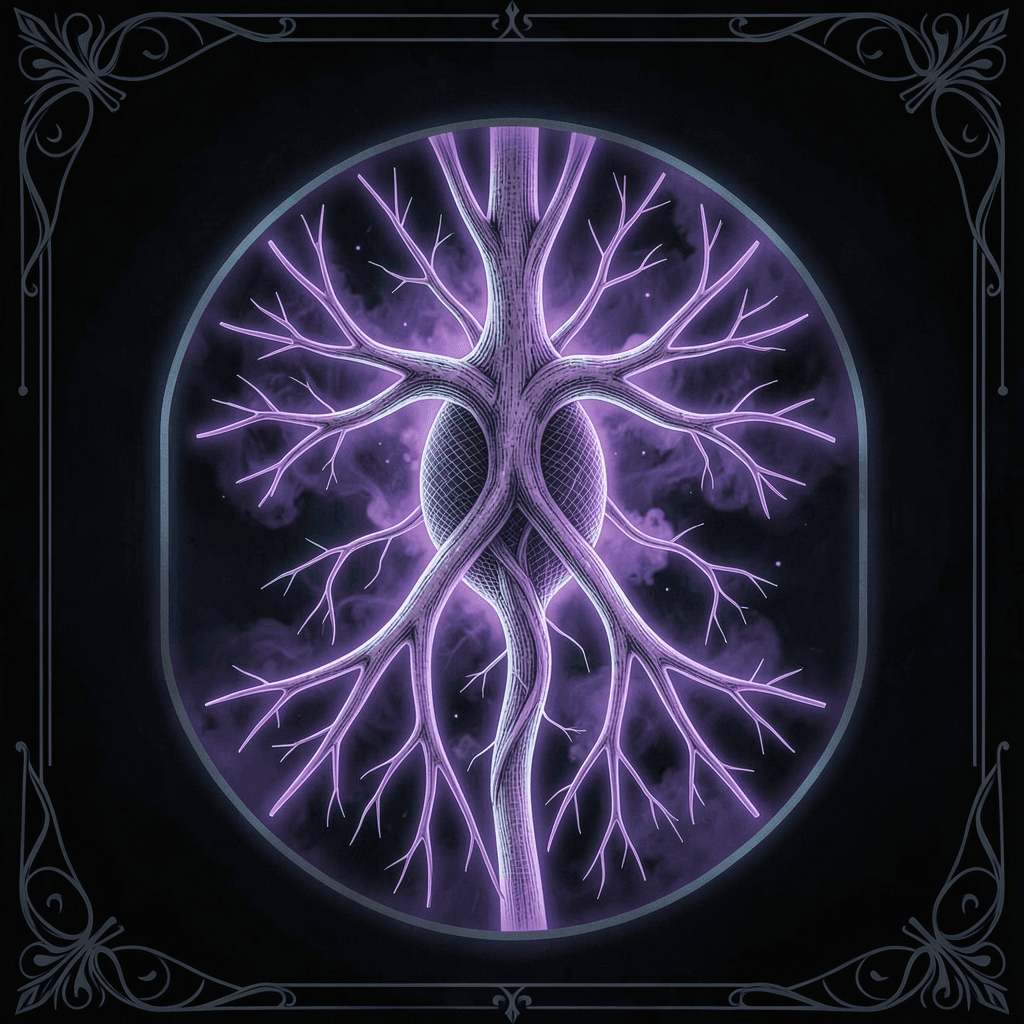
Veins dream meaning — interpretation
What it means to dream about veins: the hidden network carrying life through the body, distinct from blood as the substance itself.
Somnovis editorial team
Distinct from blood, the vital fluid itself, veins are the network carrying it — hidden beneath the skin, visible only as a faint blue map, and a dream that focuses on veins usually concerns connection and flow throughout the whole body, rather than the substance moving through it.
Veins standing out strong and visibly full, carrying an unmistakable pulse. Veins full and carrying a strong, visible pulse often reflects a felt sense of the dreamer's own vitality being genuinely well-connected right now, energy actually reaching every part of a situation that needs it.
Veins that are blocked, collapsed, or visibly drained beneath the skin. Veins that appear blocked or drained tends to point to a fear that something essential isn't reaching some part of the dreamer's life, a connection cut off somewhere they can't directly see or fix.
A vein opened deliberately. Distinct from a wound, and not automatically alarming: two of the traditions below know a vein as something a healer opens on purpose, and count that as care rather than as harm.
Veins seen in somebody else. Usually a dream about resemblance rather than about health, and both the Arabic and the Chinese material below explain why — in each language the word for vein is also the word for descent.
Veins mapped, traced, or followed. The version where the dream's interest is the pattern rather than the flow. This is where the analytical reading below is most precise: veins are not the same thing as blood, and structure is not the same complaint as substance.
What changes the reading. Whether the dream was about what is moving or about where it can go. Almost every reading below divides along that line.
What it does not mean. A vein dream is not a health signal, and nothing here should be read as one. If a real symptom prompted the dream, the person to tell is a doctor.
Perspectives across traditions
Arabic makes the reading before any interpreter does. عِرْق (ʿirq) is the vein, and the same word is the root — of a plant, and then of a person: descent, stock, inherited character. The proverb العرق دساس (al-ʿirq dassās), "the vein insinuates itself", says that inherited nature works its way through and shows up eventually, whatever has been laid over it. Veins in this tradition are therefore not simply the plumbing that blood runs in; they are the word the language uses for lineage, and a dream about them touches descent as directly as it touches health.
That is the layer usually missing when this section is written as "no distinct classical reading apart from blood". The favourable-when-full, cautionary-when-blocked reading is genuine and is an extension from the body's hidden channels — but it is not the whole of what this tradition has, and it is not even the most specific part of it.
The second thing the tradition brings is that a vein is something opened on purpose. Cupping, حجامة (ḥijāma), and venesection, فصد (faṣd), are attested and commended practices rather than emergencies — deliberately letting something out of the body in order to restore its balance. Fullness read as strength and blockage read as obstruction is the obvious half of this symbol; that the tradition also knows a vein as a thing one opens deliberately, and counts that as care, is the half that usually goes missing.
This is one of the places where Jung can be named, because the concept is genuinely his and the distinction it marks is real. Jung's energic view treats libido as psychic energy in general rather than as sexual energy specifically — the point on which he broke with Freud — and he describes that energy as needing to be canalised, led into symbolic analogues along which it can actually flow, rather than simply discharged. A network of channels that carries something vital and is invisible until it fails is that concept in bodily form.
Veins differ from blood in exactly the way structure differs from substance. Blood is what circulates; veins are the shape circulation is allowed to take. That distinction is what makes this symbol worth separating from the blood article rather than folding into it, and it is why a dream that traces the map rather than the flow is legible on its own terms.
Analytical psychology reads a blockage in such a network as a place where energy has stopped being available to a part of the personality that needs it — a local failure of supply rather than a general lack of it. That is a more precise complaint than "no energy", and a considerably more workable one: it points at a route rather than at a reservoir, and the question it raises is where the flow was diverted rather than how much of it there is.
Chinese does the same double duty as Arabic, with a different word. 血脉 (xuèmài) is the blood vessels and it is also the bloodline, and 一脉相承 (yī mài xiāng chéng), "carried down through one vein", is the current expression for an unbroken line of transmission. Two unrelated languages putting descent and vasculature in the same word is the kind of thing worth pointing out, and it needs no dream manual to license it. The kinship register has its own everyday phrases besides — 血浓于水 (xuè nóng yú shuǐ), blood is thicker than water, and 打断骨头连着筋 (dǎ duàn gǔ tou lián zhe jīn), "break the bone and the sinew still holds it together", said of relatives who quarrel and remain relatives.
The medical register is real and needs one distinction kept. Traditional Chinese medicine is built on the free circulation of 气血 (qìxuè), qi and blood, and treats obstruction as the general form of illness — where there is free passage there is no pain. That is medical doctrine, and no folk dream reading follows from it. There is no entry saying that a clear vessel dreamed is favourable or a blocked one a warning; what there is, is a culture in which obstruction is the shape illness takes, so a dreamer reaches for that frame without being told to. The two sound identical on the page and only one of them can be sourced, which is exactly why they are separated here.
One further correction is worth making, because nearly every version of this section runs the two systems together. The 经络 (jīngluò), the meridians, are not blood vessels. The tradition distinguishes them from 血管 (xuèguǎn), the anatomical vessels, and does not treat the two as one system. The qi-and-blood circulation claim survives that distinction intact; what does not survive is the impression that a dream of a vein is a dream of a meridian.
Sources
The tradition sections draw on these works. That is not a claim that every sentence is a quotation from them. Authorship of the treatise attributed to Ibn Sirin is disputed. The Chinese dream manual is paraphrased: its wording differs by version, so no edition, chapter, or date is named.
- Artemidorus of Daldis, Oneirocritica (2nd century).
- Muntakhab al-Kalām fī Tafsīr al-Aḥlām, the dream book attributed to Ibn Sirin.
- Zhou Gong Jie Meng (周公解梦).
- C. G. Jung, Man and His Symbols (1964), and the Collected Works.
Was your dream different?
Tell us exactly what you saw — our deeply trained AI will work through every detail and nuance of your specific dream.
Get a personal reading