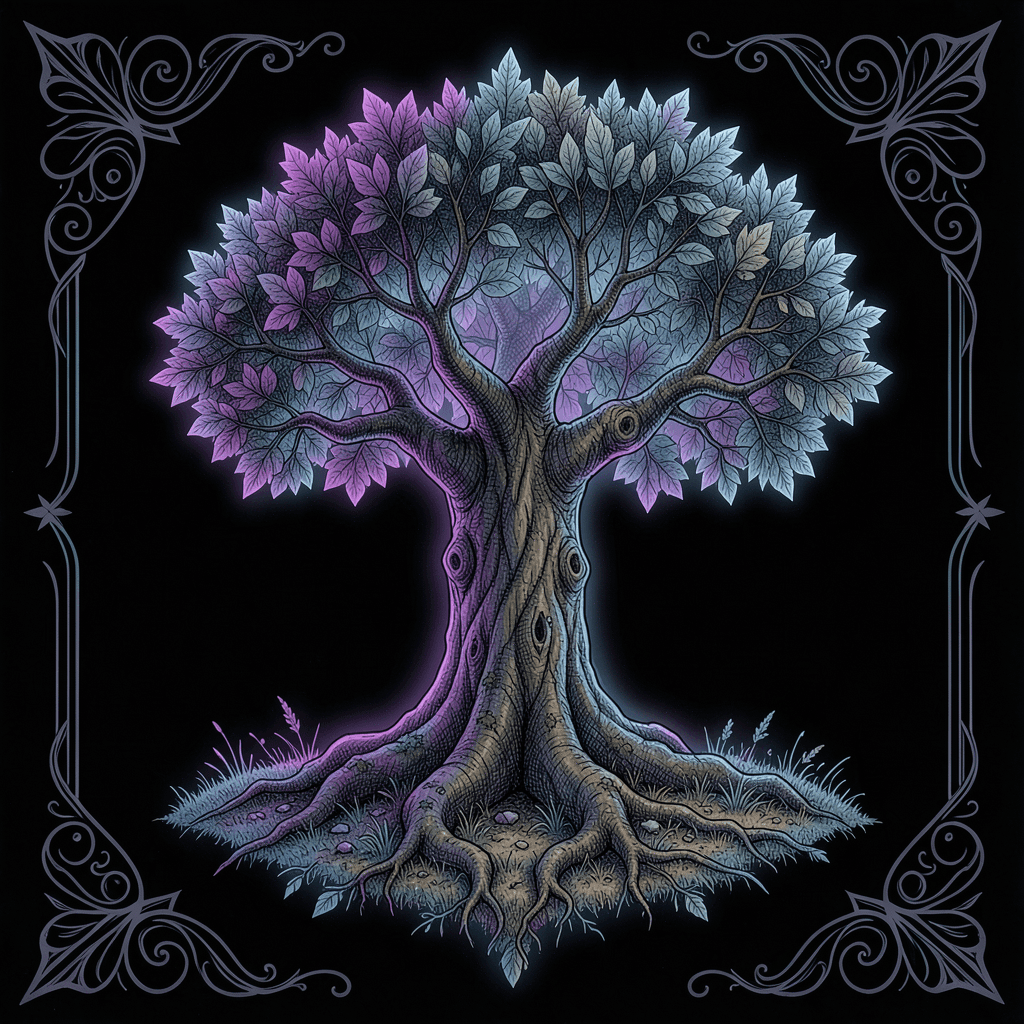
Tree dream meaning — interpretation
What it means to dream about a tree: a strong, rooted tree versus one that's dying, and different traditions' views.
Somnovis editorial team
A tree in a dream is one of the most direct images of a life examined over time rather than in a single moment — its roots, trunk, and branches inviting a reading of the dreamer's foundation, present strength, and future growth all at once.
A tall, strong, deeply rooted tree. A healthy, sturdy tree is generally read as a sign of a stable foundation — family, health, or a long-term project the dreamer has built well and can continue to rely on.
A dying, hollow, or uprooted tree. A tree that is withering, hollow at the core, or has been uprooted tends to point instead to a foundation the dreamer had assumed was solid now showing real signs of weakness.
What changes the reading. Which tree it is, and what condition it is in, matter more than the fact of a tree: in leaf or bare, fruiting or barren, standing alone or in a forest, growing or being cut. The traditions below read a felled tree very differently from a withered one — deliberate ending versus slow decline — and a specific tree the dreamer recognises carries more information than a generic one.
What it does not mean. A tree dream is not a health report and not a family prophecy — one tradition below reads trees as lineages, but as a way of describing what a dream is about, not as a forecast about relatives. A tree also cannot be hurried, and that is part of the image: whatever the dream is describing grows on its own schedule, which is information about pace, not about outcome.
Perspectives across traditions
The classical Islamic dream-interpretation tradition reads trees as people and lineages — a tree standing for a man, its branches for descendants and dependents, its fruit for what comes of him. A well-rooted, fruiting tree is read favourably; a felled or withered tree as an ending, a death or a line broken — readings reported here as the tradition's, in its own register. The anchor is a well-known hadith concerning a tree whose leaves do not fall, likened to the believer, with the answer given as the date palm — citable as a hadith, and the reason this tradition habitually reads a specific tree rather than trees in general.
Which tree, in other words, is the first question. A palm, an olive, a fruit tree and a thorn tree are not one image in this material; each carries its own associations of benefit, blessing or harm, and the corpus reads them separately. The generic tree of modern dream dictionaries is a flattening this tradition never made.
The tree is genuinely Jung's material — he wrote an essay on the philosophical tree, and treated the tree as an image of the individuation process itself: rooted in the unconscious, growing towards the light, and doing both slowly, organically, without consulting the ego about the pace. That attribution is earned here in a way it rarely is for dream symbols, and it shapes what a Jungian reading does with a specific dream: it reads the tree's condition and situation — in leaf or bare, alone or in a forest, growing or cut — as a statement about where that long process currently stands.
The detail with the most force is the one the image supplies by being what it is: a tree cannot be hurried. Whatever a dream tree is describing has its own tempo, and the dreamer's relation to that tempo — patience, frustration, the axe — is usually the dream's actual subject. The forest, the unconscious as territory rather than as a single growth, is a separate image with its own article; this one belongs to the single tree.
The dream books read the tree by its life and condition: readings of the shape that a living tree portends good fortune, a withered tree portends the household unquiet, a dead tree portends a death, climbing a tree portends a happy matter, and felling a tree portends harm to the household — entries reported in the tradition's own register, in which the tree's state falls on the house that stands near it. Trees planted at ancestral graves carry a family's continuity in custom, and some readings accordingly take a withered or felled dream tree as touching the family line — one possible reading rather than the reading, since the same image is read towards a stalled undertaking just as readily. Where this converges with the Islamic lineage material above, the two traditions arrived at it independently.
The associations are current and pull both ways. 「摇钱树」 (yáo qián shù, the money tree) — the fabled tree that drops coins when shaken — is used of a reliable source of income, and is what a dream of a tree bearing money lands on. 「大树底下好乘凉」 (dà shù dǐ xià hǎo chéng liáng, it is cool in the shade of a big tree) describes the benefit of a powerful protector; its exact negative is 「树倒猢狲散」 (shù dǎo hú sūn sàn, when the tree falls, the monkeys scatter) — the dependents who disperse once the protector is gone. A dream of sheltering under a great tree, or of that tree coming down, reads directly against the pair.
Sources
The tradition sections draw on these works. That is not a claim that every sentence is a quotation from them. Authorship of the treatise attributed to Ibn Sirin is disputed. The Chinese dream manual is paraphrased: its wording differs by version, so no edition, chapter, or date is named.
- Artemidorus of Daldis, Oneirocritica (2nd century).
- Muntakhab al-Kalām fī Tafsīr al-Aḥlām, the dream book attributed to Ibn Sirin.
- Zhou Gong Jie Meng (周公解梦).
- C. G. Jung, Man and His Symbols (1964), and the Collected Works.
Was your dream different?
Tell us exactly what you saw — our deeply trained AI will work through every detail and nuance of your specific dream.
Get a personal reading