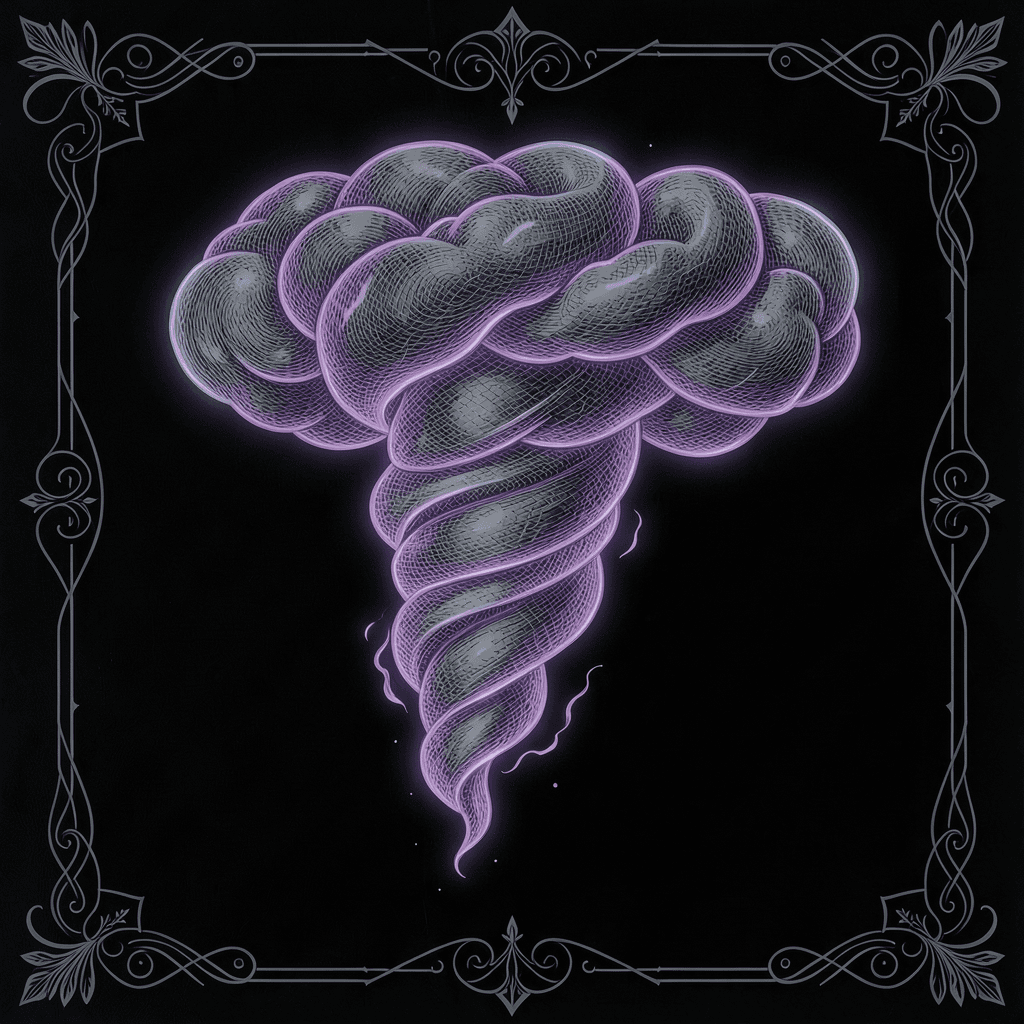
Tornado dream meaning — interpretation
What it means to dream about a tornado: chaotic, uncontrollable change, and how different traditions read this scenario.
Somnovis editorial team
A tornado in a dream is a more disorienting image of upheaval than a storm, and the difference is not scale but shape: a storm moves in a direction that can be read, and a funnel does not. The other thing that distinguishes it is how narrow it is — everything inside a thin track is destroyed and the next street is untouched, which the readings below make more of than the violence.
Watching one approach, and taking shelter. The commonest form. Seeing it coming and finding cover in time is usually read toward protection that is genuinely there — and it is worth noticing that most tornado dreams are about anticipation rather than impact.
Caught in its path. Points toward a period the dreamer feels has no handhold: circumstances changing faster and less predictably than a response can be planned.
The debris. What the funnel carries is often the dreamer's own material, recognizable and airborne, and the detail of what was lifted is usually more informative than the wind.
Afterwards. A dream that continues into the survey of what is left is doing different work from one that ends at impact.
What changes the reading. Whether the dreamer watched, sheltered, or surveyed — the affect the dream is actually working on is dread and survey more often than destruction.
What it does not mean. Not a warning of a real storm and not a prediction of harm to anyone. Violence of weather in general belongs to the storm article; the ground giving way belongs to earthquake.
Perspectives across traditions
The corpus predates the tornado as a named category, and what it holds is the wind register — an extension, and marked as one here. That register is genuinely double in this tradition, and the doubling is what makes it readable: wind that carries rain and scatters seed is read toward mercy and provision arriving, while wind that uproots and levels is read toward trial. The tradition remembers the wind sent against ʿĀd, destruction by air alone, which the storm article carries and which is not retold here.
What this page adds inside that register is the turning. A wind that travels is habitually read by where it comes from, what it carries and what it leaves — and a wind that rotates denies every one of those handles at once, which is an honest extension of the tradition's own method rather than an invented ruling. One further corpus habit belongs here and does real guardrail work: weather in this tradition is generally read as a matter concerning a place or a people rather than as a private message to the sleeper, which is exactly why a tornado dream is not a warning to the dreamer about a real storm.
The reading that distinguishes this image is that it is locally total. The funnel destroys everything inside a narrow track and leaves the next street standing, and analytical psychology reads that as the exact behaviour of a complex: catastrophic within one region of a life and simply absent from the rest, which is why a person can be articulate and competent everywhere except in the one place where they are not.
The second image is the debris. What the funnel lifts is the dreamer's own material out of position — recognizable, airborne, and no longer where it was put — and the dream usually gives more information in what was carried than in the wind that carried it. And the structure of the dream itself is worth attending to: tornado dreams characteristically consist of anticipation and aftermath rather than impact, with the dreamer watching, sheltering or surveying, which means the affect being worked on is dread and survey rather than destruction. Affect at weather scale in general belongs to the storm article, and this page does not borrow it.
There is no tornado entry as such. What the folk dream books give are wind shapes, paraphrased and hedged: a violent wind rising portending a sudden disturbance in a household's affairs; wind that scatters or carries things off toward dispersal and loss; a great wind that passes leaving nothing damaged toward a matter that alarms and does not harm.
One lexical fact is worth more than any idiom here. The modern Chinese word for a tornado is 「龙卷风」 (lóngjuǎnfēng, dragon-coil wind) — the language names the funnel after the dragon coiling up out of the water, so a Chinese dreamer's tornado already carries the whole dragon register, which the dragon article holds. The associations the language then supplies are associations rather than rulings. The standing phrase about a tall tree drawing the wind — prominence attracting trouble — is glossed at the celebrity article and referenced rather than repeated here; it may be reached for in describing a dreamer who stood exposed while everything low went untouched. 「无风不起浪」 (wú fēng bù qǐ làng, without wind, no waves) is the folk instinct against treating an upheaval as motiveless: a disturbance has a source. And 「风卷残云」 (fēng juǎn cán yún, the wind sweeps away the last of the clouds) is the closest thing the language has to what a funnel actually does — a force that clears everything remaining in one motion, and genuinely double-edged, since the sweeping can be welcome. Where a set term for sudden violence is wanted, 「狂风暴雨」 (kuáng fēng bào yǔ, mad wind, violent rain) is it; the storm article keeps its own.
Sources
The tradition sections draw on these works. That is not a claim that every sentence is a quotation from them. Authorship of the treatise attributed to Ibn Sirin is disputed. The Chinese dream manual is paraphrased: its wording differs by version, so no edition, chapter, or date is named.
- Artemidorus of Daldis, Oneirocritica (2nd century).
- Muntakhab al-Kalām fī Tafsīr al-Aḥlām, the dream book attributed to Ibn Sirin.
- Zhou Gong Jie Meng (周公解梦).
- C. G. Jung, Man and His Symbols (1964), and the Collected Works.
Was your dream different?
Tell us exactly what you saw — our deeply trained AI will work through every detail and nuance of your specific dream.
Get a personal reading