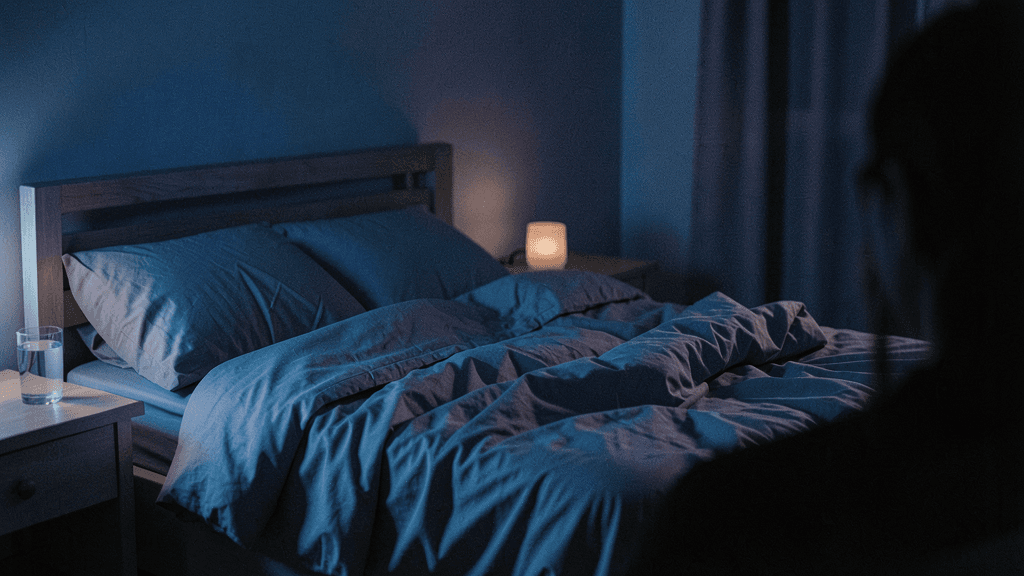
Why we sleep — what the research shows
Why an animal would give up a third of its life: the leading explanations for sleep, what deprivation research established, and how much adults need.
Somnovis editorial team
- Every animal studied so far sleeps in some form, which is the strongest single argument that sleep is essential rather than optional.
- No single function explains sleep: repair, immune regulation, energy balance, memory consolidation, synaptic downscaling and waste clearance are all supported.
- Prolonged total sleep deprivation proved fatal in Rechtschaffen's rat experiments — sleep is a biological necessity, not a habit.
- Adult sleep recommendations cluster around 7–9 hours, but individual need genuinely varies and changes across a lifetime.
Sleep is one of the strangest things a body does. An animal that sleeps is not eating, not defending its territory and not watching for predators, and it spends roughly a third of its life that way. Evolution rarely tolerates a cost that large without a return — and the return has been surprisingly hard to name. Every animal studied so far sleeps in some form: mammals, birds, reptiles and fish, and even insects and simple worms show a reversible state of reduced responsiveness that rebounds after it is prevented. That universality is the strongest single argument that sleep does something a body cannot do while awake.
There is no single agreed answer, but several strong candidates. Sleep researchers describe a set of functions rather than one purpose. The best supported include cellular repair and growth, immune regulation, energy and metabolic regulation, the consolidation of memories laid down during the day, synaptic downscaling, and the clearance of metabolic waste from brain tissue. These are not really competing theories so much as different levels of description: the same eight hours can plausibly serve the immune system and the memory system at once, and most researchers now expect the answer to be plural rather than singular.
One influential idea is that sleep rebalances the brain rather than simply resting it. Giulio Tononi and Chiara Cirelli's synaptic homeostasis hypothesis proposes that waking experience drives a net strengthening of synaptic connections, which is metabolically costly and eventually saturating, and that sleep — deep slow-wave sleep in particular — scales those connections back down proportionally. What survives the night is the signal; what fades is the noise. The hypothesis is carefully argued and has real experimental support, but it is a hypothesis, not a settled fact, and other researchers put more weight on active memory consolidation or on physical restoration.
The clearest evidence that sleep is non-negotiable comes from taking it away. In Allan Rechtschaffen's classic experiments, rats kept from sleeping for a prolonged period died — a result that established sleep as a biological necessity rather than a habit. It is worth stating plainly what that does and does not imply for a person. It does not mean that a bad night, or a run of them, is dangerous in the same way; total, enforced, prolonged deprivation is a very different thing from a short night before a deadline. It does mean that the pressure to sleep is not a preference the body can be talked out of, only postponed.
How much sleep a person needs is a population guideline, not a prescription. Adult recommendations cluster around seven to nine hours, and that range is exactly that — a range, drawn from what most adults appear to need when measured across large groups. Individual need genuinely varies, and it shifts across a lifetime: children need substantially more, and older adults often sleep more lightly and in more fragments without that being a disease. The more useful question than whether you hit a number is whether you wake reasonably restored and get through the day without fighting to stay alert.
Sleep is also not a single uniform state, which is part of why its purpose resists a one-line summary. A night is built out of repeating cycles of light sleep, deep slow-wave sleep and REM, each with its own physiology and, plausibly, its own jobs. Deep sleep looks strongly restorative and is tied to fact-based memory; REM is the stage most vivid dreaming is reported from and appears to matter for emotional and skill-based processing. Asking what sleep is for is a little like asking what a working day is for — the honest answer is that several different things happen in it.
For a site about dreams, this is the necessary foundation. Dreaming is not a separate phenomenon bolted onto sleep; it is something the sleeping brain does while it is busy with everything above. Understanding why the body insists on shutting down every night is the first step toward understanding why it also insists on telling itself stories while it does.
Frequently asked
Was your dream different?
Tell us exactly what you saw — our deeply trained AI will work through every detail and nuance of your specific dream.
Get a personal readingSources
- Giulio Tononi and Chiara Cirelli's synaptic homeostasis hypothesis
- Allan Rechtschaffen's sleep-deprivation experiments in rats
- Public-health consensus guidelines on adult sleep duration
This article is for information only and is not a substitute for medical advice.