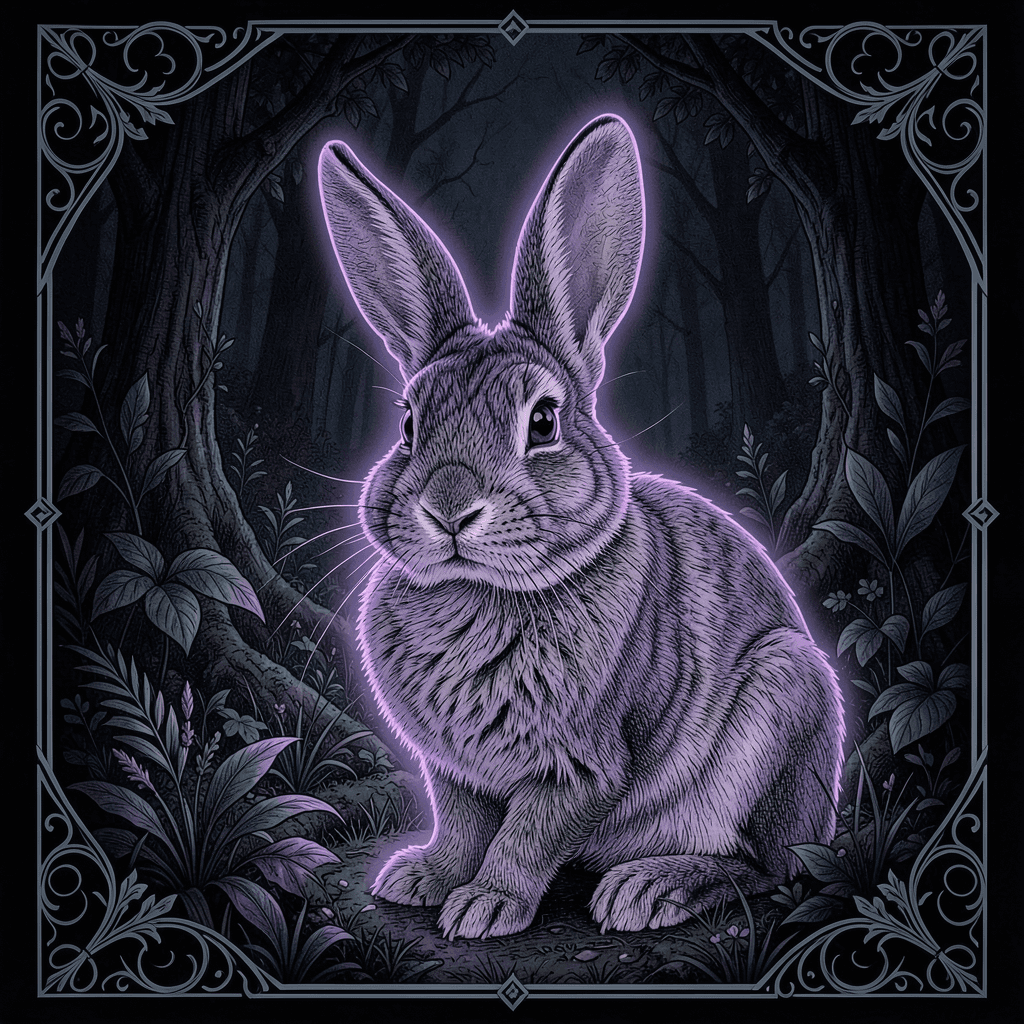
Rabbit dream meaning — interpretation
What it means to dream about a rabbit: gentleness, fertility, or nervous fear — and how traditions interpret this symbol.
Somnovis editorial team
A rabbit in a dream is read very differently by the traditions below, and the divergence is the page's most useful content: the European rabbit is fertility and skittishness, and the Chinese one is a moon creature before it is anything else.
A calm rabbit, or rabbits multiplying quickly. Read toward growth — a project or a household expanding faster than expected — with the dream's own mood deciding whether that is abundance or something getting out of hand.
A rabbit fleeing or being hunted. The rabbit is prey, and prey-fear has no object: it is a state of the whole nervous system rather than fear of a particular thing, which makes this an unusually exact image for anxiety the dreamer cannot find a cause for.
A rabbit that cannot be cornered. Worth its own line, because one tradition below has a phrase for exactly this and it is about foresight rather than speed.
A rabbit entering the house, or running off. Both are read concretely in the folk material below, and in opposite directions — an addition to the household on one side, property lost on the other.
What changes the reading. The animal's behaviour, and — in one tradition emphatically — its colour.
What it does not mean. Not a fertility forecast, and not a statement about anyone's courage. A timid rabbit is not a verdict on a real person.
Perspectives across traditions
The corpus reads the hare by character, and the character it reads is flight rather than fertility. The European register's fertility emphasis is simply not the classical one here, and the two genuinely diverge on this animal rather than saying one thing in two vocabularies.
Within the character reading, one strand reads the hare as a timid or weak person and another specifically as a woman of little consequence, or a fearful one. Both are hedged here: they are present in the popular material with a weight nobody has established, and both fall under the guardrail that runs through every person-figure on this site — these are figures, not verdicts on anyone the dreamer knows. Catching a hare reads toward a small gain in some strands. What the corpus actually attends to is the character, and the character is not the one a modern reader arrives expecting.
Two distinct readings are available rather than one. The first is proliferation: the rabbit is the psyche's image of something multiplying faster than it can be managed, and the same image reads as abundance or as anxiety depending entirely on the dream's affect — the animal's behaviour tells which, and that principle does more work here than any rule about rabbits.
The second is more specific, and it fits this animal exactly. The rabbit is prey, and prey-fear has no object: it is freeze and then bolt, a state of the entire nervous system rather than fear of some particular thing. That makes the rabbit an unusually exact image for anxiety the dreamer cannot locate a cause for, which is a common complaint and a hard one to picture. One further clause: the hare belongs with the small trickster figures of several unrelated folklores, the weak one who survives the strong by wit — which analytical psychology reads as amplification rather than as a ruling, and the trickster material itself sits at the fox article this wave.
The folk readings of this animal are blunt and material, and softening them would misrepresent the register as surely as over-claiming would. Readings of the shape, hedged: that seeing a rabbit portends gain and good fortune, sometimes considerable; that a white one is read favourably and a dark one toward worry, colour carrying real weight here; that one entering the house reads toward an addition to the household; and that one running off reads toward property lost.
The anchor, though, is the moon. 「玉兔」 (yùtù, the jade hare) is the hare in the moon, pounding the elixir of immortality — the companion figure to Chang'e, whose own material sits at the moon article — so a rabbit in this tradition reaches first for the moon, for the Mid-Autumn festival and for immortality, and a European reader expecting fecundity has walked into a different symbol entirely. The rabbit is also one of the twelve zodiac animals, which is what ties the auspicious register to a whole year rather than to an animal: 「玉兔呈祥」 (yù tù chéng xiáng, the jade hare presents good fortune) is the standing formula used in Year of the Rabbit greetings, and it is the warmest thing on this page. Three idioms, none of them about timidity. 「狡兔三窟」 (jiǎo tù sān kū, the wily hare has three burrows) is about foresight and self-protection — keeping more than one way out, not cleverness in general — and it is the phrase for a dream of a burrow, or of a rabbit that cannot be cornered. 「守株待兔」 (shǒu zhū dài tù, guarding the stump, waiting for the hare) is the classical fable of the farmer who saw one hare run into a tree stump and abandoned his plough waiting for another; it is satirical, and its target is someone who mistakes a fluke for a rule and stops working. 「兔死狗烹」 (tù sǐ gǒu pēng, the hare dead, the hound is boiled) is the instrument discarded once the task is done, which gives the Chinese rabbit a political register the European one has never carried, and which points to the dog article. The hare-and-fox phrase for grieving one's own kind is the fox article's and is not re-glossed here.
Sources
The tradition sections draw on these works. That is not a claim that every sentence is a quotation from them. Authorship of the treatise attributed to Ibn Sirin is disputed. The Chinese dream manual is paraphrased: its wording differs by version, so no edition, chapter, or date is named.
- Artemidorus of Daldis, Oneirocritica (2nd century).
- Muntakhab al-Kalām fī Tafsīr al-Aḥlām, the dream book attributed to Ibn Sirin.
- Zhou Gong Jie Meng (周公解梦).
- C. G. Jung, Man and His Symbols (1964), and the Collected Works.
Was your dream different?
Tell us exactly what you saw — our deeply trained AI will work through every detail and nuance of your specific dream.
Get a personal reading