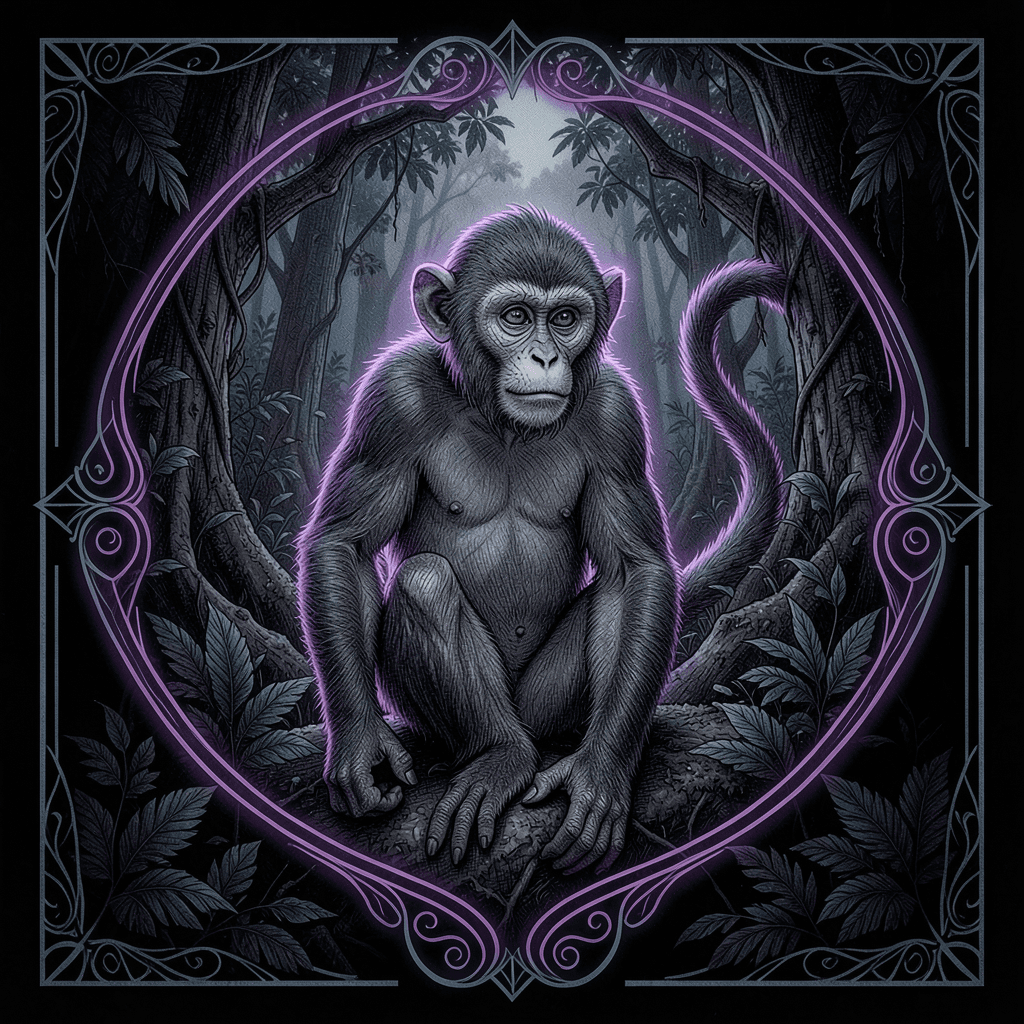
Monkey dream meaning — interpretation
What it means to dream about a monkey: playfulness, mischief, or imitation — and how different traditions read this symbol.
Somnovis editorial team
A monkey in a dream tends to bring a restless, quick-witted energy — clever and playful, but also prone to mimicry and mischief, so the dream's tone usually decides whether this reads as welcome creativity or as untrustworthy behavior.
A playful or clever monkey. A monkey that entertains or solves a problem cleverly is often linked to the dreamer's own wit and adaptability — a reminder that a lighter, more resourceful approach might serve them better than a rigid one.
A monkey that steals, mocks, or mimics. A monkey that takes something or imitates the dreamer mockingly more often points to someone in waking life who copies or undermines them, or to the dreamer's own doubts about not being taken seriously.
What changes the reading. What the monkey does with its hands decides a lot: a monkey that steals, a monkey that imitates, and a monkey that simply will not be still are three different dreams. So is the number — one monkey is a figure, a troop is an atmosphere. And a monkey that leads the dreamer somewhere belongs to a different register again, closer to guide than nuisance.
What it does not mean. A monkey dream is not an insult to the dreamer's seriousness, and it does not identify a mocking person in their life. The traditions below disagree about the animal — deceit in one, disputes in another, the psyche's own mischief in the third — and that disagreement is the useful content: which reading fits depends on what, exactly, the monkey was doing.
Perspectives across traditions
The classical Islamic dream-interpretation tradition reads the monkey unfavourably: a person of sin or deceit, and cheating in one's dealings — an associate whose cleverness is not matched by his honesty. Behind the reading stands a Qur'anic image the tradition knows well: the Sabbath-breakers transformed into apes, named in al-Baqarah and al-A'raf. That image gives the monkey its particular weight in this material — not simply a trickish animal, but a person unmade by his own transgression, someone whose state is the consequence of what he did.
The practical readings follow from that. A monkey in the dreamer's house or affairs points towards an unreliable associate — imitation without substance, dealings that will not bear scrutiny — and the dreamer's own conduct towards the animal carries the usual interpretive weight: being free of it reads better than feeding it. As throughout this tradition, the figure is a shape, not a named person; the corpus describes the kind of dealing to look at, and leaves the recognition to the dreamer.
The trickster is genuinely Jung's territory — he wrote an essay on the trickster figure, and the attribution is accurate here in a way it would not be for most animals. The monkey fits the figure exactly: the psyche's capacity for mischief, boundary-crossing, and the deflation of pretension — destructive when disowned, renewing when given room. The trickster's work in a dream is usually done at the expense of whatever the dreamer has become too solemn about, which is why these dreams so often arrive during periods of rigid self-importance, and why they sting the way being laughed at stings.
A monkey that steals from the dreamer is the sharpest version: the trickster taking what the ego overvalued. What is taken in the dream — keys, a phone, food, something absurdly specific — is usually worth more attention than the theft itself, because it names the overvaluation. And a monkey that mimics the dreamer holds up the trickster's other mirror: the gestures look ridiculous because they are being performed without the story the dreamer usually wraps around them. The school's question is not how to be rid of the animal but what it is trying to unfasten.
The folk dream books run the monkey towards disputes rather than towards flattering cleverness: readings of the shape a monkey portending quarrels, or entanglement in other people's affairs — hedged here as paraphrase, since the material circulates in many versions, but consistent in direction. The monkey is also a zodiac animal, which gives it real standing; the restlessness the West associates with it lives in the idioms rather than the rulings. 「猴年马月」 (hóu nián mǎ yuè, monkey year, horse month) names the date that never comes — the register for a dream of waiting on something that will not arrive. 「猴子捞月」 (hóu zi lāo yuè, the monkey scooping the moon from the water) is effort spent on a reflection, and a superb reading for a dream of grasping at what cannot be held. 「杀鸡儆猴」 (shā jī jǐng hóu, kill the chicken to warn the monkey) covers the dream whose warning lands on a bystander.
Two stronger pieces of the culture's monkey material sit just off the dream books' page. The decorative pun on 猴 (hóu, monkey) and 侯 (hóu, marquis) puts a monkey on horseback into ornament as 「马上封侯」 (mǎ shàng fēng hóu, ennobled at once — a marquis on a horse), an image of advancement; like the elephant-and-vase motif treated at the elephant article, it is decoration rather than a dream ruling, and is marked as such. The restless pairing of the monkey mind and the horse will — 心猿意马 — is treated at the horse article, and is the same pair seen from the monkey's side. And the culture's most vivid monkey, the Monkey King, contributes his piercing eyes to the eyes article rather than a ruling here.
Sources
The tradition sections draw on these works. That is not a claim that every sentence is a quotation from them. Authorship of the treatise attributed to Ibn Sirin is disputed. The Chinese dream manual is paraphrased: its wording differs by version, so no edition, chapter, or date is named.
- Artemidorus of Daldis, Oneirocritica (2nd century).
- Muntakhab al-Kalām fī Tafsīr al-Aḥlām, the dream book attributed to Ibn Sirin.
- Zhou Gong Jie Meng (周公解梦).
- C. G. Jung, Man and His Symbols (1964), and the Collected Works.
Was your dream different?
Tell us exactly what you saw — our deeply trained AI will work through every detail and nuance of your specific dream.
Get a personal reading