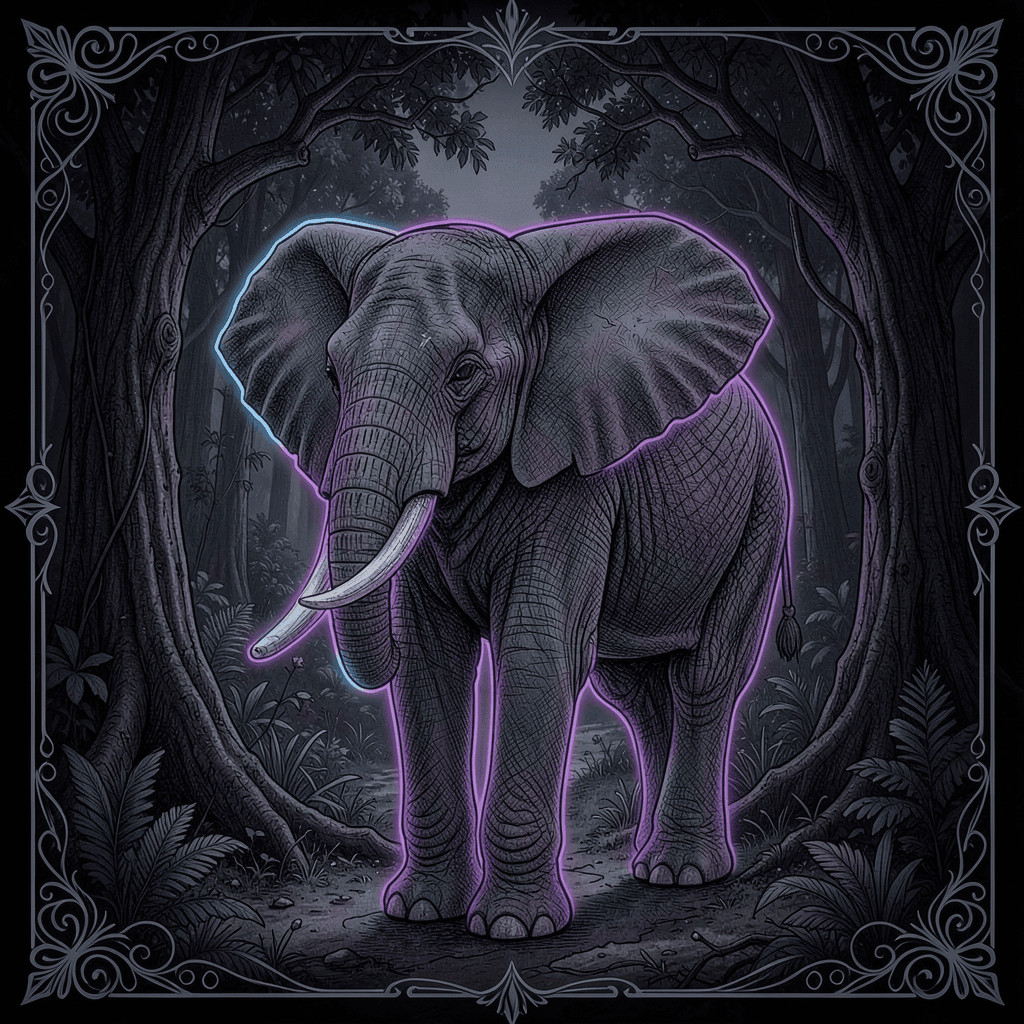
Elephant dream meaning — interpretation
What it means to dream about an elephant: memory, quiet strength, and steadiness — and how different traditions interpret it.
Somnovis editorial team
An elephant in a dream is rarely a frightening image — its size suggests power, but its temperament in most dreams is calm, deliberate, and unhurried, which is why this symbol is usually read through strength held in reserve rather than aggression.
A calm elephant, walking or standing nearby. This is generally read as a sign of steady, dependable strength — either the dreamer's own capacity to endure, or a reliable person or institution currently supporting them.
A stampeding or agitated elephant. An elephant that charges or panics is far less common, and tends to point to enormous pressure finally breaking through a normally composed exterior — a slow-building frustration given sudden, forceful release.
What changes the reading. Riding the elephant, being carried by it, watching it pass, or standing in its path are the variants that matter — the traditions below diverge precisely on whether the dreamer is on the animal or under it. Its temperament is the other axis: the same bulk reads as steadiness when calm and as unstoppable pressure when it moves against the dreamer.
What it does not mean. An elephant dream is not a comment on the dreamer's size, weight or slowness, and it is not a fixed omen of luck in either direction. The traditions collected below read it consistently as power — held in reserve, belonging to someone else, or newly available — and differ mainly on whose power it is.
Perspectives across traditions
Two things anchor the classical Islamic reading of this animal, and both are specific. The Qur'an has a sura named for the elephant, al-Fil, referring to the army that moved against Mecca with an elephant and was destroyed — so the elephant in this tradition is associated with overwhelming force that nonetheless fails, a far more precise reading than big animal, big power. And the classical corpus commonly reads the elephant as a foreign king — a ruler from outside the dreamer's own people and order. Riding an elephant is read as attaining a rank of that kind; being trampled or pursued by one, as being subject to it.
Put together, the reading is about scale and foreignness at once. A power that is simply large is a lion or a mountain in this material; the elephant is a power that belongs to somebody else's world — vast, organised, and not answerable to the dreamer's own hierarchy. Whether that reads as opportunity or threat depends, as so often in this tradition, on the dreamer's position: on the animal's back, or in its path.
There is no Jungian tradition specific to the elephant worth reporting, and it is better to say so than to manufacture one. What analytical psychology does with an image its literature never systematised is amplification: set the image beside the material it belongs to, and ask what in the dreamer's life has that quality. With the elephant the material is unusually rich — the enormous, patient, long-memoried animal; memory that does not fade; strength that is not currently being used; a bulk that cannot be moved quickly and cannot easily be turned.
Those are associations to work with, not an established meaning, and the difference matters. A reading built this way asks the dreamer where in their life something very large and very patient is standing — an old loyalty, a long memory, a capacity outgrown or unused — rather than announcing what the animal stands for. That is the honest method for any symbol the tradition never settled, and the elephant is a good place to see it applied, precisely because nothing here comes pre-decided.
The folk dream books read the elephant as a strongly favourable image of office and wealth — readings of the shape: dreaming of an elephant portends success in seeking office and in seeking wealth. The pun behind the ruling is 象 (xiàng, elephant) with 相 (xiàng), the chancellor — the highest minister of state — so an elephant in a dream is read towards high position and powerful patronage rather than towards luck in general. That is the dream reading proper, and it is where a Chinese reader would start.
The elephant's decorative register is a separate thing, and worth marking as such. 象 is also a near-homophone of 祥 (xiáng, auspicious), which is why the motif 「太平有象」 (tài píng yǒu xiàng — peace, with an elephant, and simultaneously there are signs of peace) and the elephant bearing a vase fill Chinese ornament, the vase punning in turn on the word for peace. That is decoration rather than dream interpretation, and the two registers should not be blended. Once they are kept apart, the contrast with the Islamic material sharpens: both traditions read the elephant as power, and they differ on whose — a foreign king's there, the dreamer's own advancement here.
Sources
The tradition sections draw on these works. That is not a claim that every sentence is a quotation from them. Authorship of the treatise attributed to Ibn Sirin is disputed. The Chinese dream manual is paraphrased: its wording differs by version, so no edition, chapter, or date is named.
- Artemidorus of Daldis, Oneirocritica (2nd century).
- Muntakhab al-Kalām fī Tafsīr al-Aḥlām, the dream book attributed to Ibn Sirin.
- Zhou Gong Jie Meng (周公解梦).
- C. G. Jung, Man and His Symbols (1964), and the Collected Works.
Was your dream different?
Tell us exactly what you saw — our deeply trained AI will work through every detail and nuance of your specific dream.
Get a personal reading