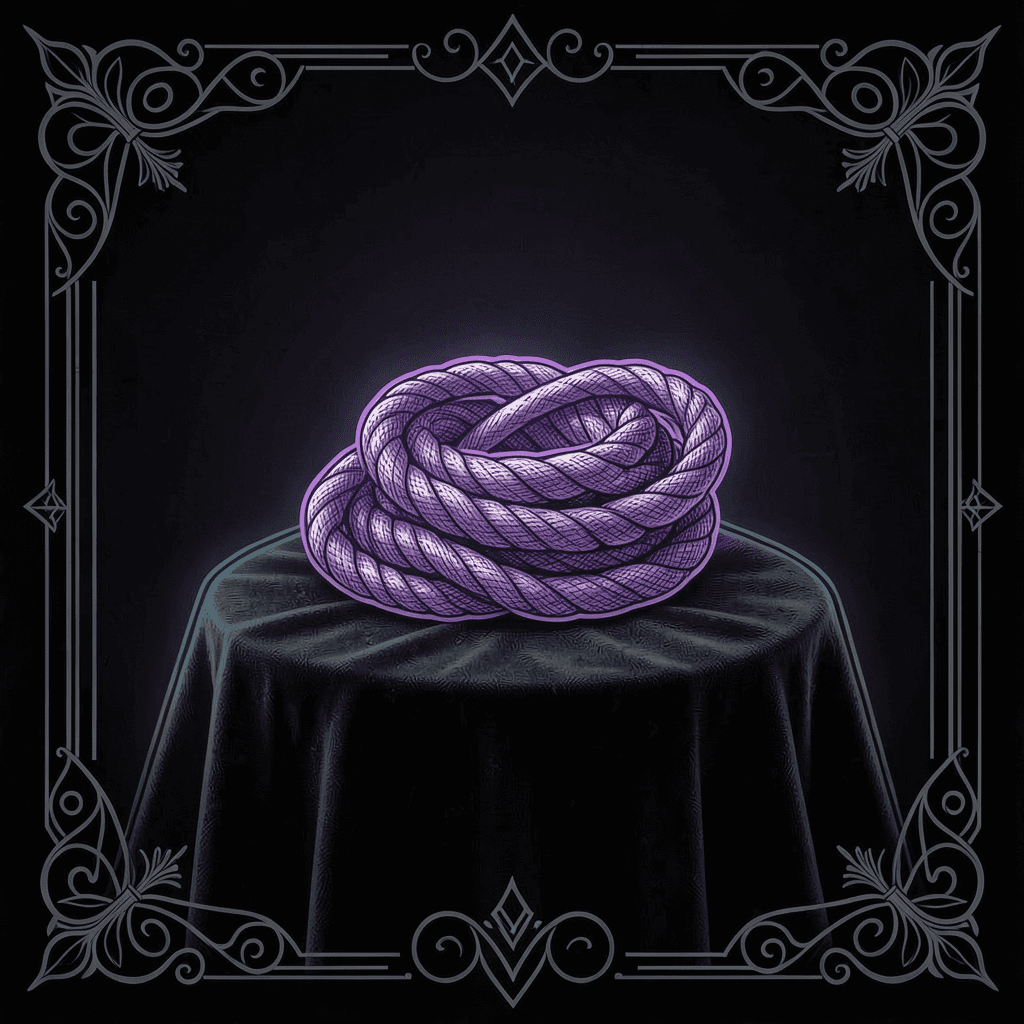
Rope dream meaning — interpretation
What it means to dream about rope: connection and support that can also become a constraint, and how traditions read this symbol.
Somnovis editorial team
A rope in a dream is defined by tension held between two states: a lifeline that supports weight and keeps someone from falling, and a binding that can just as easily restrict movement or trap. The same length of rope can mean rescue or restraint, depending entirely on how it's being used.
A strong rope holding firm — tied to something, or used to climb. A rope that holds under weight, letting the dreamer climb, cross, or stay connected to someone else, tends to reflect a real support system currently doing its job — a bond or resource the dreamer is actively relying on and finding sound.
A rope that frays, snaps, or binds too tightly. A rope that gives way under pressure, or one that restrains rather than supports, often points to a connection or obligation that has shifted from helpful to constraining — a fear of losing support at a critical moment, or of a bond that has become a trap.
A rope let down to the dreamer from above. Distinct from a rope the dreamer is holding. Help that arrives from beyond one's own reach is its own reading, and the Islamic material below is where it is most explicit.
Two people roped together. Also its own case, because a rope transmits force in both directions: whoever is held is also holding, and neither party can move without the other registering it.
A knot. The one place in the length where the line is bound to itself and will not run. Worth separating from a break — a knotted rope is intact and unusable at once.
What changes the reading. What the rope is attached to. Islamic interpretation makes this an explicit method rather than a nuance, and a rope in the hand, a rope tethering an animal and a rope with nothing on the far end are three different dreams.
What it does not mean. Nothing here reads a rope as an omen about a marriage. Chinese does have a famous cord that binds two people to each other's fate, but it is a thread rather than a rope, and it belongs to a different symbol.
Perspectives across traditions
This is the strongest and most specific Islamic material of any object in this part of the dictionary, because the rope is a Qur'anic image. حبل الله (ḥabl Allāh), the rope of God, is what the community is told to hold fast to, all of them together, and not to separate over. That is fixed text, and it makes a firm rope in this tradition an image of adherence — to religion, and to a body of people holding the same rope at the same time. A rope let go, or cut, reads inside that same image as separation rather than as accident, which is a considerably sharper reading than a bond proving unreliable.
The second attested register is covenant: the rope as pledge and contract, عهد (ʿahd) and ميثاق (mīthāq). A rope's strength is read as the soundness of an undertaking between people, and its fraying as an undertaking weakening before it visibly breaks. The two registers are close but not identical — one is about belonging and one is about a promise — and a dreamer can usually tell which was in play by whether anyone else was holding the other end.
The tradition's habitual method applies to the tool itself: a rope is read by what it is attached to and by what it is doing. A rope in the hand is a firm hold on an affair; a rope tethering an animal is a matter kept under control; a rope let down to somebody is help arriving from above their own reach. That last one is why the climbing dream reads favourably here — not because climbing is good, but because the rope was there to be climbed.
A rope only holds under tension, and it transmits force in both directions. Two people roped together are each held and each held back, which makes this the image analytical psychology reaches for when a relationship's mutuality needs to be physical rather than metaphorical: the dreamer cannot be supported by a rope without also being attached to it. A great deal of the ambivalence people report about rope dreams is that fact and not a contradiction in the symbol.
The connecting line has an amplification this school uses constantly — Ariadne's thread, laid into the labyrinth so that the return is possible. What matters in that story is not that the thread pulls anybody anywhere; it is that the thread is continuous. A line back to where one started is what makes going deeper survivable, and a dream in which the rope is paying out behind the dreamer is usually about that rather than about descent.
The knot is the third image, and the school's own vocabulary supports it without any stretching: the word complex comes from the Latin for braided together, and a complex is precisely a place in the line where the line is bound to itself and will not run. That etymology is checkable and it is not a claim about anything Jung said. It does mean that a knotted rope and a snapped one are read very differently — a break is a loss of connection, a knot is a connection that has turned back on itself.
The folk dream books do not supply a ruling for rope, and no amount of hedging turns an association into one, so this section says what the language carries instead. What 绳 carries first is not romance and not bondage — it is measurement. 绳墨 (shéngmò) is the carpenter's inked line, snapped against timber to mark a true edge, and from it 绳 acquires the sense of a standard. 准绳 (zhǔnshéng) is the ordinary modern word for a criterion, and 绳之以法 (shéng zhī yǐ fǎ), to bring somebody to account by the law, uses 绳 as a verb meaning to hold to a line. In Chinese the rope is the measure, which is a register English simply does not have for this object.
Two further associations run in the language rather than in the manuals. 绳锯木断 (shéng jù mù duàn), "a rope sawing will sever the wood", usually paired with 水滴石穿 (shuǐ dī shí chuān), "dripping water bores through stone", is the standard picture of a soft thing prevailing by persistence — an idiom about patience, not a ruling about rope dreams. And 一根绳上的蚂蚱 (yī gēn shéng shàng de màzha), "grasshoppers strung on one cord", is what people say about parties bound to each other's outcome whether they like it or not, which is the shared-fate reading of two figures tied together, stated by the culture rather than inferred from the dream.
One small mechanism explains a favourable reading that otherwise looks arbitrary: 绳 (shéng) differs only in tone from 升 (shēng), to rise or be promoted, and folk punning of this kind routinely ignores tone. That is why a rope can read toward advancement in Chinese in a way that has nothing to do with binding or support. Constraint and entanglement are the other pole and are equally present. None of these is a dream ruling, and the honest sentence is that the folk material here is associative from end to end.
Sources
The tradition sections draw on these works. That is not a claim that every sentence is a quotation from them. Authorship of the treatise attributed to Ibn Sirin is disputed. The Chinese dream manual is paraphrased: its wording differs by version, so no edition, chapter, or date is named.
- Artemidorus of Daldis, Oneirocritica (2nd century).
- Muntakhab al-Kalām fī Tafsīr al-Aḥlām, the dream book attributed to Ibn Sirin.
- Zhou Gong Jie Meng (周公解梦).
- C. G. Jung, Man and His Symbols (1964), and the Collected Works.
Was your dream different?
Tell us exactly what you saw — our deeply trained AI will work through every detail and nuance of your specific dream.
Get a personal reading