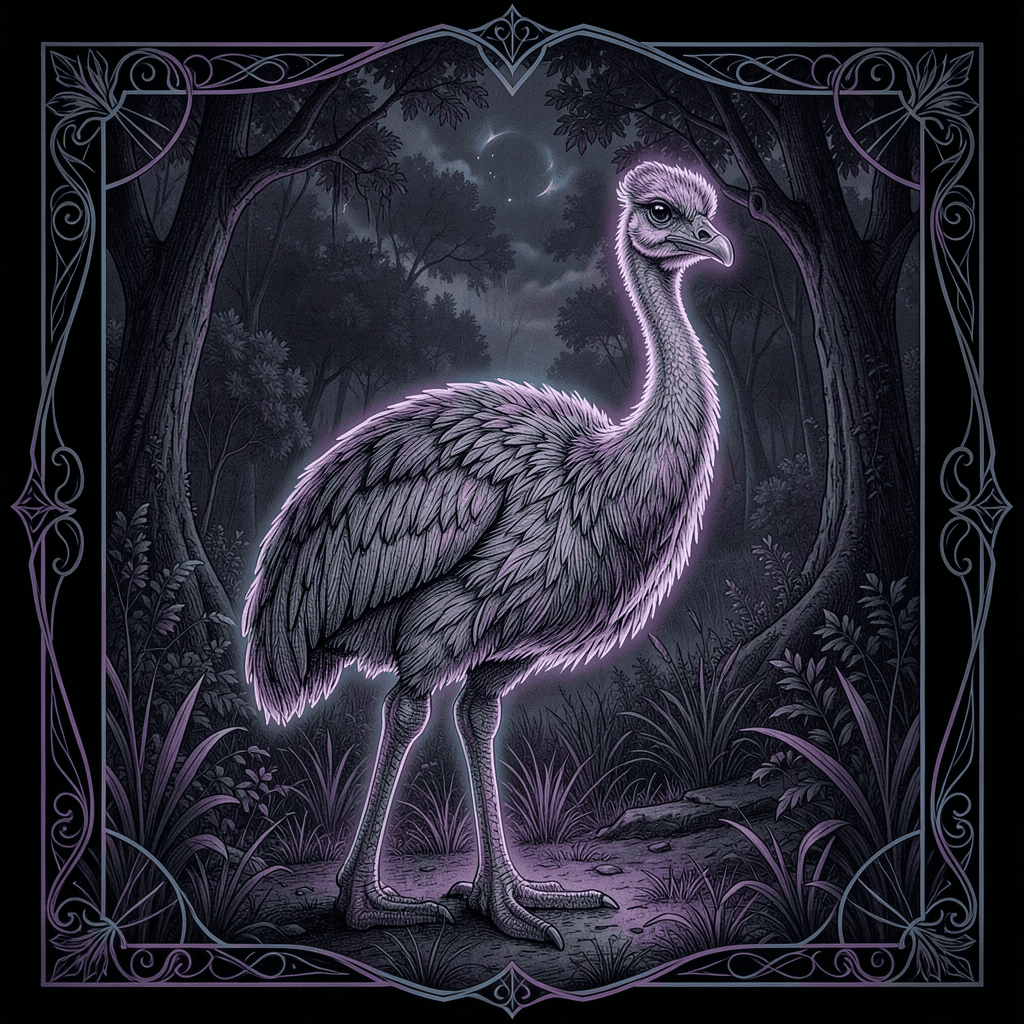
Ostrich dream meaning — interpretation
What it means to dream about an ostrich: avoidance of a hard truth, paired with real speed once it commits to running.
Somnovis editorial team
An ostrich's dream meaning plays on two contradictory facts about the same bird: the folk image of burying its head to avoid danger, and the literal reality of being among the fastest runners on land once it actually commits to moving. The dream tends to turn on which of those two the dreamer is currently living out.
An ostrich burying its head, refusing to look at what's coming. An ostrich hiding from a visible threat rather than confronting it often reflects the dreamer's own avoidance of a truth that feels too large to face directly, at least for now.
An ostrich running at full speed across open ground. An ostrich committing to outright flight, covering distance faster than seems possible for a bird that size, tends to point to real capability the dreamer has to escape or outrun a difficulty, once they stop hiding from it and actually act.
An ostrich that cannot fly, in a dream where flight was what was needed. Its own case, and the one the Islamic material below reads most directly: a bird that cannot take the route birds take is not a failed bird, it is a bird that arrives by ground.
An ostrich with its neck flat along the earth. Worth separating from the buried head, because this one the bird actually does. It is a real behaviour that a distance and a bad angle turned into the most famous false thing anybody believes about this animal.
What changes the reading. Whether the dream's ostrich was hiding or waiting. The same posture serves both, and the traditions below do not agree on which is the default.
What it does not mean. Nothing here is a claim about ostrich behaviour. The head-burying is a European invention and the sections below say so; a dreamer's ostrich is drawing on the belief, not on the bird.
Perspectives across traditions
One thing needs correcting before anything else: the ostrich is a bird of Arabia, and articles that explain its absence from the corpus by geography are simply wrong about the animal. The Arabian ostrich ranged across the peninsula and the Syrian desert until the middle of the twentieth century, its eggshell turns up routinely in the region's archaeology, and the نعامة (na'āma) is a stock figure of pre-Islamic poetry, where the male bird supplies one of the standard similes for speed. This is not a foreign creature to the culture the classical dream corpus came out of.
What can honestly be said about the readings is narrower. No fixed manual entry is quoted here, and no named interpreter is invoked. What the tradition works from, when it reads a creature, is what the creature plainly is — and this bird is two things at once: extremely fast on the ground, and unable to fly. A bird that cannot take the route birds take, and outruns everything on the route it does take, reads as capacity that will not arrive by the expected means and will arrive by another. That is a reading about method rather than about avoidance.
The caution against hiding from a matter, which is what usually gets written here, is available within this tradition's general habit of reading a fleeing animal — but it is worth noticing that it comes from the European head-burying belief rather than from the bird, and that the tradition which actually knew this animal in the wild described it as fast rather than as cowardly.
Analytical psychology reads the buried head as the plainest available image of a defence: something already registered, and deliberately not looked at. The energy the defence costs is the point — holding a perception out of awareness is work, and it is the same work that would have resolved the situation had it been spent forward instead. The dream is not usually asking the dreamer to be braver; it is showing them where their effort is going.
The animal makes the second half of that unusually literal, because the ostrich is genuinely fast — the fastest bird on land, and capable of outrunning most things that chase it. The same body that supplies the image of not-looking supplies the image of the escape actually being available. That is a rare thing for a symbol to do, and it is why this bird carries the reading better than a more obviously frightened animal would.
The burying itself is a European invention with a datable origin. Pliny the Elder, in the Natural History, wrote that ostriches push their head and neck into a bush and imagine the rest of them is hidden, and the commonplace has run from there through every European language since. The bird does not do it. What it does do is put its head to the ground to feed and to swallow grit, turn its eggs in a ground nest with its beak, and flatten its neck along the ground when threatened — which at a distance looks like a bird with no head. So the image the dreamer inherits is a real misreading of a real behaviour: something observed correctly and explained wrongly, which is also a fair description of a defence.
The ostrich is not native to China and the folk dream material has no entry for it. It arrived as a marvel rather than as an animal of the countryside, and the name it arrived under records exactly that: 鸵鸟 (tuóniǎo) is "camel bird", the same construction as the Greek and Latin names and the Persian one. Every language that met this bird from outside reached for the camel, which tells a reader when the animal entered the language and how.
The only fixed Chinese expressions for it are modern and borrowed. 鸵鸟心态 (tuóniǎo xīntài), "ostrich mentality", and 鸵鸟政策 (tuóniǎo zhèngcè), "ostrich policy", are both current and both mean wilful avoidance — and both are calques of the European belief described above rather than native observation. A Chinese speaker recognises the phrase immediately; the folk manuals do not contain the bird at all. That gap between recognition and coverage is the honest description of this section.
What Chinese does have natively for the same idea is a much older story and a better one: 掩耳盗铃 (yǎn ěr dào líng), "covering one's own ears to steal a bell", the thief who stops his ears so as not to hear the bell he is stealing and reasons that nobody else will hear it either. That is self-deception described from the inside, without any animal in it, and it is what a Chinese reader has to hand for this dream. It is an idiom about a person's reasoning and not a ruling about a dreamed bird, and the distinction is worth keeping.
Sources
The tradition sections draw on these works. That is not a claim that every sentence is a quotation from them. Authorship of the treatise attributed to Ibn Sirin is disputed. The Chinese dream manual is paraphrased: its wording differs by version, so no edition, chapter, or date is named.
- Artemidorus of Daldis, Oneirocritica (2nd century).
- Muntakhab al-Kalām fī Tafsīr al-Aḥlām, the dream book attributed to Ibn Sirin.
- Zhou Gong Jie Meng (周公解梦).
- C. G. Jung, Man and His Symbols (1964), and the Collected Works.
Was your dream different?
Tell us exactly what you saw — our deeply trained AI will work through every detail and nuance of your specific dream.
Get a personal reading