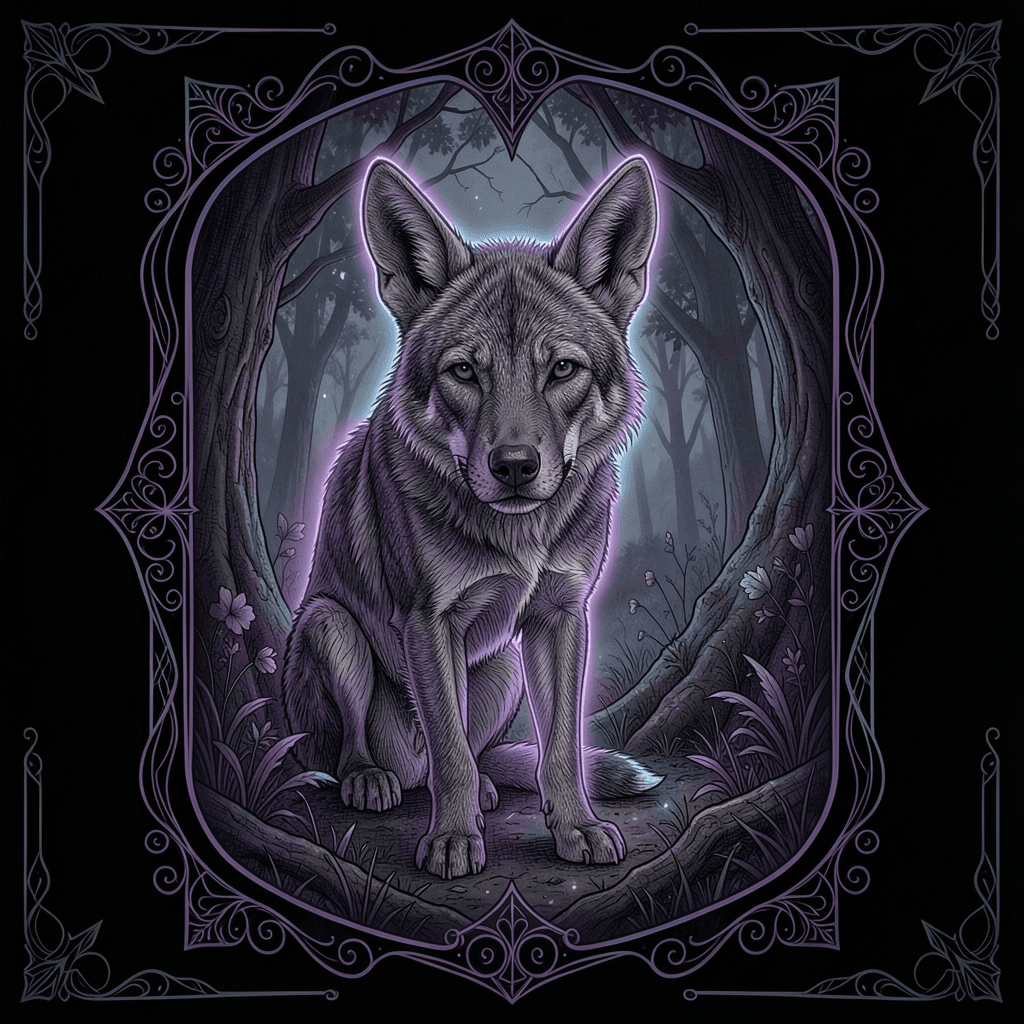
Hyena dream meaning — interpretation
What it means to dream about a hyena: scavenger, misheard laughter, foolish treachery — not the wolf's material.
Somnovis editorial team
A hyena in a dream is defined by two things it is not: it is not a hunter in the open sense the wolf is, and it does not laugh. The animal arrives to what is already dying rather than to what is fleeing, which places it at a specific point in the food chain the wolf and the lion do not occupy; and the vocalisation the tradition named "laughter" is a specific signal of agitation, not amusement, and the misreading of it is the whole of what makes the animal uncomfortable to the human it dreams itself into. A hyena dream is often working on both of those facts at once.
A lone hyena, "laughing". More accurately, uttering the signature call that reads to a human as laughter — belongs to the specific case of feeling ridiculed by something whose attention the dreamer cannot quite return. The animal is not attacking; it is watching, and the discomfort is that the watching is being described by a sound the dreamer cannot correctly interpret.
A pack of hyenas scavenging. Opportunism at scale, and the specific dread of being circled by something that will not attack but will not leave, either.
A hyena that is genuinely threatening. Teeth bared, bite delivered — reads not through mockery but through the hyena's actual biology: one of the strongest bite forces of any mammal by size. A dream that lets the hyena bite is a dream about a small, mocking-feeling threat that turns out to have real teeth.
Perspectives across traditions
The classical Islamic corpus has substantial material on the hyena. The striped hyena (الضَبع, al-ḍab') was native to Arabia, is named in pre-Islamic poetry, and appears in the dream manuals as a specific figure — usually a foul or foolish person, often gendered feminine in the material (a stupid woman, an ugly wife), and sometimes read as a night thief or as a treacherous associate whose foolishness is precisely what makes them dangerous. The reading is not thin, and reducing it to "a scavenger by analogy" understates a corpus that already reads the animal in detail.
The Arabic language itself does the material's specific work. ضَبع is hyena and also names the upper arm — the joint whose strength is what the hyena is known for — and folkloric material the dream tradition inherits attests that a hyena can be flushed from its den by lulling music: the animal's characteristic weakness is a specific gullibility, and the tradition reads that as the reading. A dream of the hyena is therefore not a dream of a strong enemy; it is a dream of a foolish one whose harm is real because the foolishness cannot be reasoned with.
Where the crow reads toward a bold, disreputable figure, the hyena reads toward a foolish, treacherous one — and the two are not interchangeable. Readings of the shape "hyena as foul or foolish figure" are standard in classical compilations; no named compiler is cited for a fixed gendering or a music-luring saying as a dream ruling. The live English reading of a treacherous or deceitful person remains compatible; what is added is the tradition's specific gloss of the harm as foolishness rather than cunning.
Analytical psychology reads the hyena as one of the sharper shadow figures in the animal repertoire, and its specific register is what makes the reading precise rather than generic. A shadow figure is disowned material given a form the ego does not want to recognise as belonging to it; the hyena is that material given the specific form of something that takes what is left over. What the shadow the hyena figures usually names is the dreamer's own capacity for opportunism — not the appetite for what they built, but the appetite for what somebody else built and abandoned, and the readiness to arrive at it without doing the earlier work.
The reading is compensatory in the school's usual sense. To a person who has been holding themselves at a distance from the opportunistic move — refusing what they might legitimately take because the taking would feel unseemly — the dream that stages a hyena is often the psyche returning to them the fact of the appetite itself, which the school does not treat as shameful and treats as harder to work with when it is denied. The mockery in the animal's projected laugh is more often the ego's own contempt for the appetite than an attribute of the figure.
Two facts about the animal are worth having exact rather than metaphorical. The vocalisation Europeans named "laughter" is associated with subordinate animals under stress and with food-competition, not with amusement — the sound reads as mockery only because it was misheard, and the shadow figure inherits the mishearing. And the spotted hyena is matriarchal, socially complex, and hunts its own prey as often as it scavenges — a fact that undoes most of the European folkloric reading of the animal, but the dream image is working with the folklore rather than with the biology, and a section that insists on the biology at the expense of the image misses what the dream was doing.
The hyena is not native to China and the classical Chinese tradition has no dream material on it. This is a straightforward fact and the honest section is short: the animal enters modern Chinese usage as 鬣狗 (liè gǒu, "mane dog") or 土狼 (tǔ láng, "earth wolf"), both descriptive coinages rather than classical figures, and neither carries a compilation entry.
What a Chinese reader may bring to the dream extends from the readings the classical tradition does have on the animals around it. Wild dogs and jackals (犬 and 豺) carry a light-unfavourable reading in the manuals — the animal that arrives to what is dying, the pack that circles what is weak — and the hyena reads inside that extension rather than inside an entry of its own. The wolf material is deeper and belongs on the wolf page; a hyena is not a wolf, and the tradition treats them differently even where it does not treat the hyena at all. Saying plainly that the tradition does not carry the animal is more credible than inventing coverage.
Sources
The tradition sections draw on these works. That is not a claim that every sentence is a quotation from them. Authorship of the treatise attributed to Ibn Sirin is disputed. The Chinese dream manual is paraphrased: its wording differs by version, so no edition, chapter, or date is named.
- Artemidorus of Daldis, Oneirocritica (2nd century).
- Muntakhab al-Kalām fī Tafsīr al-Aḥlām, the dream book attributed to Ibn Sirin.
- Zhou Gong Jie Meng (周公解梦).
- C. G. Jung, Man and His Symbols (1964), and the Collected Works.
Was your dream different?
Tell us exactly what you saw — our deeply trained AI will work through every detail and nuance of your specific dream.
Get a personal reading