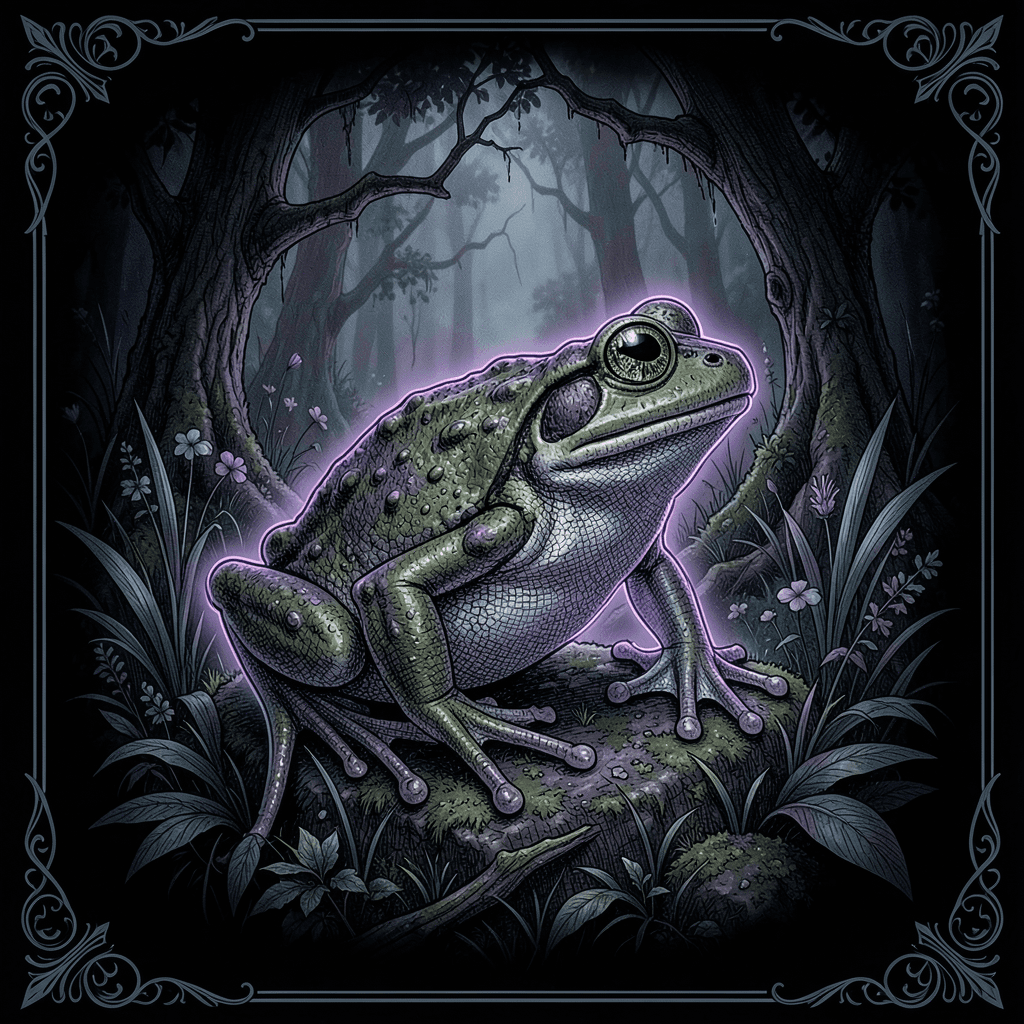
Frog dream meaning — interpretation
What it means to dream about a frog: transformation, fertility, or an uneasy transition — and how traditions read it.
Somnovis editorial team
A frog's life passes through the most complete change of form in the ordinary animal world, which is why it is so often read as a symbol of transformation — but the transformation has a cost the butterfly's does not, and the readings below make more of that than of the change itself.
A frog in clean water, or one that leaps well. Generally read toward a transition going smoothly — movement between two stages without getting caught in between.
A frog that seems trapped, or an overwhelming chorus of croaking. Points toward a transition the dreamer feels stuck inside, unable to leave one stage or arrive at the next.
A frog entering the house. Read concretely, and in opposite directions, by the folk material below — worth knowing before assuming it is a good sign.
A frog the dreamer finds repellent. Worth its own line: in the folktale material the reflex of disgust is the marker rather than an obstacle.
Frogs in great number. A different reading from one frog, and in one tradition below an opposite one.
What changes the reading. How many there were, and whether the water was clean. The toad is a separate animal with a separate register and its own article.
What it does not mean. Not a fertility sign, and not an omen of money on its way; one tradition below reads a plague of them as affliction outright.
Perspectives across traditions
The tradition holds more than one thing about this animal, and the plurality is itself the honest answer. Some strands read the frog through its noise, as a person who talks a great deal without much substance, and that is the strand a reader is likeliest to meet first. Other strands hear the same ceaseless croaking as ceaseless remembrance, and read the frog accordingly as a devoted worshipper. Neither is presented here as the stronger, the older or the correct one: the same sound is heard as empty chatter by one strand and as unbroken devotion by another, which is a genuine feature of the material rather than a hedge around it. The tradition's protection of the animal — a well-known report forbidding the killing of frogs — belongs beside them, and makes the favourable strand intelligible without establishing it.
Against both stands the frog as affliction, and here the tradition's own scripture supplies the image: the frogs among the signs sent against Pharaoh, in al-Aʿrāf. Frogs in great number, a house overrun, read toward torment. So one frog and a plague of them are opposite readings inside the same tradition, which is unusually clean as an axis — number does more work here than any quality of the animal.
The frog's metamorphosis is the most complete in the ordinary animal world: gills to lungs, the tail reabsorbed rather than shed, an animal that ends up unable to live where it began. Analytical psychology reads that as development that costs the earlier form — the tadpole is not left behind somewhere, it is consumed, and there is no returning to it. That is a more exact reading than transition, and it is what distinguishes this image from the butterfly, where the chrysalis preserves a discontinuity the frog's slow reabsorption does not.
The second reading is the folktale one, and it is the frog's strongest Western amplification: the frog who must be taken to the table and into the room before it changes. The school reads that as a shadow-figure whose transformation depends on being admitted rather than defeated — and the reflex of disgust these dreams so often carry is itself the marker rather than an obstacle to be got past. The shadow article carries the disowned material as such; the point here is narrower and more practical, which is that what changes is what is let in.
The folk material gives readings of the shape, hedged and paraphrased, that frogs in the water or croaking across the fields portend a wet, productive season and provision; that a frog entering the house is read in opposite directions, in some shapes toward a guest arriving and in others toward quarrels and sharp words; and that killing or eating one is unfavourable. The association between frog-song and a good season is a common one in agrarian folk material — a folk association rather than a rule the books hand down — and there is no single fixed proverb for it, since the weather sayings about frogs vary from place to place; this page states the association in prose and quotes none of them. (A folk pun pairing the word for frog with the word for a small child is reported in some accounts and would attach to the house-entering shape; it crosses a tone boundary, and no fertility reading is built on it here.)
There is a distinction here that the language makes and speakers constantly ignore: Chinese separates the frog from 「蟾蜍」 (chánchú, the toad), and the two carry different registers entirely. The wealth-toad and the moon-toad are the toad's, and so is the most famous phrase a reader will bring to this page, 「癞蛤蟆想吃天鹅肉」 (lài há ma xiǎng chī tiān é ròu, the toad wants to eat swan flesh) — a toad phrase, and the toad has its own article. Running the two animals together is how a frog reading ends up promising money. What the frog proper owns is 「井底之蛙」 (jǐng dǐ zhī wā, the frog at the bottom of the well), its most famous appearance in the language and the one the well article glosses in full — the two pages approach it from opposite ends, and only one of them should carry the explanation.
Sources
The tradition sections draw on these works. That is not a claim that every sentence is a quotation from them. Authorship of the treatise attributed to Ibn Sirin is disputed. The Chinese dream manual is paraphrased: its wording differs by version, so no edition, chapter, or date is named.
- Artemidorus of Daldis, Oneirocritica (2nd century).
- Muntakhab al-Kalām fī Tafsīr al-Aḥlām, the dream book attributed to Ibn Sirin.
- Zhou Gong Jie Meng (周公解梦).
- C. G. Jung, Man and His Symbols (1964), and the Collected Works.
Was your dream different?
Tell us exactly what you saw — our deeply trained AI will work through every detail and nuance of your specific dream.
Get a personal reading