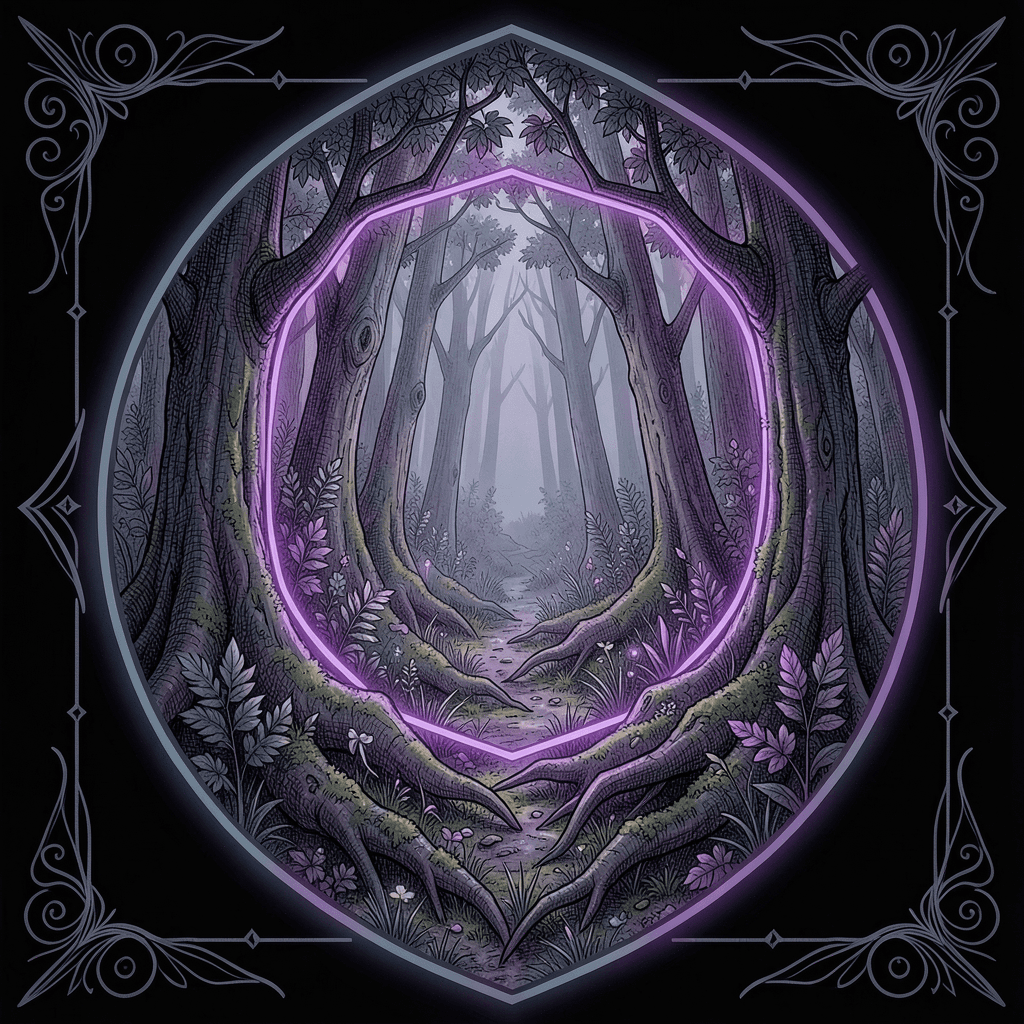
Forest dream meaning — interpretation
What it means to dream about a forest: getting lost among the trees, finding a clearing, and different traditions' views.
Somnovis editorial team
A forest in a dream is a symbol of the unknown that surrounds and presses in — dense, disorienting, and full of things not yet seen clearly. Unlike open landscapes, a forest limits the dreamer's view to what's immediately in front of them, which is usually the point: something in waking life resists being taken in all at once.
Lost among dense, dark trees. Wandering without a visible path or landmark is one of the most common versions of this dream, and typically reflects a situation the dreamer feels they're navigating without enough information — a decision made one step at a time, with no wider view available.
Reaching a clearing or the forest's edge. Suddenly finding open space, light, or a way out is usually read as relief following a long stretch of uncertainty — not necessarily a resolution, but the first sign that one is close.
A forest with paths, or without. A marked path that gives out half-way, a trail the dreamer trusts, or trackless undergrowth are three different dreams — the path is the part of the forest other people made, and its presence or failure usually mirrors how much of the current situation comes with any map at all.
What changes the reading. Density, light and edge do the work: an open wood the dreamer can see through, a treeline entered deliberately, a forest that has simply surrounded them without a remembered way in. What lives in the forest matters too — a forest with eyes in it is a different image from an empty one, and the psychological reading below turns on exactly that point.
What it does not mean. A forest dream is not a verdict of being lost in life, and reaching no clearing before waking is not a bad ending — the dream is usually a report on visibility, not on progress. Nothing below reads the forest as a place the dreamer should not have entered.
Perspectives across traditions
The forest as such is thin in the classical corpus — the tradition's landscapes are desert, oasis, garden and cultivated field, and the dense wood of northern imagination is not among its standing entries. What the corpus supplies is borrowed from adjacent registers, and this section is honest about the borrowing. Trees read toward men — gathered trees as gathered men, a tree by its kind and its fruit, as the tree article sets out — so a forest can be read, hedged, as men in number: a crowd, a tribe, a market of dealings in which the dreamer moves among many. And wilderness reads toward exposure: ground outside the ordered camp, where provision and protection are not arranged.
Held together, hedged, they give a forest dream a workable shape inside the tradition: among many and outside order at once — dealings entered without full knowledge, in company that has not been chosen one by one. Emerging onto open ground reads as relief in this register, a matter clarifying. But the honest statement stands first: the classical interpreters wrote no forest entry, and what this section applies is their method at its edges.
This is the image the school reads as territory, and the reading is the strongest of the three here. The tree article treats the single tree — rooted, individual, a life in cross-section; the forest is the other thing: the unconscious as terrain, entered rather than owned. Its properties are the reading. It is older than the dreamer and indifferent to them; its paths exist only partway, made by others for other errands, and give out precisely where the familiar does; its treeline is a real edge — the visible boundary of the known self, crossed in one step and only noticed once it is behind you. Being lost here differs from being lost in a city, the register the being-lost article carries: a city is made of intentions, a forest is not, and its disorientation has no one to blame.
And the forest adds cover: things live in it. The dream-forest is inhabited before the dreamer arrives — watched-feeling, rustling at the edge of sight — and analytical psychology reads that population as the point: contents not yet met, living where the light does not organise things. A clearing in this register is exactly what it is in the terrain — a bounded openness inside the unknown, where what has been following can finally be seen. The dream's useful questions are territorial ones: how far in, along whose path, and what was glimpsed between the trees.
The traditional dream books read the wood by its condition, hedged as always: a green and flourishing forest toward vitality and gathering fortune, a withered or burnt one toward decline — the shapes are brief, and the language around them carries more. 「独木不成林」 (dú mù bù chéng lín, one tree makes no forest) is the register's first phrase: one strength is not enough, the call to combine — the natural reading for dreams that contrast a lone tree with the mass, and for dreamers carrying something alone that wants allies. 「林子大了,什么鸟都有」 (línzi dà le, shénme niǎo dōu yǒu, in a big enough forest there is every kind of bird) holds tolerance and wariness in one saying: all kinds exist where the gathering is large — the reading for crowded forest dreams, where the point is the variety of what the dreamer has walked in among, for good and ill at once.
「深山老林」 (shēn shān lǎo lín, deep hills, old forest) is the standing term for the far interior — the place where ordinary rules thin out, beyond administration and neighbours — and it names the register of dreams that go deep: the further in, the less the village's logic applies. Between them the three phrases give the folk reading its frame: the forest as the social world at scale — combination, variety, and a depth at which the ordinary no longer governs.
Sources
The tradition sections draw on these works. That is not a claim that every sentence is a quotation from them. Authorship of the treatise attributed to Ibn Sirin is disputed. The Chinese dream manual is paraphrased: its wording differs by version, so no edition, chapter, or date is named.
- Artemidorus of Daldis, Oneirocritica (2nd century).
- Muntakhab al-Kalām fī Tafsīr al-Aḥlām, the dream book attributed to Ibn Sirin.
- Zhou Gong Jie Meng (周公解梦).
- C. G. Jung, Man and His Symbols (1964), and the Collected Works.
Was your dream different?
Tell us exactly what you saw — our deeply trained AI will work through every detail and nuance of your specific dream.
Get a personal reading