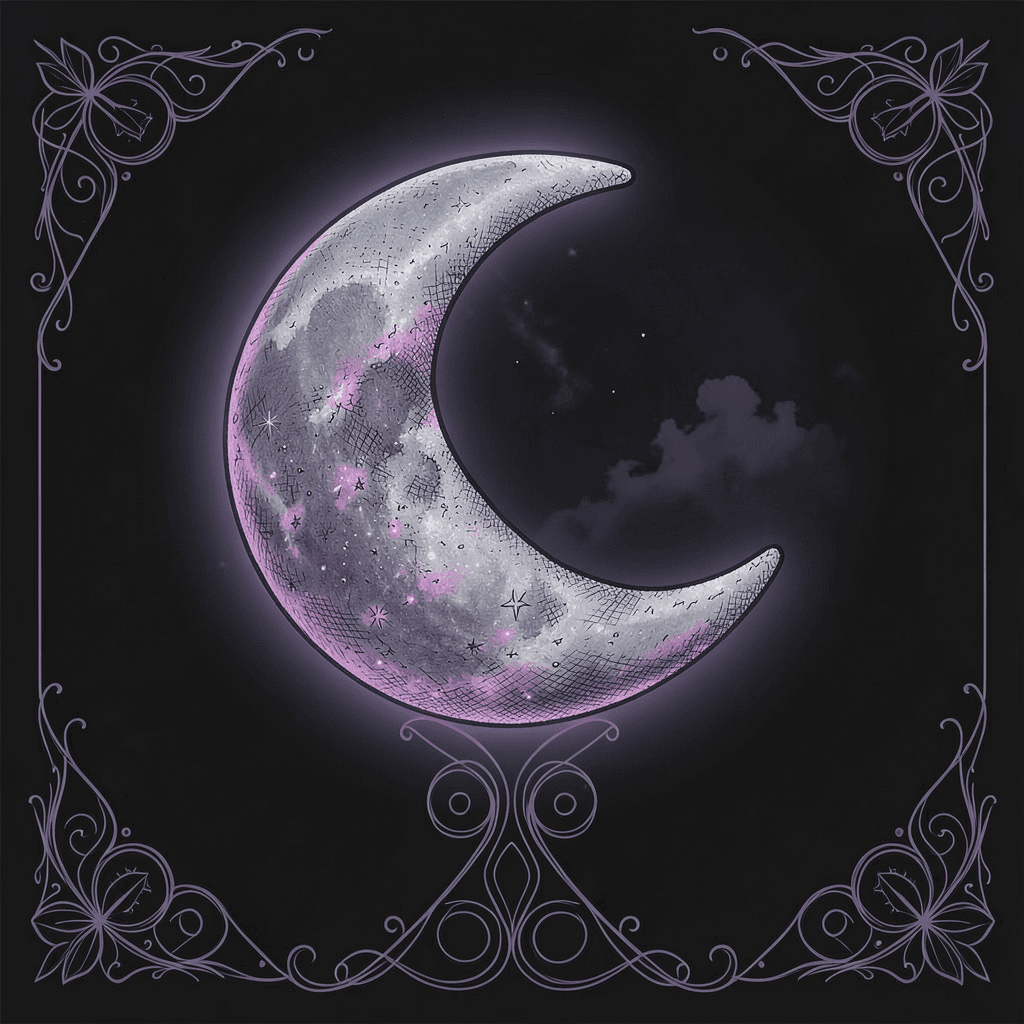
Moon dream meaning — interpretation
What it means to dream about the moon: a full moon, a hidden or new moon, and how different traditions interpret this symbol.
Somnovis editorial team
The moon in a dream speaks in a different register than the sun: quieter, more inward, tied to what changes gradually and is best seen indirectly. Where the sun stands for clarity and outward will, the moon is more often linked to intuition, emotion, and the parts of the self that only show themselves by degrees.
A bright, full moon. A full moon lighting the whole scene is usually read as a sign of emotional clarity or a cycle reaching its peak — feelings that have been building are finally fully visible, for better or worse.
A hidden, dark, or waning moon. A moon that is obscured, sliver-thin, or absent altogether tends to point to intuition the dreamer is currently ignoring, or an emotional truth not yet ready to surface into full awareness.
What changes the reading. The phase is the reading, to a degree unusual among dream symbols: full, new, waning, eclipsed and absent moons are five different dreams in every tradition collected here. Whether the moon can be seen at all matters as much as its shape — a moon hidden by cloud is not a dark moon — and a moon that falls or breaks is its own, far sharper image.
What it does not mean. A moon dream is not a statement about the dreamer's gender or anyone else's, however often the moon is culturally coded feminine — a point one tradition below makes explicitly. Nor is a waning moon a countdown to anything: it is an image of something in decline or in transition, read against the dreamer's own affairs rather than against a calendar.
Perspectives across traditions
In the dream of Joseph in Surah Yusuf — given in full in this site's article on the sun — the moon is read as the mother, and that placement colours the whole classical reading: the moon is a person of standing and nearness, read by its phase and its light. A full moon is read favourably, as a matter at its clearest or a person of beauty and standing; a waning or darkened moon as decline; a moon that cannot be seen as guidance withheld. The corpus's habit of reading the moon's state rather than its mere presence is consistent — the same object carries opposite readings at opposite ends of its cycle.
One practical fact gives the moon a weight in this tradition that it does not have in solar-calendar cultures: the Islamic calendar is lunar, and the sighting of the new moon is what tells the community when the month — and Ramadan, and the festivals — begins. The moon here is not only a symbol; it is an instrument the whole community actually consults, and that standing carries into how seriously its appearances in dreams are taken.
In a Jungian reading the moon carries the reflective, receptive, cyclical mode of the psyche — knowledge that arrives indirectly, in phases, by reflection rather than by direct application. The pairing with the sun is the alchemical Sol and Luna, whose union Jung worked on at length in his alchemical writing; the moon's side of that pair is the mode of consciousness that receives and mirrors rather than orders and asserts. A moon dream is commonly read as that mode announcing itself: something in the dreamer's life currently graspable only sideways, by watching how it changes.
A caution this article states rather than implies: analytical psychology does associate the lunar mode with the anima and with receptive consciousness, but a dream moon is not a statement about the dreamer's gender, and the older habit of flatly equating moon with the feminine deserves to be retired rather than repeated. The image is about a way of knowing and a rhythm of change — available to anyone — and about where in the cycle the dreamer's own matter currently stands.
The governing association is reunion. 「月圆人团圆」 (yuè yuán rén tuán yuán, when the moon is full, people are reunited) ties the full moon to family gathering, and the Mid-Autumn Festival is built on exactly that — mooncakes, the full moon, and the absent relative looking at the same moon somewhere else. Chang'e (嫦娥), who ascended to the moon and stayed, gives the image its other face: the moon as the place of a separation that cannot be undone. 「花好月圆」 (huā hǎo yuè yuán, flowers fine, moon full) is the standard phrase for things being as good as they get, and it belongs to the same register.
The dream books are blunter than the associations. They give readings of the shape: a full moon portends a matter completed; a new moon portends a new turn of fortune; the moon setting or falling portends loss of position, or trouble for a parent; and — as with the sun — the moon entering the breast portends bearing a distinguished child, an entry reported here strictly as what the tradition holds, with nothing in it meaning a dream can reveal anything about an actual pregnancy or child. The pattern across the entries is plain rather than poetic: a full, bright moon reads favourably; a waning, cold or fallen one does not.
Sources
The tradition sections draw on these works. That is not a claim that every sentence is a quotation from them. Authorship of the treatise attributed to Ibn Sirin is disputed. The Chinese dream manual is paraphrased: its wording differs by version, so no edition, chapter, or date is named.
- Artemidorus of Daldis, Oneirocritica (2nd century).
- Muntakhab al-Kalām fī Tafsīr al-Aḥlām, the dream book attributed to Ibn Sirin.
- Zhou Gong Jie Meng (周公解梦).
- C. G. Jung, Man and His Symbols (1964), and the Collected Works.
Was your dream different?
Tell us exactly what you saw — our deeply trained AI will work through every detail and nuance of your specific dream.
Get a personal reading