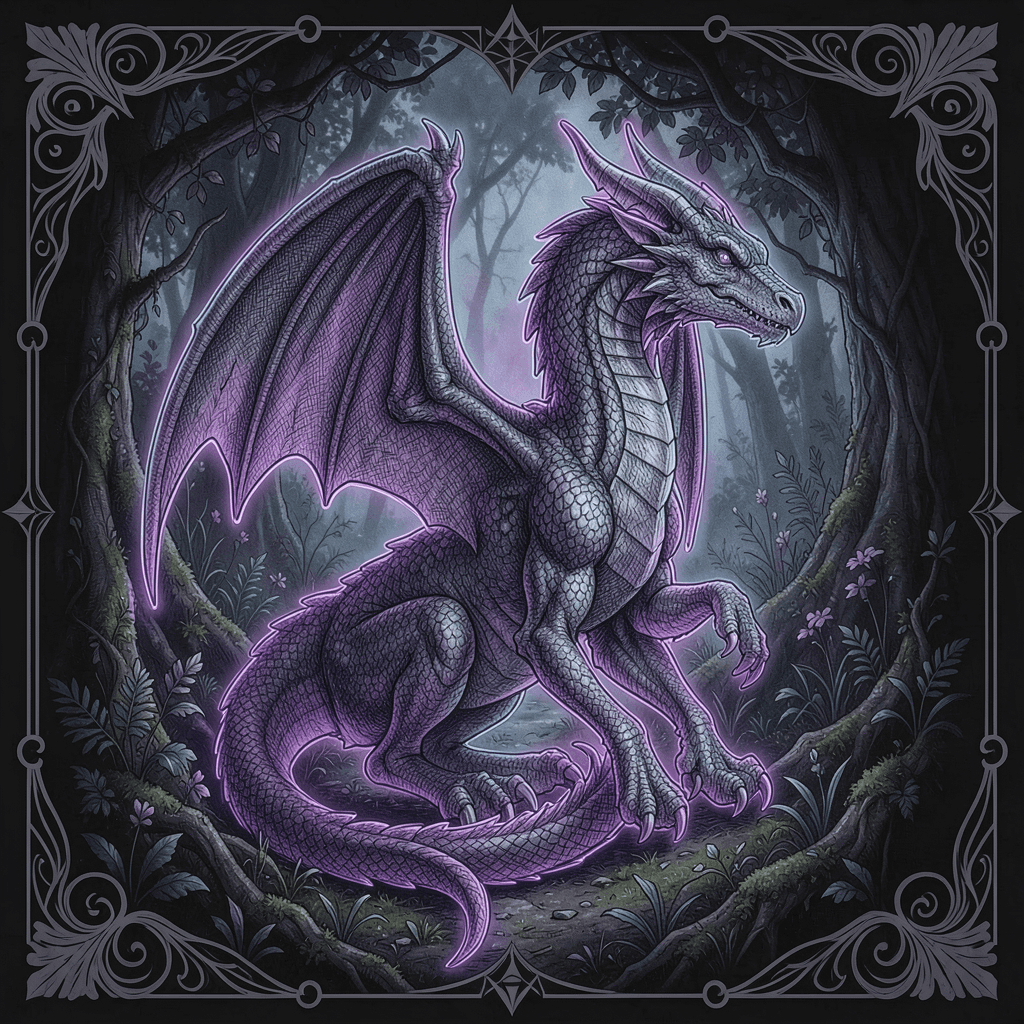
Dragon dream meaning — interpretation
What it means to dream about a dragon: raw power, hoarded treasure, and how Eastern and Western traditions read this symbol so differently.
Somnovis editorial team
Few dream symbols carry as much cultural weight in as many directions as the dragon — a creature that in one tradition guards a threat to be slain and in another embodies the very source of good fortune. What the dragon is doing, and how the dreamer feels toward it, matters more here than for almost any other animal symbol.
A dragon guarding treasure or a hoard. A dragon coiled protectively around gold, jewels, or some other prize is usually read as a symbol of power held tightly rather than shared — the dreamer's own ambition, resources, or hard-won position, and a question of whether it's being guarded wisely or simply hoarded out of fear of loss.
A dragon in flight, commanding the sky. A dragon soaring freely, especially one the dreamer feels aligned with rather than threatened by, tends to point toward untapped personal power or authority the dreamer senses in themselves but hasn't yet fully claimed in waking life.
What changes the reading. Fought or ridden is the hinge: a dragon that must be battled and one that must be mounted are different dreams, and the difference maps almost exactly onto the two halves of the world's dragon-lore below. Direction matters too — ascending and descending dragons carry opposite registers in the material that has the most to say here.
What it does not mean. A dragon dream is not a fixed omen in either direction, and the two great traditions that read it — one as the hero's obstacle, one as the most auspicious of beasts — cannot both be flattened into a single verdict. The split itself is the information: which register the dream used is usually obvious from whether the dreamer's fear or awe was the ruling feeling.
Perspectives across traditions
Honesty first: the dragon is not a category of the classical corpus. The interpreters wrote about the creatures of their world and their texts, and a winged, hoarding, fire-breathing dragon was not among them — so this section reports a method rather than a ruling. Where the classical material meets dragon-like creatures at all, it meets them as great serpents, and the readings follow the snake's register of enmity, treated in full at the snake article: a formidable, concealed adversary, scaled up — overcoming it read as prevailing, being seized by it as being overpowered.
A reader inside this tradition can therefore read a dragon dream, but should know what they are doing: applying the serpent's logic to a larger image, by analogy, not consulting an entry the corpus contains. The magnification itself is worth something — an enemy grown to dragon size in a dream is an enmity the dreamer experiences as beyond ordinary scale — but the honest statement is that this tradition's centre of gravity for such creatures is the snake, and the dragon's own richest readings on this page belong to the other two traditions.
In a Jungian reading the dragon is the classic guardian of the treasure — the obstacle that stands exactly where the value is. The pairing is the point: dragons in myth do not guard nothing, and the school reads the dream accordingly — wherever the dragon stands, something the psyche values is behind it, and the dream's subject is less the monster than the courage required to approach. The hero's task is genuinely Jungian territory — the hero archetype is his concept — though the step from dragon to meaning stays at the school level: the fight is the ego's confrontation with what blocks its own development, and the treasure is never incidental to where the dragon chose to sleep.
But a dragon that must be fought and a dragon that must be ridden are different dreams, and the difference is the most interesting thing on this page. The fought dragon belongs to the Western register — obstacle, hoard, the test of approach. The ridden dragon belongs to the Eastern one, where mounting the dragon is ascent rather than conquest — and a Western dreamer whose dragon wanted to be ridden, not killed, has dreamed something the folk material below reads far more fluently than the hero-myth does. Which register the dream used is usually decided by the feeling: fear guards treasure, awe offers flight.
This is the most Chinese-loaded symbol in the entire dictionary, and the register leads. The folk dream books give readings of the shape a dragon portending eminence, honour and great fortune: a dragon ascending to the sky, riding a dragon upward, a dragon entering the house or coiling around the dreamer are among the most auspicious images the material has. And the books carry negative forms too — a dragon descending into a well portending loss of position, a dead dragon portending misfortune — so the honest statement is predominantly favourable, not uniformly: the manual knows a fallen dragon as well as a rising one, and direction is most of the reading. That ladder of directions is not the manual's invention: behind it stands the Yijing's first hexagram, 乾 (qián, the Creative), whose line texts climb through 潜龙勿用 (qián lóng wù yòng, the hidden dragon bides its time), 飞龙在天 (fēi lóng zài tiān, the flying dragon in the heavens) and 亢龙有悔 (kàng lóng yǒu huǐ, the dragon that overreaches has regrets) — the classical backbone beneath the manual's rising and falling dragons, in which even the most auspicious creature in the tradition can climb too high. The dragon is the imperial symbol, a zodiac sign, and favourable here where it is a monster in the West — an inversion worth stating plainly, because no other symbol on this site splits the world's dream-lore so cleanly in half.
The language carries the register into daily life. 「望子成龙」 (wàng zǐ chéng lóng, hoping the son becomes a dragon) is the standard phrase for parental ambition — reported as the phrase parents use, and never as something a dream promises about any child. 「生龙活虎」 (shēng lóng huó hǔ, live dragon, lively tiger) and 「龙腾虎跃」 (lóng téng hǔ yuè, dragons rising, tigers leaping) supply the vitality register and pair this entry with the tiger's. And for the dreamer who was afraid of the dragon, the language keeps the exact story: 「叶公好龙」 (Yè gōng hào lóng, Lord Ye's love of dragons) — the man who professed to love dragons and fled when a real one looked through his window — professed ambition meeting the real thing, which is the sharpest reading available for fearing an auspicious dragon. Beneath the idioms sits the folk-religion layer: the 龙王 (Lóng Wáng, Dragon King) is the rain-lord to whom villages prayed in drought, which keeps the dream-dragon tied to water and weather as much as to rank, and the festival calendar still marks 二月二龙抬头 (èr yuè èr lóng tái tóu, on the second of the second month the dragon lifts its head) — the spring day the dragon wakes and the rains return. The carp leaping the Dragon Gate is treated at the fish article, and the painted dragon given its eyes at the eyes article — both referenced here rather than restated, because each is its own reading in its own place.
Sources
The tradition sections draw on these works. That is not a claim that every sentence is a quotation from them. Authorship of the treatise attributed to Ibn Sirin is disputed. The Chinese dream manual is paraphrased: its wording differs by version, so no edition, chapter, or date is named.
- Artemidorus of Daldis, Oneirocritica (2nd century).
- Muntakhab al-Kalām fī Tafsīr al-Aḥlām, the dream book attributed to Ibn Sirin.
- Zhou Gong Jie Meng (周公解梦).
- C. G. Jung, Man and His Symbols (1964), and the Collected Works.
Was your dream different?
Tell us exactly what you saw — our deeply trained AI will work through every detail and nuance of your specific dream.
Get a personal reading