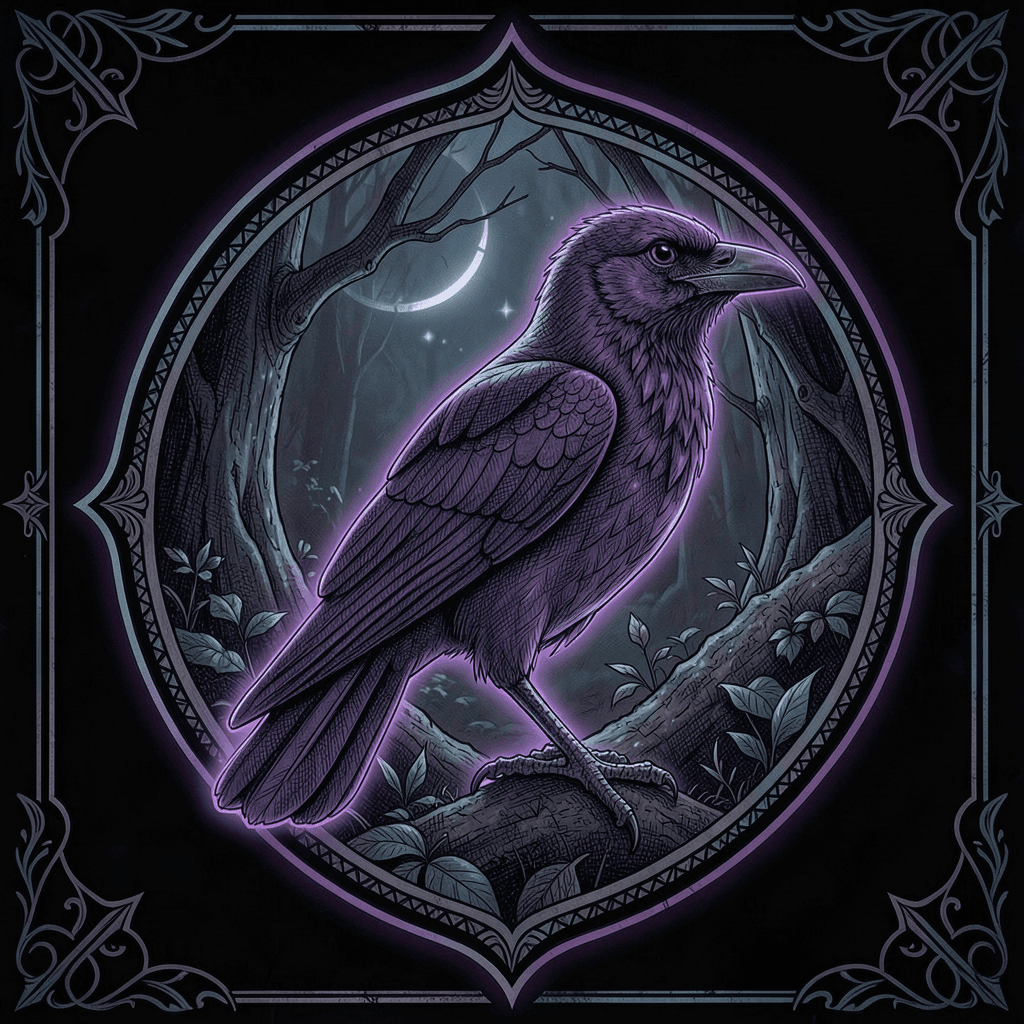
Crow dream meaning — interpretation
What it means to dream about a crow or raven: a warning, a message, or misunderstood intelligence — and how traditions interpret it.
Somnovis editorial team
A crow or raven in a dream tends to arrive as an omen more than as a character — genuinely intelligent birds long associated in folklore with warnings and news, which shapes how consistently this symbol is read across very different traditions.
A single crow watching or calling out. A lone, watchful crow is often read as a message trying to get through — a warning worth taking seriously rather than dismissing as simply an unpleasant image.
A murder of crows, or one that seems aggressive. Multiple crows, or one that behaves aggressively, more often points to a situation with several converging bad signs at once, or to gossip and rumor circling the dreamer.
What changes the reading. Number and behaviour carry most of it: one crow watching, many gathered, a crow that caws at the dreamer, one that follows. The traditions below also care what the crow does with its intelligence — a bird this clever is read as knowing something, and the dream's question is usually whether the knowledge is unwelcome, useful, or both.
What it does not mean. A crow dream is not a death omen, whatever folklore's reputation suggests — even the tradition below that reads the call as misfortune treats it as warning, not sentence. Nor does the crow identify a corrupt person in the dreamer's circle; where a tradition reads the bird as a disreputable figure, it describes a shape of conduct, and leaves the naming alone.
Perspectives across traditions
The crow is one of the strong entries in the classical corpus, and it carries two poles at once. The first is disreputable: the corpus reads the crow toward a man of corrupt and dissolute conduct — bold, grasping, untrustworthy in his dealings — so a crow at the door or in the house reads toward such a figure entering the dreamer's affairs. The bird's boldness and its scavenging habits are the features the tradition is reading; the register describes conduct, not a person, and identifies no one.
The second pole is the unexpected one, and it comes from scripture: in the account named in al-Ma'idah, a crow is sent to scratch at the ground and show Qabil how to cover the body of his slain brother — the bird as teacher of burial, arriving at the exact point where a human being did not know what to do with what death had left. That gives the crow a standing no merely disreputable animal could hold: the same corpus that reads it as a corrupt man also knows it as the creature through which a hard, necessary knowledge arrived. A crow dream inside this tradition can therefore carry either face — the warning about conduct, or the unwelcome but genuine instruction — and the dream's own tone usually says which.
The school-level reading takes the crow as a threshold bird: black-plumaged, carrion-adjacent, and conspicuously intelligent — a combination that makes it a natural carrier of shadow material, the knowing that arrives in a dark form. Analytical psychology reads birds generally as movements of the psyche between its levels; the crow's particular register is intelligence in dark plumage, and the dream-crow often carries a knowing the dreamer would rather not have — something already noticed at some level and not yet admitted upstairs.
That is why the crow's behaviour in the dream matters more than its presence. A crow that watches is knowledge waiting; one that caws insists; one that follows has attached itself to the dreamer's route and will not be outwalked. The reading's question is not how to drive the bird off but what it already knows — since in this register the crow only ever announces what is, in some corner of the psyche, already the case.
The bird article on this site already carries the base line of this register — 乌鸦叫,祸事到, the crow calls and the disaster arrives — and this page extends it rather than repeating it: the crow's call is the classic inauspicious sound of the folk material, and a cawing crow in a dream inherits that weight. What the crow's own page adds is the language built around exactly that reputation. 「乌鸦嘴」 (wūyā zuǐ, a crow's mouth) is the standing phrase for the person whose spoken misfortunes come true — the jinx — and it is the natural reading for a dream of a speaking or insistently cawing crow: speech that makes the feared thing arrive. 「天下乌鸦一般黑」 (tiānxià wūyā yībān hēi, all crows under heaven are equally black) reads corruption as general rather than local — the register for dreams of many crows, where the point is not one bad actor but a whole field of them.
Then the counter-pole, which tends to surprise a Western reader: 「乌鸦反哺」 (wūyā fǎnbǔ, the crow feeds its parents back) — the classical emblem of filial return, the grown bird bringing food to the parents that raised it. It gives the crow its one genuinely warm register, and a dream of a crow feeding or tending another can be read there: care returned to where care came from. The traditional dream books' own crow shapes run unfavourable and are reported hedged — the material circulates in many versions — but the spread of the phrases is the honest picture: the same black bird carries the jinx, the general verdict on human greed, and the culture's favourite image of gratitude.
Sources
The tradition sections draw on these works. That is not a claim that every sentence is a quotation from them. Authorship of the treatise attributed to Ibn Sirin is disputed. The Chinese dream manual is paraphrased: its wording differs by version, so no edition, chapter, or date is named.
- Artemidorus of Daldis, Oneirocritica (2nd century).
- Muntakhab al-Kalām fī Tafsīr al-Aḥlām, the dream book attributed to Ibn Sirin.
- Zhou Gong Jie Meng (周公解梦).
- C. G. Jung, Man and His Symbols (1964), and the Collected Works.
Was your dream different?
Tell us exactly what you saw — our deeply trained AI will work through every detail and nuance of your specific dream.
Get a personal reading