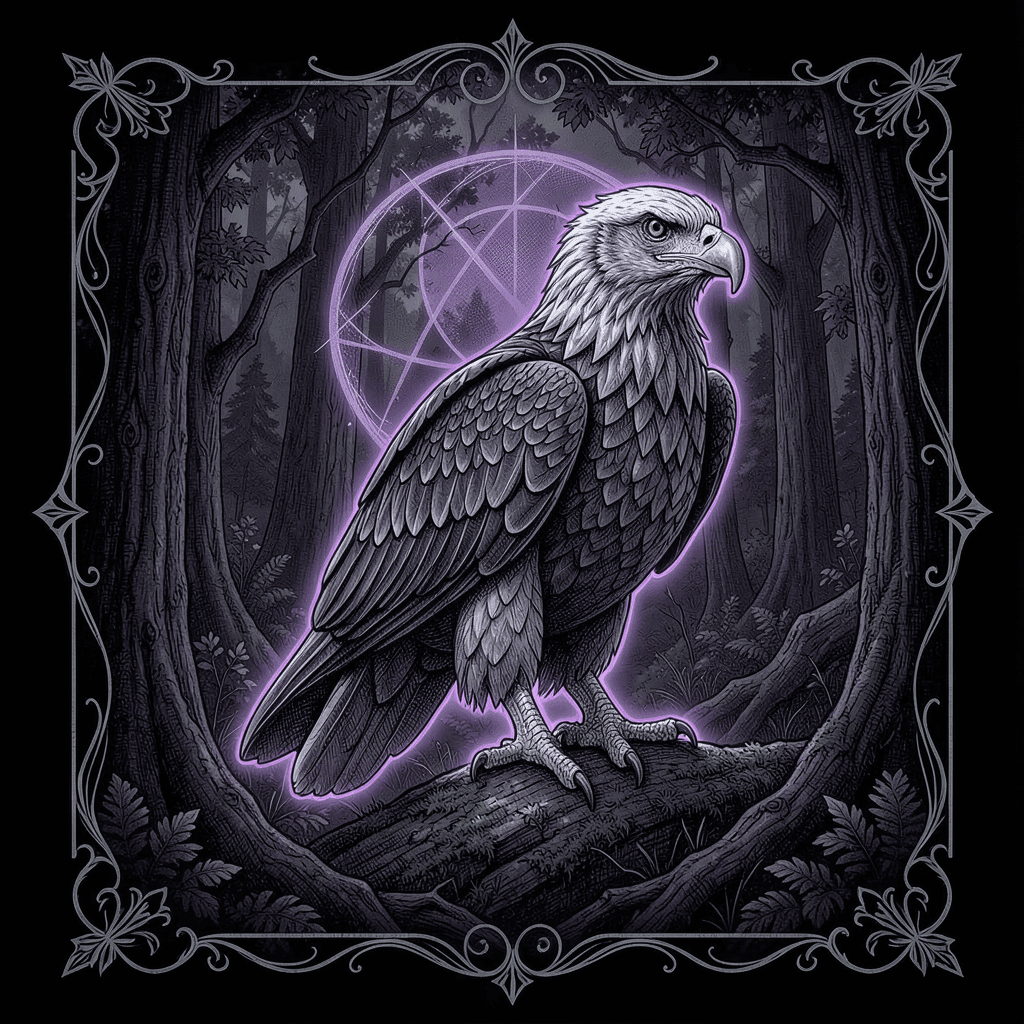
Eagle dream meaning — interpretation
What it means to dream about an eagle: ambition, vision, and rising above a struggle — and how traditions interpret it.
Somnovis editorial team
An eagle in a dream is usually read toward ambition and perspective, and what is worth knowing is that both halves have a cost: the bird's gift is vision at distance, and what it gives up is the ground. The readings below take the eagle less sentimentally than the modern inspirational version does.
An eagle soaring, or perched with a clear view. Broadly favourable — achievement, recognition, or the clarity that comes from rising above a situation rather than staying tangled in it.
An eagle watching the dreamer. Read two ways, and both are live: the attention of someone powerful, which is a good thing to have, or scrutiny from something that takes.
An eagle seizing something. The talons are the other half of the image. This is a bird that takes, and ambition and predation arrive here in one figure rather than two.
An eagle injured, caged, or falling. Ambition stalled — capacity the dreamer has that is not, for now, being allowed to fly, and the standing counter-pole to every favourable reading below.
What changes the reading. Height, and what it costs. The messenger register belongs to the bird article and the dreamer's own flight to flying; this page owns raptor sovereignty and the view.
What it does not mean. Not a forecast of success, and — in one tradition below — not automatically a good omen at all.
Perspectives across traditions
The corpus reads birds of prey as men who take by force, and the eagle as the largest of them: a king, a commander, a man whose reach exceeds the ordinary. An eagle that carries the dreamer off reads in some strands toward travel, or toward being taken up by such a figure; an eagle brought down or caught reads toward power gained over one. The classical habit worth naming is that high-flying birds are read as news and messages generally, and that the eagle's height is read as the extent of an authority rather than as its virtue.
That is a notably unsentimental treatment, and the difference from the modern inspirational eagle is the honest thing to point out: this tradition's eagle is powerful and is not automatically good. The ambivalence has deep roots — the word is known as a name from before Islam, Nasr, one of the idols named in Surah Nūḥ, being a bird of prey — which is context for how the figure is weighed rather than a dream ruling of its own.
The solar-bird line holds, and what gives the image its point is the cost: the eagle's gift is vision at distance, and what it gives up is the ground. Analytical psychology reads the eagle as the function of overview, and reads the same image's shadow as inflation — the ego identified with a height it has not earned, seeing everything and touching nothing. That makes an eagle dream as readily a caution as an encouragement, which a uniformly favourable reading cannot allow for.
The second half of the image is the talons. The eagle is a bird that takes, so ambition and predation arrive in one figure rather than two, and a dream in which the eagle seizes something is not a departure from the symbol but its completion. The wounded or caged eagle is the counter-pole: capacity grounded, and the frustration of it. The messenger category belongs to the bird article and the dreamer's own flight to flying; where the carried-height contrast is wanted, the airplane article holds it.
The folk register runs both ways and the favourable shapes are real: readings of the shape, hedged and paraphrased, that a great bird soaring portends a rise in standing and a name spread widely; that a bird of prey settling on a height reads toward renown; that a bird of prey seizing something is read by who holds what, toward a gain taken by force or a loss suffered by one, and in some shapes toward litigation and official trouble; and that a wounded or fallen bird is unfavourable.
What that favourable register needs is a distinction rather than a denial. The eagle's favourable register here is martial in flavour — rank, ambition, reach, a name that carries — and it is not the blessing register the crane, the magpie and the phoenix carry, which is longevity, joy and their own quite different order of auspiciousness. Both are favourable; they are favourable about different things, and calling the eagle straightforwardly auspicious blurs exactly that. The dark pole has no European counterpart: 「鹰视狼顾」 (yīng shì láng gù, an eagle's gaze, a wolf's backward glance) is the classical physiognomic description of a man of ruthless ambition who cannot be trusted, and the wolf article carries the wolf's half of it. Reaching for it to describe a watching eagle means giving the other pole in the same breath, because folk practice reads a watching eagle at least as often as the attention of someone powerful, which is a thing one wants rather than fears. For the favourable-martial pole the language gives 「雄鹰展翅」 (xióng yīng zhǎn chì, the mighty eagle spreads its wings), a common expression rather than a classical idiom, and the phrase that habitually travels with it, 「大展宏图」 (dà zhǎn hóng tú, to unroll the great design). 「老鹰捉小鸡」 (lǎo yīng zhuō xiǎo jī, the eagle catches the chicks) is the children's game and the standing image of the predator above the defenceless, available for a dream of an eagle over something small.
Sources
The tradition sections draw on these works. That is not a claim that every sentence is a quotation from them. Authorship of the treatise attributed to Ibn Sirin is disputed. The Chinese dream manual is paraphrased: its wording differs by version, so no edition, chapter, or date is named.
- Artemidorus of Daldis, Oneirocritica (2nd century).
- Muntakhab al-Kalām fī Tafsīr al-Aḥlām, the dream book attributed to Ibn Sirin.
- Zhou Gong Jie Meng (周公解梦).
- C. G. Jung, Man and His Symbols (1964), and the Collected Works.
Was your dream different?
Tell us exactly what you saw — our deeply trained AI will work through every detail and nuance of your specific dream.
Get a personal reading