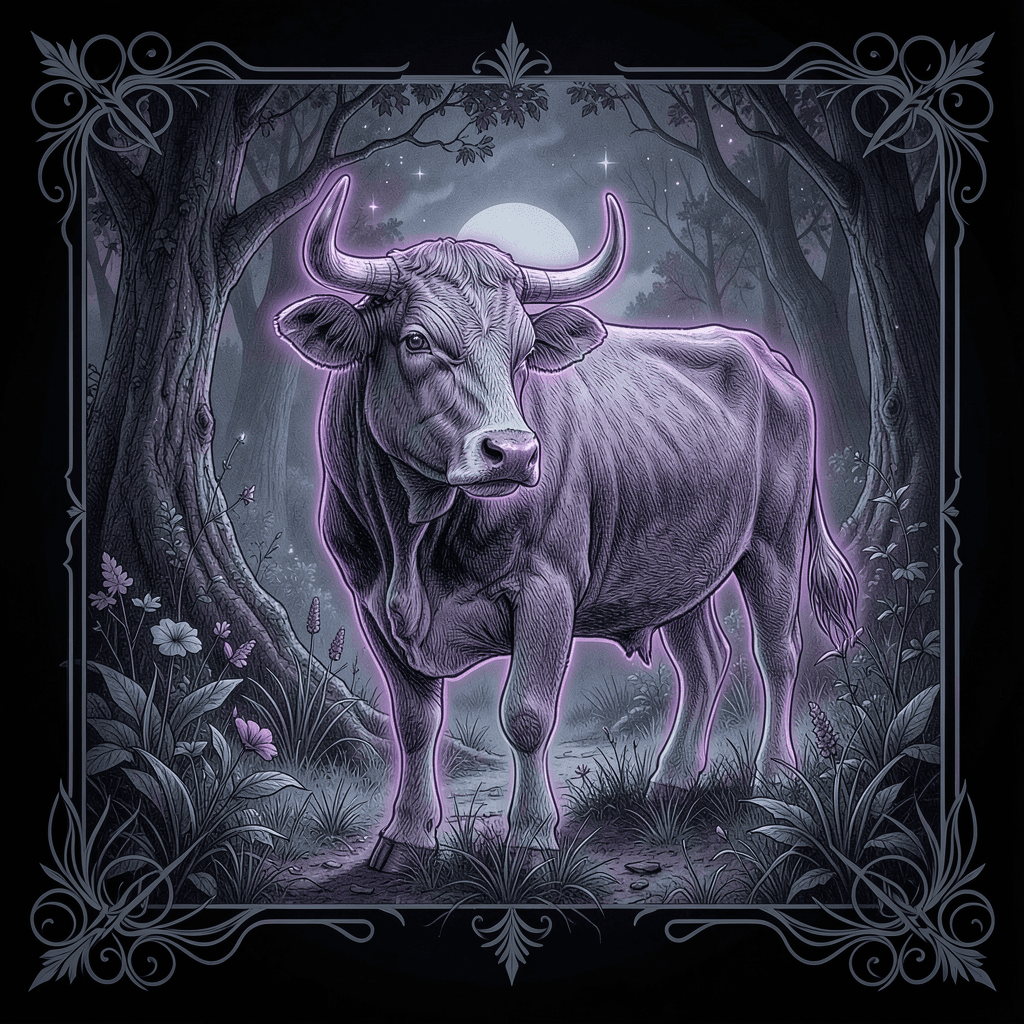
Cow dream meaning — interpretation
What it means to dream about a cow: nourishment, patience, and abundance — and how different traditions interpret this symbol.
Somnovis editorial team
A cow in a dream carries an unusually gentle, sustaining charge compared to most animal symbols — an image of patience and provision rather than threat, tied closely to the idea of being fed, materially or emotionally.
A healthy, calm cow, or one giving milk. This is broadly read as a sign of nourishment and steady abundance — resources, whether financial or emotional, that the dreamer can count on without needing to fight for them.
A thin, sick, or distressed cow. A cow that looks starved or unwell instead points to a source of support the dreamer relies on that is itself running thin — a reserve, financial or emotional, in need of replenishing.
What changes the reading. Fat and lean is the axis every tradition below cares about, more than colour or number: a thriving animal and a starved one are opposite dreams. What the cow is doing matters too — calving, giving milk, coming towards the dreamer's house, or dying — since the traditions read the animal less as a character than as a measure of what sustains the dreamer.
What it does not mean. A cow dream is not a comment on anyone's appearance, and it is not a livestock forecast. Across traditions the animal stands for provision — the resources, human and material, a household runs on — and the dream's information is about the state of that provision, not about cattle.
Perspectives across traditions
This is one of the few dream images with an actual interpreted dream behind it in scripture, and the classical Islamic tradition treats it accordingly. In Surah Yusuf the king dreams of seven fat cows eaten by seven lean ones, alongside seven green ears of grain and seven dry, and Joseph interprets the dream: seven years of plenty followed by seven of famine, with the instruction to store grain through the good years. That is a dream and its interpretation given in the text itself — a source, not a later corpus ruling — and it establishes the reading the tradition carries forward: cows as years, seasons and the yield of them, with fat and lean as the axis on which everything turns.
Two things follow. A dream cow in this material is read as time and its provision rather than as livestock or as a person — a thriving cow is a good year, a starved one a hard year ahead of it. And the tradition takes from this dream a principle it applies far beyond cows: a dream may concern a public or shared future, not only the dreamer's own affairs. The king's dream was about his whole country's food supply, and this is the passage that principle comes from.
In a Jungian reading the cow belongs to the Great Mother material — the archetype is genuinely Jung's, and this is the one place in the article where the name is earned. The cow is that archetype's benign face: nourishment that is given rather than earned, sustenance, patient fertility — provision that asks nothing before it provides. A dream of a calm cow giving milk sits squarely in that register, and often appears when the dreamer is being carried by support they have not had to fight for.
Analytical psychology watches for the archetype's second face here exactly as it does with the mother herself. A cow that cannot be fed, or that the dreamer must keep feeding at growing cost, moves the image away from plenty and towards depletion and obligation — nourishment reversed into demand. The archetype and its two faces are Jung's; the step from cow to meaning is not, and this tradition would not make it as a rule. What it offers is the question of which direction the sustenance in the dream was flowing, and at whose expense.
The manual register is unusually dense for this animal, and it comes first. The folk dream books give readings of the shape: an ox going up a hill portends high rank, leading an ox uphill portends wealth and honour, a yellow ox coming to the house portends great fortune, an ox calving portends gain, an ox goring someone portends a matter that will not come off, and a dead ox portends loss of property. The readings are concrete rather than psychological — a dead ox is a household's fortunes declining, not a metaphor about effort — and the animal's condition and direction of travel do most of the work.
Behind the rulings stands what the ox is in the culture: the image of patient, uncomplaining labour. 「老黄牛」 (lǎo huáng niú, old yellow ox) is the standard term for someone who works hard without asking for credit, and it is affectionate rather than pitying — being called one is praise. For most of the tradition's life the ox was also the household's single most valuable possession, which is why the dream readings above stay so close to property, rank and the household's fortunes: what happens to the ox in the dream is read as happening to what the household depends on.
Sources
The tradition sections draw on these works. That is not a claim that every sentence is a quotation from them. Authorship of the treatise attributed to Ibn Sirin is disputed. The Chinese dream manual is paraphrased: its wording differs by version, so no edition, chapter, or date is named.
- Artemidorus of Daldis, Oneirocritica (2nd century).
- Muntakhab al-Kalām fī Tafsīr al-Aḥlām, the dream book attributed to Ibn Sirin.
- Zhou Gong Jie Meng (周公解梦).
- C. G. Jung, Man and His Symbols (1964), and the Collected Works.
Was your dream different?
Tell us exactly what you saw — our deeply trained AI will work through every detail and nuance of your specific dream.
Get a personal reading