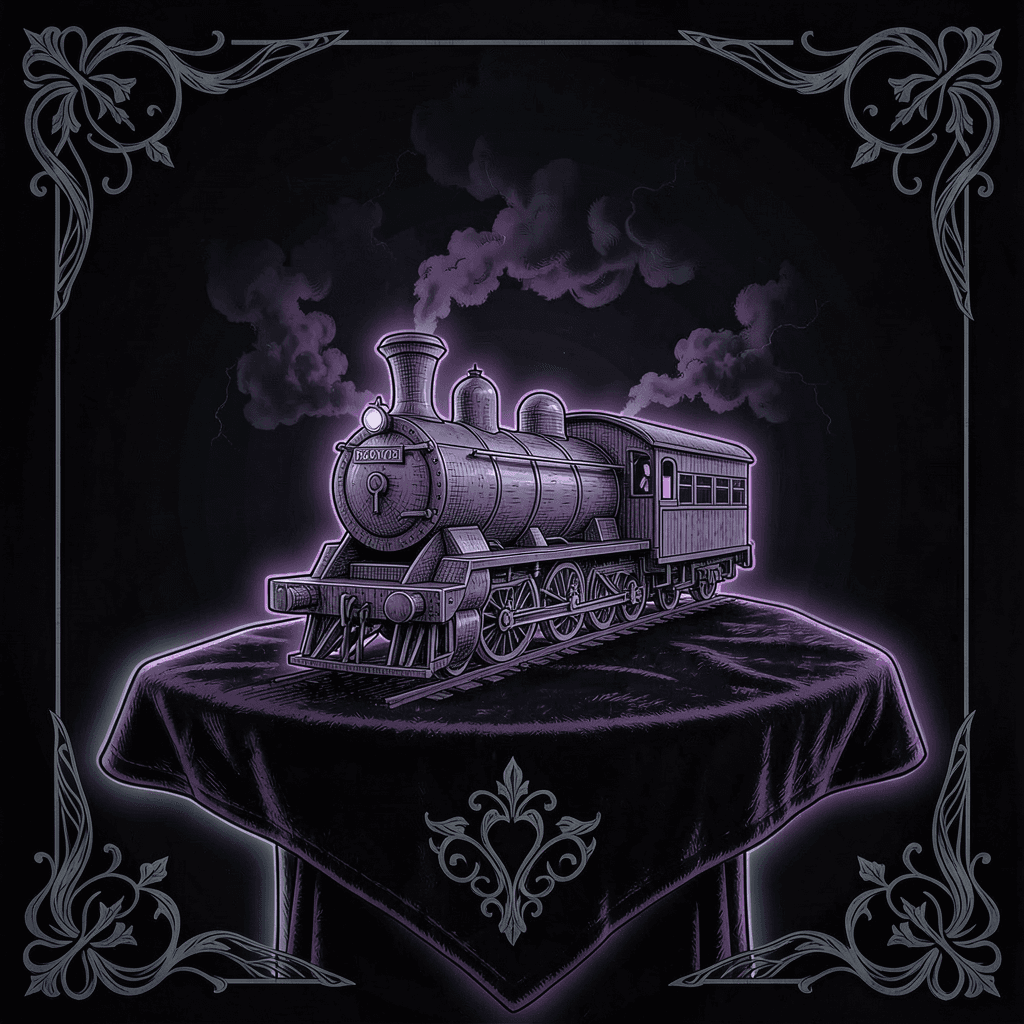
Train dream meaning — interpretation
What it means to dream about a train: progress along a fixed path shared with others, distinct from an airplane's individual journey.
Somnovis editorial team
Distinct from an airplane's fast, individual passage above everything else, a train moves along a path already laid down, on a schedule the dreamer doesn't set alone, in a car shared with other passengers heading the same direction for their own reasons. A train dream tends to concern a plan already set in motion — how it's proceeding, and whether the dreamer is still aboard it.
Riding a train smoothly along its tracks. A train moving steadily toward a known destination often reflects real progress along a plan the dreamer has already committed to — forward motion that requires less personal steering than piloting a plane, but comes with the reassurance of a fixed, dependable course.
Missing a train, or a train going off its tracks. Missing a departure, or watching a train derail unexpectedly, tends to point to a fixed opportunity or schedule slipping past despite the dreamer's efforts, or a structured plan the dreamer trusted suddenly breaking from its intended course.
Standing at the station, or aboard. Stations are the image's scheduled thresholds — waiting rooms between life stages — and the traditions below read boarding, riding and arriving as three different dreams. The missed train itself belongs with the being-late article; this page owns the vehicle.
What changes the reading. Against the car, the question shifts: the car asks who drives, the train asks who laid the track. The rails are the image's fixed term — a route drawn by others, shared with strangers keeping their own reasons — so the variants sort by the dreamer's relation to that fixity: riding it gratefully, riding it trapped, or watching the train leave without them.
What it does not mean. A train dream is not a verdict that the dreamer's life is on rails, for good or ill, and a dreamed derailment is not a prophecy of one — in any sense, including the marital one a Chinese reader will recognise below. The image concerns shared passage along a route the dreamer did not draw; how that feels — dependable or airless — is the dream's actual report.
Perspectives across traditions
The corpus predates the railway, and this section works the way the phone article's does: the method extended, the extension marked. What the tradition supplies is its journey-and-means register — travel as passage between states of affairs, with the mount, the caravan and the road as the means it actually ruled on: a sound mount toward a matter well carried, a road followed toward conduct and course, the caravan toward passage in company. Extended to the train, hedged: the journey's outcome reads toward the matter's outcome; the shared carriage borrows the caravan's register of company on the road; the fixed track reads toward a course already laid — a matter proceeding by arrangements made earlier, whose direction is no longer decided leg by leg.
The honest statement stands first: no classical entry rules on a train, and what this section applies is the tradition's method at a modern object — the same questions the corpus asks of any journey: whether it was completed, on what means, in what company, and in what condition the traveller arrived.
The school-level reading is carried passage on rails laid by others: the train as the life-stage vehicle whose route the dreamer did not draw. Against the car article's question — who drives — the train asks who laid the track: the schooling, the career ladder, the family's expectations, the mortgage's arithmetic — structures that carry genuinely and decide the route as the price of carrying. Stations read as scheduled transitions: the stops are set, named in advance, and arrive whether the dreamer is ready or not — the image's version of the ages and stages a life is expected to keep. The shared carriage is the register's second subject: fate held in common with strangers — everyone aboard bound for the same station for entirely different reasons, intimacy without acquaintance, the compartment as the dream's image of a cohort.
The variants sort by the dreamer's relation to the fixity. Riding content reads toward a structure trusted; riding trapped — the landscape sliding past a sealed window — toward a route obeyed after belief in it has lapsed; the emergency cord, the unscheduled stop and the walk into open country are the dream's images of leaving the laid track, with everything that costs. A missed train belongs to the being-late article's register of the missed moment — one clause, and this page returns to the vehicle.
The strongest association here is live, modern, and known to every Chinese speaker: 「出轨」 (chū guǐ, to leave the rails) is the word for a derailment, and in everyday speech it is also the word for marital infidelity. A dreamed derailment therefore carries a double reading a dictionary cannot suppress: the plan leaving its track, and the vocabulary's other, domestic sense arriving with it unasked. It is reported as exactly what it is — an association built into the language, the register the cheating article treats from its own side — and the guardrail binds at full strength: the pun is not a verdict, and a derailment dream is evidence of nothing about any real relationship; what the language supplies is a word's shadow, not a finding.
Underneath sits the register the modern reader actually inherits: the traditional dream books ruled on the cart, and their vehicle shapes are the base modern interpreters extend to the train — readings of the shape that riding a cart is auspicious, that a cart without wheels is a matter that will not move, that a broken-down cart is unfavourable, and that a loaded cart reads toward gain. They are given here as the extension they are: the train inherits the cart's questions — soundness, motion, and burden — with the rails adding a fixity the cart never had. The modern phrases close the register, marked modern: 「火车跑得快,全靠车头带」 (huǒchē pǎo de kuài, quán kào chētóu dài, the train runs fast because the engine pulls) — leadership, the venture only as good as its front — and 「开倒车」 (kāi dàochē, driving in reverse) — regression, the standing phrase for going backwards dressed as progress, and the natural reading for a dream of a train running the wrong way down its own line.
Sources
The tradition sections draw on these works. That is not a claim that every sentence is a quotation from them. Authorship of the treatise attributed to Ibn Sirin is disputed. The Chinese dream manual is paraphrased: its wording differs by version, so no edition, chapter, or date is named.
- Artemidorus of Daldis, Oneirocritica (2nd century).
- Muntakhab al-Kalām fī Tafsīr al-Aḥlām, the dream book attributed to Ibn Sirin.
- Zhou Gong Jie Meng (周公解梦).
- C. G. Jung, Man and His Symbols (1964), and the Collected Works.
Was your dream different?
Tell us exactly what you saw — our deeply trained AI will work through every detail and nuance of your specific dream.
Get a personal reading