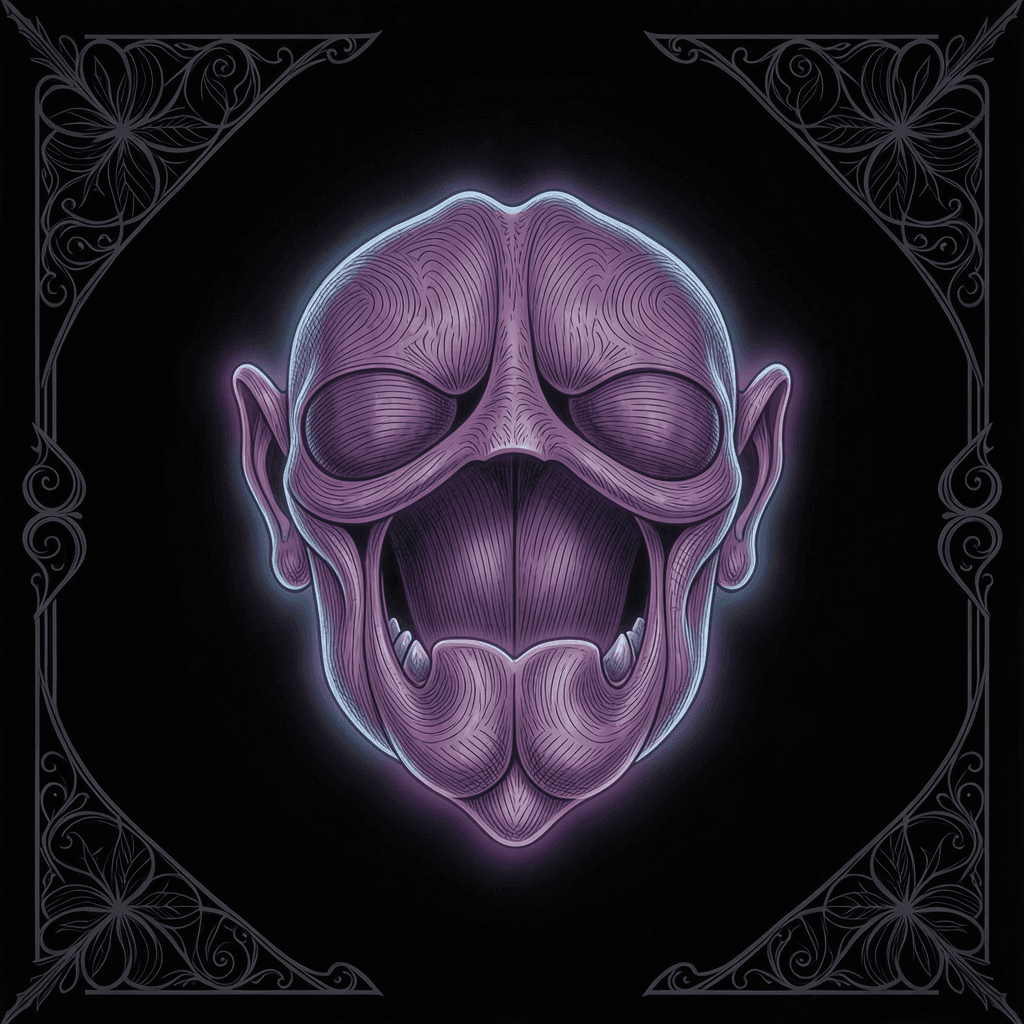
Jaw Dream Meaning: a Broken, Locked or Falling-Off Jaw
A broken jaw, a locked jaw, or a jaw that falls off are not one dream. This page separates those three images.
Somnovis editorial team
The jaw is the hinge that opens the mouth, closes it, and holds the teeth against each other. What a dream about the jaw usually turns on is not the bone but the tension — the specific work of not saying, not eating, not opening, held in a joint that a person carries whether they notice it or not. That is a different image from teeth, which own loss and appearance, and it should be kept separate from them.
A jaw that finally relaxes. Belongs to something the person had been gripping without knowing it. The release in the dream is often the first honest report that the clench had become involuntary.
A jaw that has locked, that aches, or that will not open on a word that needs speaking. Belongs to material held past the point at which the person can still choose to release it. Both versions are common, and both are dreams about voluntariness becoming involuntary rather than about the mouth as such.
What this is not. Nothing on this page is a diagnosis. A dream of a locked jaw is not a report on TMJ, bruxism, or any waking dental condition, however tempting the correspondence looks. The image is bodily and the reading is psychological. If pain or locking in waking life prompted the dream, that belongs with a clinician.
Perspectives across traditions
The classical corpus reads the mouth (فَم, fam), the teeth, the tongue (لسان), and the throat (حَلْق) as distinct categories with well-attested entries. The jaw itself (فَكّ, fakk) as a separate reading is thin — the tradition treats the parts the jaw does work with, and reads them, rather than the joint.
What the joint carries by extension from those attested categories is speech held or released. A mouth that will not open reads as a matter one cannot yet speak of; a mouth that opens too far reads as speech beyond one's business. The jaw as the mechanism of both sits inside that reading rather than beside it. Extension from the mouth and teeth entries is a legitimate move in this material where a body part has no entry of its own; the page says so plainly and does not invent a ruling. No named compiler is cited for a jaw-specific entry that has not been located.
Analytical psychology reads a joint locked mid-motion as energy that has stopped where it was going. The jaw is a specific case because the motion it is in the middle of is speech, and speech is the ego's own instrument for translating an interior state into something another person can hear. A jaw held shut is therefore read as the moment at which the interior has become large enough that the ordinary instrument for reporting it is not equal to the task.
The reading is compensatory in the school's ordinary sense, and it runs both ways. To a person who has been talking their way around something they are refusing to feel, the dream that closes their mouth is not punitive; it is the psyche declining to keep performing the deflection. To a person who has been swallowing something they need to say, the dream of a jaw finally opening is often the material announcing itself as ready before the person has caught up with it.
Two facts about the joint make the image more specific than a general "tension" reading. The masseter is one of the strongest muscles in the body by weight, and the jaw is the site at which sleep bruxism actually happens — the body enacts the clench without the person's cooperation. A dream in which a jaw locks is the psyche using an image the body already produces without instruction, which is a different kind of authority from a symbol chosen by the dreamer's own imagination. That authority still does not make the dream a diagnosis.
The Chinese folk register on the jaw runs through a live reading system that is distinct from dream manuals and needs saying as such: 面相 (miànxiàng, physiognomy) reads the shape of the face for a person's fortune, and the lower jaw has a specific name and a specific reading in it. 地阁 (dìgé), "earth pavilion", is the mianxiang term for the lower jaw and chin, and a full, well-formed 地阁 is read as auspicious for late-life fortune and stability — what a person will have when the middle years are past. 天庭 (tiāntíng, "heavenly hall") is the forehead, read for early life; 地阁 is its opposite bracket. The system is not dream interpretation, and its readings do not transfer directly, but a Chinese dreamer bringing their jaw to a dream may already be carrying the physiognomic sense of it without noticing.
The dream-manual register on the jaw itself is thin — the manuals read teeth and mouth in detail, and the jaw is peripheral to both. Readings of the shape "a jaw that opens easily" attach to speech and consumption unimpeded; "a jaw that will not open" attach to both blocked at once. No entry is quoted and no compilation is named. Teeth idioms such as grinding the teeth in fury or biting the teeth-gate tight belong on the teeth article and are not borrowed here.
Sources
The tradition sections draw on these works. That is not a claim that every sentence is a quotation from them. Authorship of the treatise attributed to Ibn Sirin is disputed. The Chinese dream manual is paraphrased: its wording differs by version, so no edition, chapter, or date is named.
- Artemidorus of Daldis, Oneirocritica (2nd century).
- Muntakhab al-Kalām fī Tafsīr al-Aḥlām, the dream book attributed to Ibn Sirin.
- Zhou Gong Jie Meng (周公解梦).
- C. G. Jung, Man and His Symbols (1964), and the Collected Works.
Was your dream different?
Tell us exactly what you saw — our deeply trained AI will work through every detail and nuance of your specific dream.
Get a personal reading