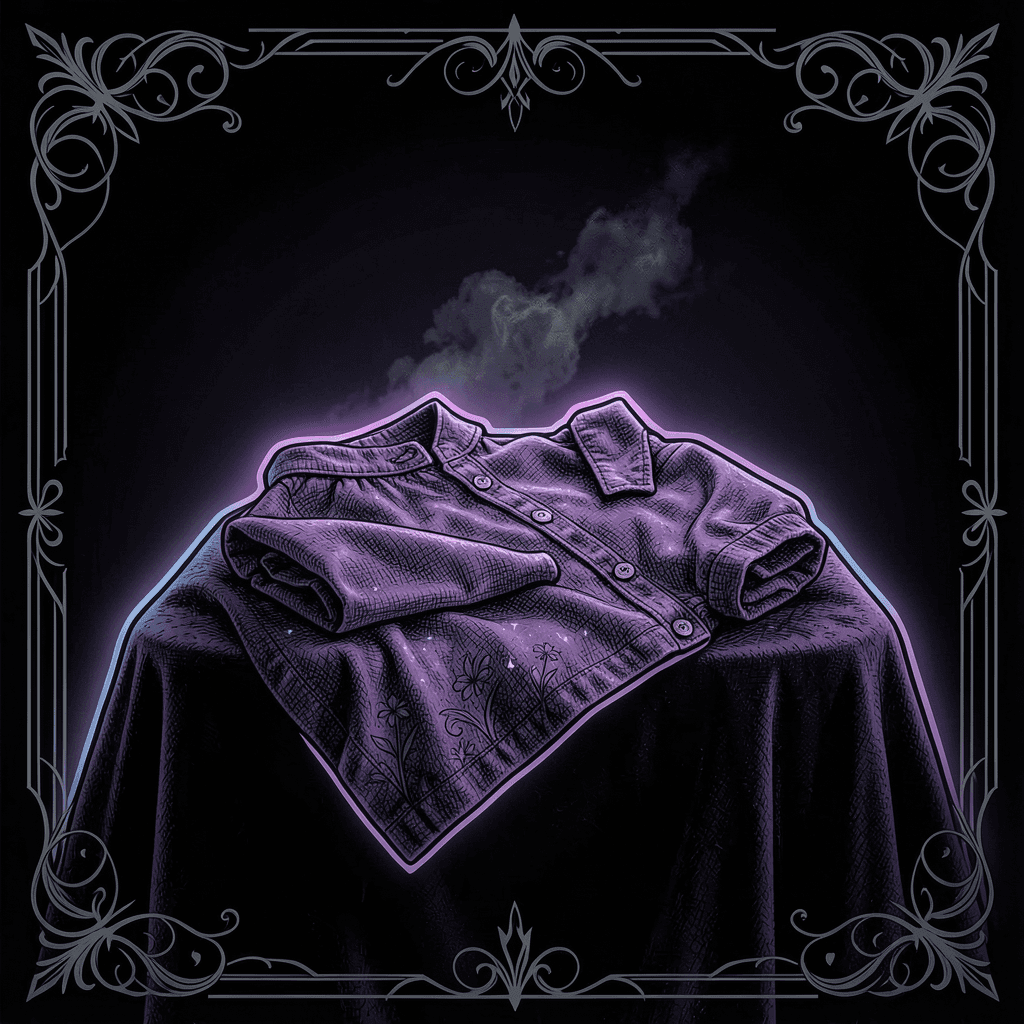
Clothes dream meaning — interpretation
What it means to dream about clothing: the self you present to others, and how different traditions interpret this symbol.
Somnovis editorial team
Clothes in a dream are closely tied to the self the dreamer presents to the outside world — the persona, in the everyday sense — which is why a dream about clothing so often concerns appearance and social role rather than the body underneath.
New, fitting, or admired clothing. Clothes that fit well and draw admiration are generally read as a sign that the dreamer feels comfortable with how they're currently presenting themselves to others, or pride in a new role recently taken on.
Ill-fitting, torn, or mismatched clothes. Clothes that don't fit, are torn, or feel wrong for the occasion more often point to a sense of not yet inhabiting a role comfortably — a feeling of being out of step with how the dreamer wants to be seen.
What changes the reading. Fit and ownership carry the dream: clothes that belong to someone else, a uniform, a costume, or clothes that will not come off each shift the question from appearance to control. Colour does unusually real work with this symbol too — the traditions below attach specific and sometimes opposite meanings to white, green and red — and a change of clothes mid-dream is its own event, not a wardrobe detail.
What it does not mean. A clothing dream is not fashion advice and not a verdict on the dreamer's looks. All three traditions below read garments as the dreamer's presented state — standing, role, condition — so the dream's information concerns how the dreamer is placed and seen, not what they should wear.
Perspectives across traditions
The classical Islamic dream-interpretation tradition reads a garment as the dreamer's condition, standing and religion — what they are wearing is what they are in. Clean, whole, well-fitting clothing is read favourably; torn, soiled or borrowed clothing as a condition damaged or not one's own. The anchor for the whole reading is a well-known hadith in which the Prophet describes a dream of people wearing shirts of differing lengths and identifies the garment as religion (dīn) — that identification, cited here without narrating the report, is why this tradition treats clothing as the state of the person rather than as decoration.
Two details are distinctive. A change of clothing is read as a change of state — new clothes are a new condition, not a purchase. And colour genuinely matters here in a way it does not for most objects: green in particular is favourable in this material. The tradition's consistency is the striking thing — from the hadith to the corpus rulings, the garment is never merely worn; it is what the wearer currently is.
This is the persona article, and here the term can be used precisely: the persona is Jung's own concept, the face turned to the world, and clothing is its most literal dream image. Jung's emphasis, worth keeping, was that the persona is necessary rather than false — a person without one is not more authentic, only less able to function. So a Jungian reading does not treat dream clothing as a mask to be torn off; it asks about fit and ownership. A costume, a uniform, someone else's clothes, clothes that will not come off: each moves the image towards a persona that has become fixed or imposed rather than worn. Clothes that keep changing touch the opposite problem — a presented self that will not settle.
The removal of the persona belongs to a different dream — nakedness, which this site treats separately — and the distinction is worth holding: that dream is about exposure, this one is about the wearing itself. The questions a dream of clothing leaves are whether the dreamer chose what they have on, whether it still fits the life it is worn in, and what it would cost to take it off.
One colour fact has to come first, because a non-Chinese reader will otherwise apply the wrong code to everything that follows: white — traditionally, rather than black — is the colour of mourning in Chinese custom, and 「披麻戴孝」 (pī má dài xiào, to wear hemp and mourning white) names the practice. Black is not absent — modern funerals use black armbands and black cloth alongside white — but white is the traditional register. The dream books read clothing accordingly and bluntly, with readings of the shape: new clothes portend good fortune, ragged or ruined clothing portends trouble, and white clothing portends a death in the family — that last a reading the tradition holds, reported here as such and not as anything a dream can actually tell about anyone's life or health.
The social register comes second, as association rather than ruling. What is worn is public face — 面子 (miànzi) — and respectability, 体面 (tǐmiàn); 「衣锦还乡」 (yī jǐn huán xiāng, to return home in embroidered silk) is the standard phrase for success made visible to the people who knew you before, and it is the association a dream of fine clothing carries. Red is festive and bridal. Green carries an unfavourable charge of its own through 绿帽子 (lǜ màozi, the green hat), the expression for a betrayed husband — one more case of this material's colour code running at right angles to a Western reader's expectations.
Sources
The tradition sections draw on these works. That is not a claim that every sentence is a quotation from them. Authorship of the treatise attributed to Ibn Sirin is disputed. The Chinese dream manual is paraphrased: its wording differs by version, so no edition, chapter, or date is named.
- Artemidorus of Daldis, Oneirocritica (2nd century).
- Muntakhab al-Kalām fī Tafsīr al-Aḥlām, the dream book attributed to Ibn Sirin.
- Zhou Gong Jie Meng (周公解梦).
- C. G. Jung, Man and His Symbols (1964), and the Collected Works.
Was your dream different?
Tell us exactly what you saw — our deeply trained AI will work through every detail and nuance of your specific dream.
Get a personal reading