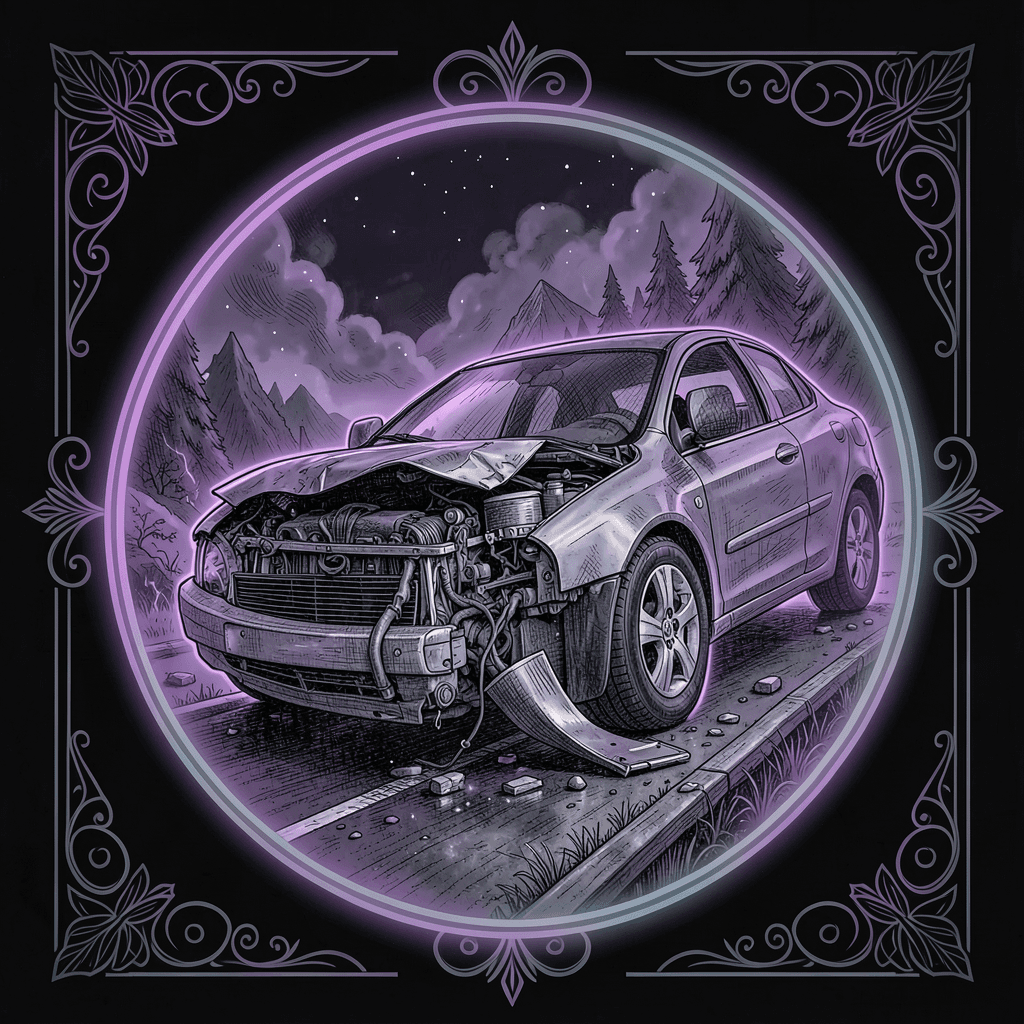
Car crash dream meaning — interpretation
What it means to dream about a car crash: loss of control over one's direction, and traditions' perspectives.
Somnovis editorial team
A crash is an interruption. Where a dream about a car asks who is driving and in what direction, a crash dream is about the moment that question stops mattering — impact, two directions meeting that cannot both be travelled, and a forced stop. That is the centre of this symbol and the reason it has its own page: the material about steering, ownership and control belongs to the car itself, while what belongs here is the collision and everything after it.
Losing control before the impact. Swerving, brakes that fail, a slide that cannot be corrected. Dreamers usually remember the seconds before the crash more vividly than the crash, and that stretch is where most of the reading sits.
Being hit by another vehicle. A collision caused by somebody else reads quite differently from one caused by the dreamer, and every framework below distinguishes them. This version tends to concern something arriving from outside a plan rather than a failure inside one.
A crash caused by the road itself. Ice, a bend, a missing sign, a road that simply ends. Under-discussed and common, and different again from either of the two above.
The aftermath rather than the impact. Walking away unhurt, being trapped, standing at the roadside looking at the wreck. Several traditions treat what happens after the crash as more informative than the crash, and dreamers who wake up in the aftermath rather than at the moment of impact should read from there.
Watching a crash happen to someone else. Being a witness rather than a participant is its own dream, and one of the folk readings below addresses it specifically.
Damage without injury. Very common, and not simply a milder version of the same dream — one tradition here reads it as a categorically different outcome rather than a lesser one.
What changes the reading. Fault, speed, and who else was in the car. Whether anyone was hurt is the largest single variable, and it separates two quite different readings rather than shading one.
What this dream does not mean. This is worth saying first and plainly, because most people arrive at this page frightened: a crash dream is not a premonition. No tradition collected here — and no research on dreaming — treats it as a forecast of an accident, and it is not a reason to change travel plans. Crash dreams are also very common after real accidents, after near-misses, and among people who have recently started driving.
Perspectives across traditions
The classical Islamic material is thinner here than for the vehicle itself, and that is better stated than disguised. There is no classical ruling on traffic collisions. The nearest things the corpus addresses are a sudden calamity striking a journey, and a fall from one's mount — and the latter transfers directly, including its most useful distinction, between the dreamer's own misstep and being pushed by another. That distinction maps neatly onto the difference between losing control alone and being hit by someone else, and it is the single most transferable thing this tradition offers on this page.
Two further points are genuinely classical and worth the space. The first is that the tradition does not read a dream of harm as a prediction of harm, and readers arriving here frightened should be told that without qualification. The second is more specific and more interesting: classical practice divides dreams into three kinds — a true dream, a dream arising from the dreamer's own self and preoccupations, and a disturbing dream attributed to Satan. A sudden, violent, shocking dream is close to the paradigm case of the third, and the tradition's response to that category is not to interpret it at all. The sleeper is directed to seek refuge, and specifically not to relate the dream to others and not to act on it. Between these two points there is a substantial and honest section here without a single invented ruling, which is worth more than a confident-sounding classical meaning for a car crash would be.
In a Jungian reading a crash is a collision in the strict sense — two directions meeting that cannot both be travelled — and the forced interruption of a course the ego was committed to. Where a dream about a car asks who is driving, a crash dream asks what the psyche is stopping. A violent halt is read as compensation for a waking life running at a speed, or in a direction, that the dreamer will not voluntarily reconsider; that is the same compensatory mechanism at work elsewhere in this framework, applied to an image where it is unusually literal.
What caused the crash gives the reading its shape. A collision with another vehicle points towards a conflict with a figure, or with a disowned part of the self that is travelling on its own line. Losing control alone points instead to the ego overestimating its command of a situation. The road itself failing is a third case, closer to circumstance than to either. And the aftermath matters more than the impact: walking away, being trapped in the wreck, and watching from outside are read as three different relationships to a disruption rather than as three endings to the same dream. The guardrail belongs at the end and in plain terms. This is not read as a premonition; analytical psychology does not treat dreams as forecasts of events, and Jung assigned the image no fixed meaning at all.
Like the car itself, the crash belongs to the modern layer of Chinese folk dream material rather than to anything transmitted, and the same honesty applies. Within that layer a crash is read as an abrupt setback — typically in career or finances, given how the vehicle is read — and it functions as a caution to take care in the near term rather than as a forecast that an accident is coming. Damage to the vehicle without injury is not merely read more lightly than a crash involving people — folk reading treats it as favourable outright, for the reason given below. The image also lands in the register of the calamity of bloodshed, the formula recorded on the page for blood, which is what folk material reaches for when a dream involves sudden violent injury; that is a warning-to-take-care phrase and not a prediction, and it should be read as one.
The folk logic behind treating damage without injury more lightly has a name, and it is not merely a matter of degree: a loss of money dispels a calamity. It is an extremely common everyday saying, invoked whenever someone suffers a material loss, and the idea is that the money has absorbed a worse fate that was already on its way. Applied here, a dream in which the vehicle is wrecked and nobody is hurt is not a milder version of the same omen but a case where the exchange has already been made favourably. That is folk consolation logic rather than a mechanism the tradition argues for, and it works better presented as such. A Chinese reader will also have the idiom about the cart ahead, from the fuller saying that the overturning of the cart in front is the lesson for the cart behind. It is the standard phrase for learning from someone else's disaster, and it is worth having as language — but it should not be mapped onto the dream of watching a crash happen to somebody else, because folk reading of that dream goes somewhere else entirely. What it gives is a plain reminder to take care, or the older idea of a misfortune borne in another person's place, and neither of those is what the cart idiom is about. One last note on register: the everyday remark that dreams are the opposite is applied very freely in ordinary Chinese speech to any frightening dream, accidents emphatically included. It is what one person says to another who has woken up shaken — ordinary consolation rather than a folk ruling about accidents, and it is worth reporting as exactly that.
The manual register handles the survivable crash directly rather than by inference. The folk dream books give readings of the shape: a crash portends a reversal of fortune, surviving one portends blessing to come after a narrow escape, and watching someone else's crash portends a caution to take care, or a misfortune falling on another in one's stead. The consoling phrase that goes with the first two is 「大难不死,必有后福」 (dà nàn bù sǐ, bì yǒu hòu fú), survive a great disaster and there is certain to be later good fortune — said to anyone who has come through something badly, and the exact thing a Chinese reader would say to someone shaken by this dream. One limit worth adding to the bloodshed formula noted above: it is reached for where the dream involves injury or bleeding, and is not applied to every crash by default.
Sources
The tradition sections draw on these works. That is not a claim that every sentence is a quotation from them. Authorship of the treatise attributed to Ibn Sirin is disputed. The Chinese dream manual is paraphrased: its wording differs by version, so no edition, chapter, or date is named.
- Artemidorus of Daldis, Oneirocritica (2nd century).
- Muntakhab al-Kalām fī Tafsīr al-Aḥlām, the dream book attributed to Ibn Sirin.
- Zhou Gong Jie Meng (周公解梦).
- C. G. Jung, Man and His Symbols (1964), and the Collected Works.
Was your dream different?
Tell us exactly what you saw — our deeply trained AI will work through every detail and nuance of your specific dream.
Get a personal reading