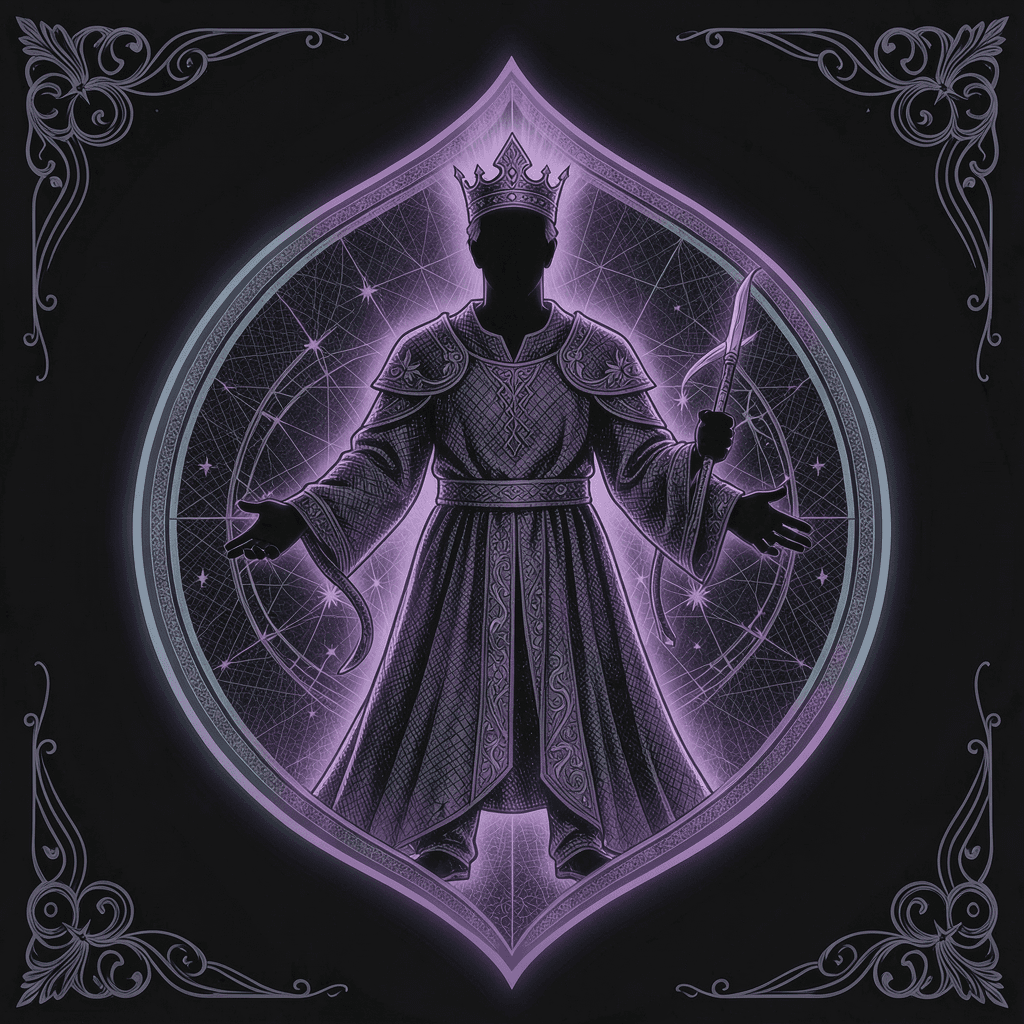
King dream meaning — interpretation
What it means to dream about a king: being honored or overruled, and how different traditions read this figure of authority.
Somnovis editorial team
A king in a dream personifies ultimate worldly authority — standing either for the dreamer's own aspiration toward mastery over their life, or for the far more uneasy sense of being subject to a decision made well above their own reach.
Being crowned, honored, or granted favor by a king. This usually points to recognition finally arriving, or to a long-sought sense of validation and elevated status the dreamer has been waiting for.
A king who is cruel, indifferent, or whose favor is withdrawn. This more often reflects a fear of being at the mercy of forces the dreamer can't control — an institution, a boss, or circumstance in general — anxiety about arbitrary power rather than any specific ruler.
Meeting the king, rather than being one. The traditions below share a habit worth noticing: they read the encounter, not the figure — received, ignored, gifted, judged — so the dream's information sits in how the meeting went, far more than in the king's presence.
What changes the reading. Legitimacy is the axis the deeper readings turn on: a crowned king and a usurper are opposite images wearing the same robes, and more than one tradition below has a specific figure for the pretender. The king's own conduct — just, mad, indifferent — reads as the character of whatever authority currently governs the dreamer's affairs.
What it does not mean. A king dream is not a promotion foretold, and a cruel dream-king is not an accusation against any actual boss or ruler. The figure personifies authority as such — legitimate or hollow, accessible or deaf — and the traditions below read the dreamer's standing before it, not any real person's character.
Perspectives across traditions
The king is one of the corpus's strong entries: authority itself, wearing its human face. The manual habit is the section's real content — the tradition reads the encounter rather than the figure: being received by the king reads toward standing and matters advancing; being ignored, toward access closed; being gifted, toward benefit from power's direction; being judged, toward one's affairs coming under scrutiny that cannot be argued with. The king's own state carries weight too — a just king reads as authority in order, an unjust one as power out of joint — with the corpus's readings always tracking the dreamer's position before power rather than power in the abstract.
The tradition's most famous royal dream makes this page's real point, and it is referenced rather than retold: the king's dream of the cows, treated at the cow article, could not be read by the court at all — the interpretation had to be fetched from prison, from Yusuf, the one man in the kingdom who could say what the dream meant. Power needed truth from below: the corpus's king material carries that structure inside it — the throne can command everything except the meaning of its own dream — and a dreamer weighing a king dream inside this tradition inherits the question in both directions: where they stand before authority, and what truth authority currently needs from them.
The school-level line this site carries for the crowned figure holds: the king as the ordered Self in its sovereign aspect — the psyche's image of legitimate authority, rule that orders rather than seizes. Crowned, not seized, is the reading's hinge: legitimacy is what distinguishes the king from the mere strongman, and analytical psychology reads the dream-king's condition as the condition of whatever currently governs the dreamer's inner house — a just king as authority integrated, ruling with the consent of the governed parts; an old or ailing king as an ordering principle due for renewal; the lion's animal sovereignty, treated at its own article, the same register worn as instinct rather than office.
The false or mad king is the variant worth the closest reading: authority the dreamer obeys without believing. A court that bows to a figure everyone in the dream quietly knows to be illegitimate or deranged is a precise image of a psyche — or a waking life — organised around a principle that has kept the throne and lost the mandate: a career, a self-image, an old rule of the family still commanding obedience on habit alone. The dream's question in that case is not how to depose the figure but what the genuine authority would be, since the throne itself, in this reading, is never the problem — only the occupant.
The traditional dream books read the ruler favourably in the standing shapes — seeing the emperor, hedged as always, portends honour, advancement or benefit from on high — the register formed under examinations and imperial office, where the throne's notice was the height of fortune. The language then supplies the register's two real questions. The first is legitimacy: 「真命天子」 (zhēnmìng tiānzǐ, the true son of heaven) names the rightful ruler — the one whose authority is mandated rather than merely held — and it is the register's core distinction, since everything in this material turns on whether the figure on the throne is the true one.
The second is the pretender, and the phrase is one of the language's best: 「山中无老虎,猴子称大王」 (shān zhōng wú lǎohǔ, hóuzi chēng dàwáng, with no tiger on the mountain, the monkey calls itself king) — the mediocrity seizing a vacancy, 小人得志 (xiǎo rén dé zhì) territory: the petty man come into his moment. This is the pretender rather than the unconvincing sovereign — the tiger and monkey articles carry the two animals' own registers — and it is the folk reading for dreams of a false or usurping king: not majesty corrupted but a vacancy filled by whatever scrambled up first. Between the true son of heaven and the monkey king, the register asks of any dreamed authority the only question it considers worth asking: whose mountain is this, and where is the tiger.
Sources
The tradition sections draw on these works. That is not a claim that every sentence is a quotation from them. Authorship of the treatise attributed to Ibn Sirin is disputed. The Chinese dream manual is paraphrased: its wording differs by version, so no edition, chapter, or date is named.
- Artemidorus of Daldis, Oneirocritica (2nd century).
- Muntakhab al-Kalām fī Tafsīr al-Aḥlām, the dream book attributed to Ibn Sirin.
- Zhou Gong Jie Meng (周公解梦).
- C. G. Jung, Man and His Symbols (1964), and the Collected Works.
Was your dream different?
Tell us exactly what you saw — our deeply trained AI will work through every detail and nuance of your specific dream.
Get a personal reading