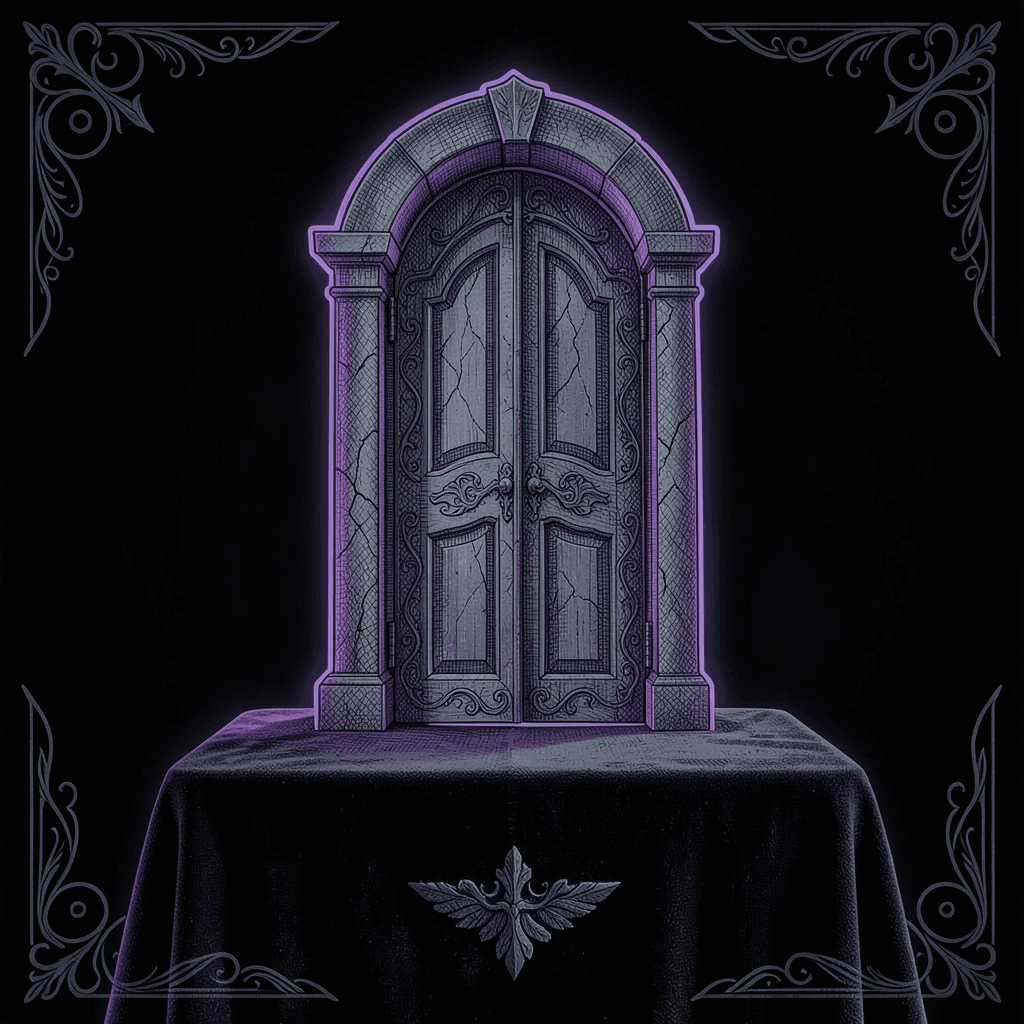
Door dream meaning — interpretation
What it means to dream about a door: a decision opened or refused, and how different traditions read this threshold symbol.
Somnovis editorial team
A door in a dream almost always marks a decision point — not a passive view onto something, which is what a window represents, but an active threshold the dreamer must choose to open, walk through, or leave firmly shut.
Opening a door onto something unexpected. Stepping through into a genuinely new phase or opportunity; what waits beyond the door often mirrors the dreamer's own expectation, hopeful or fearful, of the consequences that a choice already being weighed might bring.
A door that won't open, is locked, or that the dreamer refuses to open. This tends to reflect hesitation before a real decision — an opportunity the dreamer isn't yet ready to commit to, or a boundary they're choosing, consciously or not, not to cross.
What changes the reading. Who controls the door is the question under every variant: the dreamer opening it, holding it shut, knocking, or hearing knocking from the other side are four different dreams. The door's own state carries weight too — new, broken, barred, or standing open on its own — and the traditions below read those states with surprising specificity.
What it does not mean. A door dream does not tell the dreamer what stands on the other side, and no tradition collected here claims it does. The image is about passage and its control — entry, exclusion, and who decides — so the dream's information ends at the threshold; what lies beyond it is exactly what remains to be found out.
Perspectives across traditions
The classical Islamic dream-interpretation tradition reads the door of a house as its protection and as the point through which provision and people arrive. An open door is read as access, opportunity or an accessible household; a closed or barred one as prevention; and a door that will not open as a matter obstructed rather than as danger — the distinction matters, because the tradition's advice for an obstruction is patience and another approach, not alarm. One strand of the corpus associates the door of the house with the woman of the household, on the reasoning that she is what the house is entered by and guarded through — reported here as that strand's reading, and left there.
What the tradition is consistently reading is the threshold rather than the object: passage and its control — who may come in, who may go out, and who decides. That is why the door's state does so much work in these readings. A house's door is its face to the street and its defence at once, and the dream readings treat it as exactly that boundary.
In a Jungian reading a door is a threshold image, and the question it puts is one the dreamer's own behaviour in the dream answers: what is on the other side, and is it being opened, held shut, or knocked on from outside. Knocking heard from the other side is commonly read as unconscious content presenting itself — something asking to be admitted to awareness. A door the dreamer refuses to open is read as the same content declined, which is not the same thing as safety achieved: what is not admitted does not leave, it waits.
The reading deliberately does not settle what is behind the door, and should not pretend to — that is precisely what the dreamer's own associations supply, and any table claiming to know in advance has left this tradition behind. What analytical psychology offers instead is attention to the dreamer's posture at the threshold: opening, barring, hesitating, or standing with a hand on the handle. That posture, repeated across dreams, is usually the real finding.
The folk dream books read the door by its state, in a dense run of short entries that is characteristic of the material: a door opening portends good fortune and a matter proceeding; a door that opens suddenly of itself is very auspicious; a door shut or blocked portends a matter that cannot proceed; a broken door portends the household breaking up; a new door portends a new undertaking or a new household. The density is the point — the manual discriminates by condition, and the same object carries half a dozen different rulings depending on the state it is in.
Around the rulings stands a vocabulary in which the door means the family itself, and it is the association a Chinese reader brings: 门第 (mén dì) and 门风 (mén fēng) — a family's standing and a family's conduct, both built on the character for door; 「门当户对」 (mén dāng hù duì), the phrase for a marriage between families of equal standing; 「门可罗雀」 (mén kě luó què, you could net sparrows at the door), for a household nobody visits any more; and 「开门红」 (kāi mén hóng), an auspicious start. The associations run to the household — though the dream entries themselves serve both registers, ruining a family with a broken door and bringing one person good news with an opening one.
Sources
The tradition sections draw on these works. That is not a claim that every sentence is a quotation from them. Authorship of the treatise attributed to Ibn Sirin is disputed. The Chinese dream manual is paraphrased: its wording differs by version, so no edition, chapter, or date is named.
- Artemidorus of Daldis, Oneirocritica (2nd century).
- Muntakhab al-Kalām fī Tafsīr al-Aḥlām, the dream book attributed to Ibn Sirin.
- Zhou Gong Jie Meng (周公解梦).
- C. G. Jung, Man and His Symbols (1964), and the Collected Works.
Was your dream different?
Tell us exactly what you saw — our deeply trained AI will work through every detail and nuance of your specific dream.
Get a personal reading