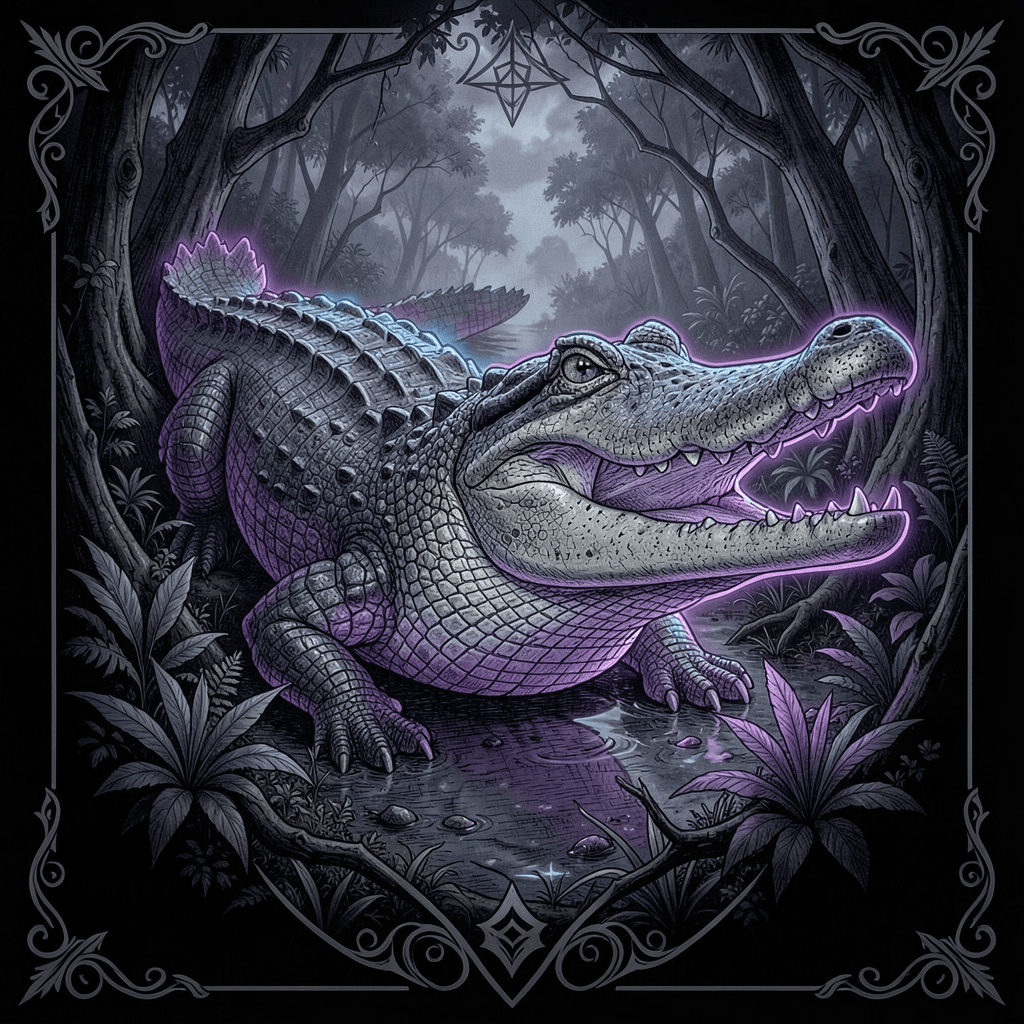
Crocodile dream meaning — interpretation
What it means to dream about a crocodile or alligator: hidden danger, betrayal, or a threat lying in wait — and how traditions read it.
Somnovis editorial team
A crocodile or alligator in a dream draws its power from stillness — an animal that waits, camouflaged and patient, before it strikes, which is why this symbol is so often tied to deception and danger that isn't obvious until it's already too late.
A crocodile submerged or motionless nearby. A crocodile that merely watches, half-hidden in water, often points to a threat or deceit the dreamer half-senses but hasn't yet been able to prove.
A crocodile that attacks or bites. An attacking crocodile more often reflects a betrayal already in motion — a situation in which someone the dreamer trusted, or let their guard down around, turns out to have been a genuine danger.
What changes the reading. The waterline is the hinge: a crocodile fully visible on a bank is a known danger, while one submerged to the eyes is the dream's real subject — how much of the threat is above the surface. Whether the water is somewhere the dreamer must go — a crossing, a washing place, a shore — or somewhere they could simply avoid also shifts the reading.
What it does not mean. A crocodile dream does not identify a treacherous person, and it is not evidence that someone trusted is a danger. The traditions below read the animal as a shape — patience, concealment, the strike from stillness — and the recognition of where that shape fits is left, deliberately, to the dreamer.
Perspectives across traditions
One strand of the classical corpus reads the crocodile as a treacherous enemy — and the location does the work: this is the predator at the waterline, danger stationed precisely where provision is drawn. Water in this tradition is provision and life; the crocodile is what waits in it, and the reading follows the logic the tradition applies to water predators consistently — a threat embedded in the very thing the dreamer must approach in order to live. The entry is present in the material but not deep, and it is hedged accordingly: one strand reads it so, and that is the honest ceiling of the claim.
The register it belongs to, though, is solid. An enemy who conceals intent until the moment of the strike, met at a place the dreamer cannot simply avoid — a livelihood, a household, a necessary dealing — is a shape this tradition describes with precision across many animals, and the crocodile is its most patient instance. As always, the corpus points at a kind of danger and its position, not at a person; the identification belongs to the dreamer's own knowledge of their affairs.
The school-level reading here is one of the strongest in the animal register. The crocodile is the archaic layer of the psyche made visible: a predator essentially unchanged since before mammals existed, surfacing from water — the unconscious' standing image — with only its eyes showing. Everything the image carries is about age, patience and concealment: danger that is ancient rather than new, that does not chase but waits, and that keeps almost all of itself below the surface. Dreamers consistently report the stillness, not the attack, as the frightening part, and the reading agrees with them — the dream's subject is what cannot be seen from above the waterline.
The jaws are the second movement. A crocodile's strike is the clamp — sudden, total, and from a direction the dreamer was looking at without seeing — and it reads towards the fear of being seized by something one can usually not see: an old pattern, an affect, a history that spends most of its time submerged. The school's question is not how to kill the animal but how much of the water the dreamer is prepared to look into; the crocodile is exactly as dangerous as it is invisible.
Chinese folk material is honestly thin here, and the reason is itself informative: the crocodile is not a native folk category — it is not one of the zodiac animals, and it never entered the decorative canon of puns and emblems that generates this material's readings. The one phrase a Chinese reader knows — 鳄鱼的眼泪 (è yú de yǎn lèi, crocodile tears) — is an imported idiom, calqued from the Western phrase, and must be marked as imported rather than blended with native material: it carries the Western sense of false grief, and nothing older stands behind it in Chinese.
There is one native footnote worth its sentence: China's own crocodilian, the Yangtze alligator, is the ancient 鼍 (tuó) — a creature at the edge of the dragon's mythic family, whose hide once made drums. That places the animal's only indigenous trace next door to the most auspicious symbol in the whole tradition, treated at the dragon article, without turning it into one: no folk dream reading is claimed for the 鼍, because none is attested. Where a tradition is silent, the silence is the finding — a dreamer looking for a Chinese reading of this animal is better served by the general water material, and by the honest statement that the folk books simply do not treat it.
Sources
The tradition sections draw on these works. That is not a claim that every sentence is a quotation from them. Authorship of the treatise attributed to Ibn Sirin is disputed. The Chinese dream manual is paraphrased: its wording differs by version, so no edition, chapter, or date is named.
- Artemidorus of Daldis, Oneirocritica (2nd century).
- Muntakhab al-Kalām fī Tafsīr al-Aḥlām, the dream book attributed to Ibn Sirin.
- Zhou Gong Jie Meng (周公解梦).
- C. G. Jung, Man and His Symbols (1964), and the Collected Works.
Was your dream different?
Tell us exactly what you saw — our deeply trained AI will work through every detail and nuance of your specific dream.
Get a personal reading