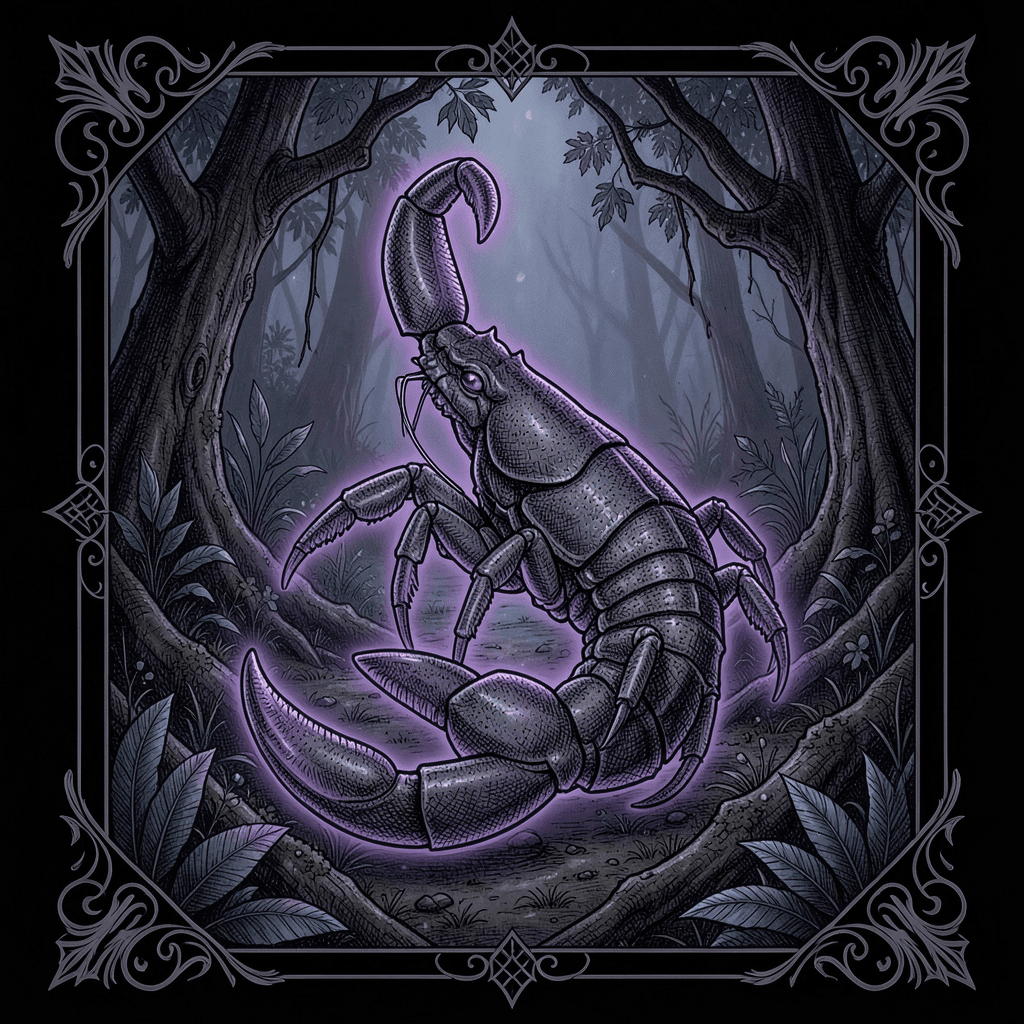
Scorpion dream meaning — interpretation
What it means to dream about a scorpion: a hidden sting, small betrayal, or self-protection — and how traditions interpret it.
Somnovis editorial team
A scorpion in a dream concentrates danger into something small and easy to overlook until it's too close — a symbol less about overwhelming force than about a sharp, sudden hurt delivered by someone or something the dreamer didn't see coming.
A scorpion seen and avoided. Noticing a scorpion in time to avoid it is often read as a sign that the dreamer's own caution is currently well-placed — an instinct to watch for a small betrayal that is, in fact, correctly tuned.
Being stung by a scorpion. Being stung more often points to a betrayal or sharp remark that has already landed — frequently from someone closer to the dreamer than a stranger, since a scorpion is usually found nearby, not far away.
What changes the reading. Position and timing carry it: a scorpion seen in the open differs from one found in a shoe, a bed, or a pocket — the readings below turn precisely on concealment near the body. Whether the sting lands, and whether the dreamer kills the animal, are the other two hinges; killing it is one of the few acts the traditions agree in reading favourably.
What it does not mean. A scorpion dream does not name a backbiter, and it is not a licence to comb one's circle for the person the sting stands for. The material below describes a precise shape of harm — small, hidden, delivered from concealment — and describing a shape is all it does; the dream accuses nobody.
Perspectives across traditions
This is one of the stronger corpus entries in the animal register, and its strength is its precision. The scorpion is a malicious enemy — and specifically the backbiter: one who stings with the tongue, wounding reputation from concealment. Not danger in general, but slander in particular; not the open rival the lion describes, but the small, hidden harm that is discovered only when it lands. The animal's habits carry the reading — something that lives close, in the dreamer's own house and shoes, and strikes from a hiding place rather than across open ground.
Killing the scorpion is read favourably, as an enemy of exactly that kind defeated — the slander answered, the concealed harm ended — one of the tradition's characteristic moves, in which the dreamer's act in the dream carries as much weight as the animal itself. The precision is the useful content: a dreamer inside this tradition is being pointed not at enemies at large but at the specific register of words spoken from concealment — and the corpus, as always, describes the shape and leaves the recognition to the dreamer; it does not name anyone.
In a Jungian reading — school-level throughout — the scorpion is the sting in the tail: harm delivered by what follows behind. The image is close to the snake's betrayal material but colder and more deliberate — a snake strikes when disturbed, while the scorpion's weapon rides permanently over its back, aimed forward, part of its posture. Harm of that shape in a dream tends to concern what trails the dreamer: a resentment carried so long it has become anatomy, a grievance that travels with its owner and stings on contact.
The shadow register sharpens when the dream reverses the roles. A dream in which the dreamer is the scorpion — or owns it, carries it, releases it — reads towards the dreamer's own capacity for the small, precise, deniable wound: the remark that could not quite be called an attack, the withdrawal timed to hurt. The school treats such dreams as unusually honest, because they show the sting as belonging to the psyche's own equipment rather than to an enemy. The question they ask is not who stung the dreamer but what the tail is for — what the carried weapon has been protecting, and at whose expense.
The scorpion's folk identity is membership: it is one of the 五毒 (wǔ dú), the Five Poisons of folk custom — the venomous creatures warded off at the Duanwu festival with realgar and charms. The list runs scorpion, snake, centipede, toad, and then a fifth that varies by region — lizard in some tellings, spider in others — and the variation is worth naming rather than fixing, because the point is the category, not the roster: the scorpion is a catalogued danger with a prescribed apotropaic answer, not an open terror. A danger with a festival against it is a danger the culture has already domesticated.
The dream books, in the same direction, give readings of the shape a scorpion's sting portending the covert scheme of a 小人 (xiǎo rén, a petty person) — and killing the scorpion averting the harm, which agrees with the Islamic material's reading of the same act. The phrase 蛇蝎心肠 (shé xiē xīn cháng, a heart of snakes and scorpions) names venom as character, and it covers the scorpion half of the pairing as fully as the snake half. And there is a hedged homophone in folk speech: 蝎 (xiē) heard against 邪 (xié, the baleful) — the scorpion as a carrier of 邪气 (xié qì, baleful influence), the same 邪 the shoe pun turns on at the shoes article. That is wordplay at the edge of the material, reported as such, not a ruling.
Sources
The tradition sections draw on these works. That is not a claim that every sentence is a quotation from them. Authorship of the treatise attributed to Ibn Sirin is disputed. The Chinese dream manual is paraphrased: its wording differs by version, so no edition, chapter, or date is named.
- Artemidorus of Daldis, Oneirocritica (2nd century).
- Muntakhab al-Kalām fī Tafsīr al-Aḥlām, the dream book attributed to Ibn Sirin.
- Zhou Gong Jie Meng (周公解梦).
- C. G. Jung, Man and His Symbols (1964), and the Collected Works.
Was your dream different?
Tell us exactly what you saw — our deeply trained AI will work through every detail and nuance of your specific dream.
Get a personal reading