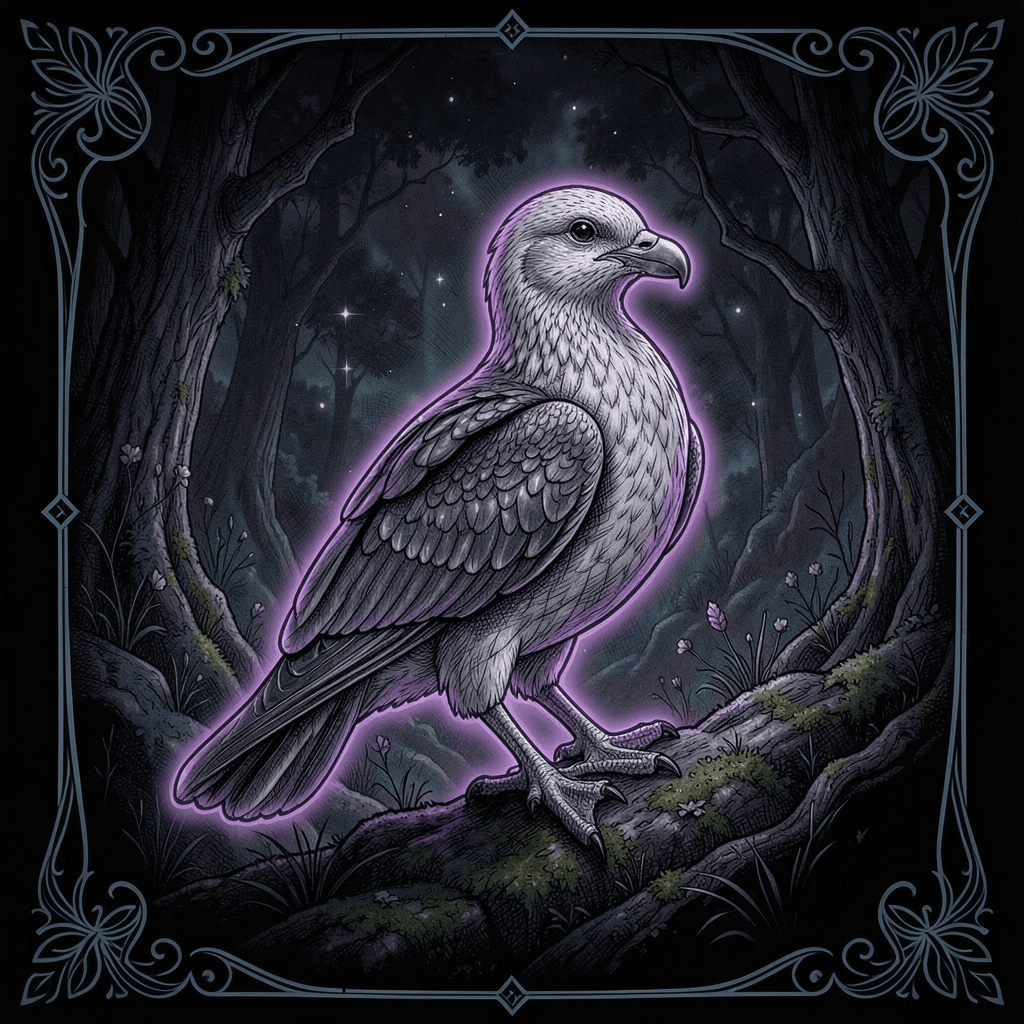
Albatross Dream Meaning: What It Means to Dream of an Albatross
Dreaming of an albatross is read through a long journey or a burden carried a great distance. What the bird is doing changes the reading.
Somnovis editorial team
An albatross in a dream carries a weight neither the eagle's raw power nor the dove's message of peace is built to hold — long associated, since the old sailor's poem, with a burden fastened to someone against their will, worn as visible proof of some past mistake or debt not yet settled. An albatross's dream meaning tends to center on that involuntary weight: guilt, obligation, or consequence carried openly, for others to see, rather than resolved and set down.
An albatross hung around the dreamer's own neck. An albatross worn heavily around the neck is usually read as a sign that the dreamer feels burdened by a specific guilt or mistake that hasn't been resolved — a consequence they're carrying visibly, whether or not anyone else has actually asked them to.
An albatross finally set down or released. The albatross being removed or allowed to fly off tends to point to real relief the dreamer feels, or hopes for, at a long-carried burden finally being allowed to lift — an old debt or guilt released rather than carried indefinitely.
An albatross in the air, crossing open ocean. The other half of this bird, and a genuinely separate reading rather than a lighter version of the first: a crossing completed alone, over distances nothing else attempts, with almost no visible effort.
An albatross on the ground, or on a deck. The same bird made ridiculous. It walks badly and takes off badly, and a dream that strands one is about a capacity that is magnificent in its element and disabling outside it.
An albatross following the dreamer's ship without landing. Attendance rather than burden. Sailors read a following albatross as a good sign long before anybody hung one on anybody's neck, and the dream in which the bird simply keeps pace belongs to that older reading.
What changes the reading. Whether the bird was on the dreamer or in the air. The neck image is famous enough to swallow the whole symbol, and it is worth knowing that it is one strand, from one poem, and roughly two centuries old.
What it does not mean. The burden reading is not ancient and it is not universal. Where it belongs is stated below, and where it does not belong is stated too.
Perspectives across traditions
There is no albatross in the classical corpus. It is a bird of the southern oceans and the open Pacific and Atlantic, not of the seas that literature knew, and no entry for it exists to be quoted.
What the tradition does with a bird it has no ruling on is read it by size, habit and station — a large bird by the standing of a large man, a travelling bird by news or by a journey. A bird that stays at sea for months at a time therefore falls under readings of the shape of long absence, and of news arriving from far off, rather than under any reading about a weight. That is an extension from a documented method, said plainly as one.
The burden reading is not from this tradition at all, and it is worth saying so directly, because it is routinely written here. It comes from an English poem of 1798 and entered general English use considerably later than that. Nothing in the Arabic material attaches a bird to anybody's neck, and a section that puts the albatross-as-burden inside the classical corpus is placing a Romantic poem inside a medieval Arabic literature.
Analytical psychology reads a weight the person carries visibly, and cannot put down, as material the ego has been made to hold in the open rather than absorb quietly — which is the condition under which it can finally be looked at. That is why the burden and the possibility of release are the same image here rather than two: what is hung where everybody can see it is no longer being hidden, and hiding was the part that made it insoluble.
The literary sources are specific and both are worth having. In Coleridge's The Rime of the Ancient Mariner (1798) the mariner shoots the albatross that had been following the ship, and the crew hang the dead bird around his neck in place of a cross. That scene, and nothing earlier, is where "an albatross around one's neck" comes from. Coleridge was drawing on a real sailors' belief that killing one of these birds brought misfortune, and on the tradition that they carried the souls of drowned sailors — so the guilt in the image is guilt toward the bird before it is guilt in general.
Baudelaire's L'Albatros, in Les Fleurs du mal (1857), is the other albatross and it is not about guilt at all: sailors catch the bird for sport, and it is sovereign in the air and absurd on the deck, its enormous wings making it unable to walk. The poet is the comparison. That image is biologically exact — the wandering albatross has the largest wingspan of any living bird, soars enormous distances on wind gradients with almost no flapping, spends most of its life airborne, and takes off badly, needing a run or a headwind. A capacity that is magnificent in its element and disabling outside it is a genuinely different content from a guilt hung on a neck, and both are really attached to this bird.
The albatross has no entry in the Chinese folk material — it is not a bird of those coasts, and there is no manual reading and no traditional saying for it. What it has instead is a name that says something. 信天翁 (xìntiānwēng) reads, character by character, as "the old man who trusts to heaven".
What follows from that is about the name rather than about a dream, and it is worth keeping the distinction. Chinese named this bird for patience that looks like passivity, and whether that patience is trust or resignation is a question the name itself leaves open. Two current idioms answer the "trusts to heaven" element directly and hold the question between them: 听天由命 (tīng tiān yóu mìng), to leave things to heaven and to fate, which carries a note of giving up; and 靠天吃饭 (kào tiān chī fàn), to eat by heaven's grace, said of farming that depends on the weather, which carries no reproach at all and simply describes a life without a safety net.
Neither is a dream ruling and neither is offered as one. What they give a reader is the register a Chinese speaker already has for a creature that commits itself to the open air and to whatever conditions arrive — which is a considerably more interesting frame for this bird than the outcome-based reading that usually gets written here, where a burden released is fortunate and a burden retained is a caution.
Sources
The tradition sections draw on these works. That is not a claim that every sentence is a quotation from them. Authorship of the treatise attributed to Ibn Sirin is disputed. The Chinese dream manual is paraphrased: its wording differs by version, so no edition, chapter, or date is named.
- Artemidorus of Daldis, Oneirocritica (2nd century).
- Muntakhab al-Kalām fī Tafsīr al-Aḥlām, the dream book attributed to Ibn Sirin.
- Zhou Gong Jie Meng (周公解梦).
- C. G. Jung, Man and His Symbols (1964), and the Collected Works.
Was your dream different?
Tell us exactly what you saw — our deeply trained AI will work through every detail and nuance of your specific dream.
Get a personal reading