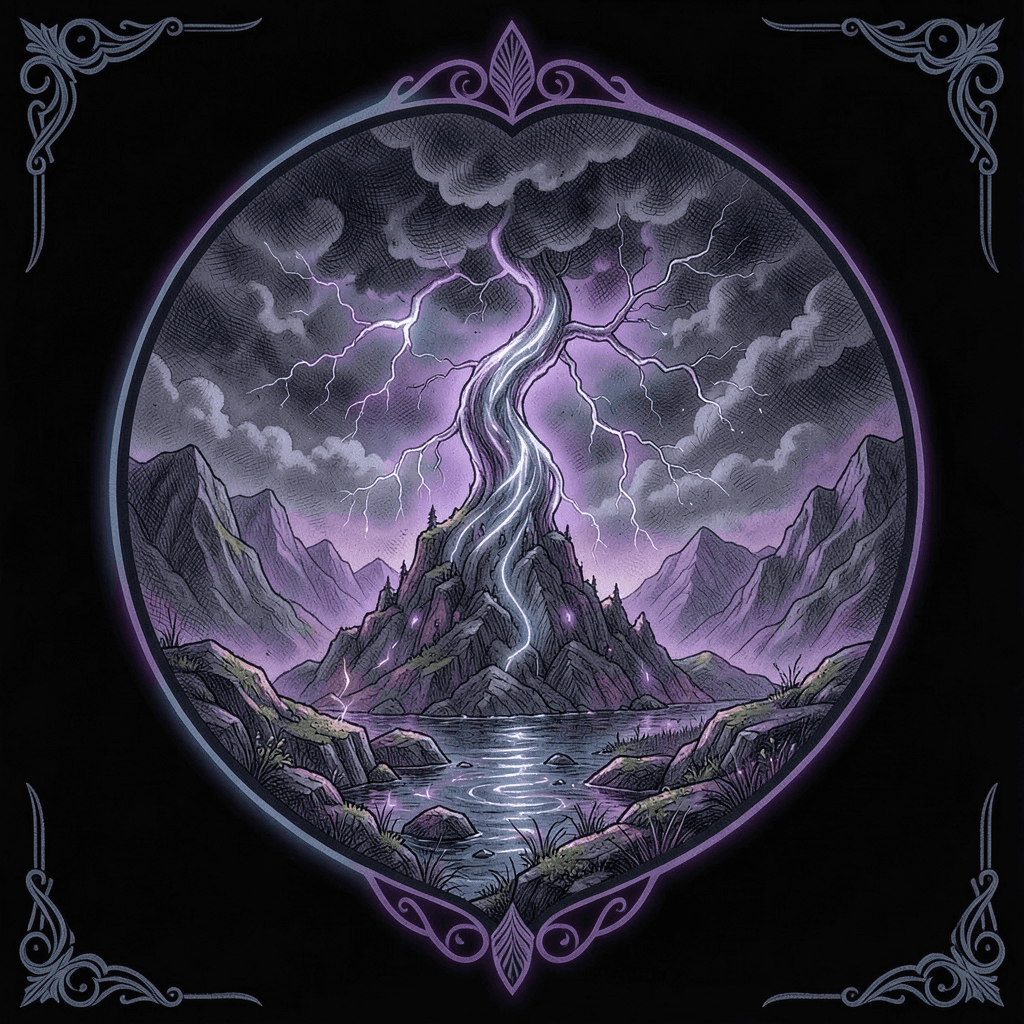
Storm dream meaning — interpretation
What it means to dream about a storm: watching it approach versus being caught in it, and different traditions' views.
Somnovis editorial team
A storm in a dream is rarely subtle: it usually marks a conflict or upheaval the dreamer already senses is coming, or is already in the middle of, even if its waking-life form hasn't fully declared itself yet. What matters most is the dreamer's position relative to the storm — approaching, inside it, or watching it pass.
Watching a storm approach from a distance. Seeing dark clouds gather while still safe often reflects a mounting sense that conflict or difficulty is on its way, even before any concrete sign of it has appeared in waking life.
Caught in the middle of a violent storm. Being battered by wind and rain directly usually points to a crisis the dreamer feels is already fully underway — less a warning than a description of how overwhelmed they currently feel.
Sheltered, exposed, or behind glass. Where the dreamer stands relative to the storm is usually the dream's real information — out in it, under cover as it passes, or watching it through a window — three positions the psychological reading below treats as three relations to the same weather.
What changes the reading. What the storm does decides its register: one that gathers and never breaks, one that destroys, one that passes and leaves the air washed. The aftermath deserves as much attention as the violence — more than one tradition below reads the clearing after the storm as the dream's actual point.
What it does not mean. A storm dream is not a forecast of disaster, and being caught in one is not a punishment. The image is conflict at weather scale — larger than the dreamer and temporary by nature — and every tradition below keeps hold of the second half of that as firmly as the first.
Perspectives across traditions
Weather in this tradition carries a double register — mercy or judgement, told apart by conduct — and the storm inherits the severe half while the rain article carries the merciful one. The tradition remembers wind as an instrument in both directions: winds that carry rain read toward relief and provision, and the tradition remembers the wind sent against the people of ʿĀd — destruction by air, a nation's end told in scripture — so a destroying storm in a dream reads toward trial or judgement upon a place: not a private omen but a matter arriving over a whole neighbourhood, market or community at once. The ʿĀd account spans several suras and is referenced here without pinning one.
The storm that passes belongs to the other pole. A storm that breaks, spends itself, and leaves rain behind reads toward hardship resolving into provision — the frightening arrival of what turns out to be relief — and the tradition's question for a storm dream sits exactly there: what the storm left. Wreckage reads one way; washed air and water in the cisterns read the other. As throughout this corpus, the weather's conduct, not its violence alone, is what is being read.
The site's standing line for the storm holds at school level: affect at weather scale — emotion too large to be experienced as belonging to oneself, met instead as climate. What deepening adds is position, because the dream nearly always supplies one: in the open, sheltered, or watching from behind glass. Caught in the open reads as the affect met without defence — drenched, deafened, but in contact. Sheltered reads as the affect endured behind a boundary that holds — contained, and paying containment's price of passivity. And the third position belongs with the window article: the storm watched through glass is feeling seen without being felt, present at one remove — knowing there is grief or rage in the field and remaining, for now, dry.
The calm after is the reading's second half, and the psyche often supplies it as the dream's actual point: the washed light, the dripping quiet, the world intact after all. Analytical psychology reads that ending as what the dream was for — the demonstration that the affect passes and the ground remains — and a dreamer who wakes before the storm breaks has usually been given the other message: the pressure is still building, and the dream is a barometer, not a verdict.
The traditional dream books read violent weather, hedged as always, toward disturbance and dispute — sudden wind and rain as sudden trouble — with the aftermath read separately and more kindly when the skies clear. The language then supplies the register's best lines. 「山雨欲来风满楼」 (shān yǔ yù lái fēng mǎn lóu, the mountain rain is about to come — wind fills the tower) is among the finest phrases in the language for the felt pressure before a thing breaks: everyone in the building knows, the air itself has changed, and nothing has yet happened. It is the exact reading for dreams of gathering weather — the dream is about the before, and so, usually, is the waking situation.
「暴风骤雨」 (bào fēng zhòu yǔ, violent wind and sudden rain) is the set term for sudden violence — the storm as event, arriving all at once — and marks the register of dreams where the break has already come. Against both stands 「风雨同舟」 (fēng yǔ tóng zhōu, in the same boat through wind and rain): shared adversity, the storm as the thing that reveals who is in the boat — the register the boat article carries from the vessel's side, met here from the weather's. A storm dream in this material asks which of the three it was: the pressure building, the violence breaking, or the company discovered in it.
Sources
The tradition sections draw on these works. That is not a claim that every sentence is a quotation from them. Authorship of the treatise attributed to Ibn Sirin is disputed. The Chinese dream manual is paraphrased: its wording differs by version, so no edition, chapter, or date is named.
- Artemidorus of Daldis, Oneirocritica (2nd century).
- Muntakhab al-Kalām fī Tafsīr al-Aḥlām, the dream book attributed to Ibn Sirin.
- Zhou Gong Jie Meng (周公解梦).
- C. G. Jung, Man and His Symbols (1964), and the Collected Works.
Was your dream different?
Tell us exactly what you saw — our deeply trained AI will work through every detail and nuance of your specific dream.
Get a personal reading