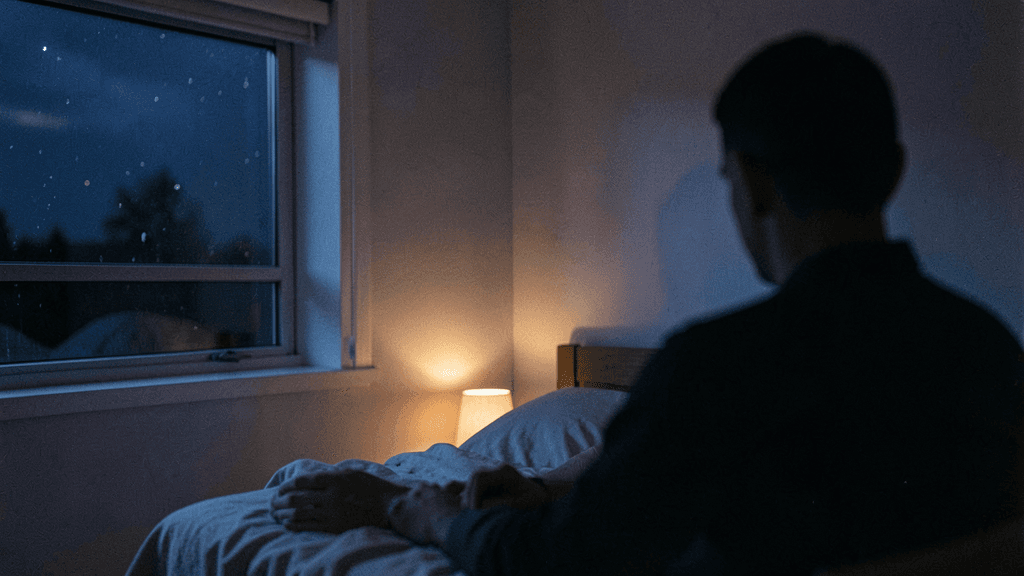
Melatonin: the darkness signal, not a sedative
What melatonin actually does: a hormone that tells the body what time it is rather than forcing sleep, why light suppresses it, and why rules differ by country.
Somnovis editorial team
- Melatonin is released by the pineal gland as light fades; it signals biological night rather than forcing sleep.
- Nocturnal animals produce melatonin at night too, while awake — evidence that it is a timing signal, not a sedative.
- Light exposure in the evening suppresses and delays the melatonin rise.
- Supplement status differs sharply by country, from freely sold dietary supplement to prescription-only medicine.
Melatonin has one of the widest gaps between what it does and what people believe it does. It is routinely described as a sleep hormone or a natural sleeping pill. Neither description is accurate, and the inaccuracy is not a technicality — it explains why some people find it useless and others expect the wrong thing from it entirely.
Melatonin is a timing signal. It is produced by the pineal gland and released as ambient light fades, rising through the evening, peaking in the middle of the biological night, and falling again toward morning. Its job is to tell the rest of the body what time the internal clock currently thinks it is. It is sometimes called the hormone of darkness, which is a better name than sleep hormone, because it is produced at night in nocturnal animals too — animals that are awake at exactly the time it is highest. Melatonin does not mean sleep. It means night.
Light suppresses it, and that is the most useful thing to know about it. Exposure to light in the evening delays and reduces the rise in melatonin, which effectively tells the clock that the day is not over. The effect depends on intensity, duration and timing, and the difference between a dim room and a brightly lit one is real. This connects directly to the evening-screens question covered elsewhere in this section, where the melatonin part of the story is the well-supported part and other parts of the popular story are much shakier.
Because it is a signal rather than a sedative, melatonin behaves differently from what the sleeping-pill framing predicts. It does not reliably knock anyone out, and taking more does not produce more sleep — if anything, the research literature is notable for how small the doses used in careful timing studies are compared with what is sold commercially. Its clearest documented use is for shifting the clock rather than for deepening sleep, which is why the timing of when it is taken matters as much as whether it is taken at all. Taken at the wrong point in the cycle, it can move the clock in the direction you did not want.
Its legal and commercial status varies sharply between countries, which distorts the conversation about it. In some countries melatonin is sold freely as a dietary supplement in whatever dose a manufacturer chooses; in others it is a prescription medicine, sometimes only for specific indications and age groups, in a controlled formulation. That means advice written for one country can be simply inapplicable in another — not because the biology differs, but because the regulatory reasoning does. Products sold as supplements are also not subject to the same content verification as licensed medicines in every market, and analyses of commercial products have found the actual content can differ from the label.
There is a further consideration worth stating plainly: the body's own melatonin is produced in very small quantities, and typical commercial doses are considerably higher than the physiological output it is meant to mimic. Research on long-term use, particularly in children and adolescents, is less complete than the casual availability of the product suggests. This is not an argument that melatonin is dangerous; it is an argument that "natural" and "sold without a prescription" are not the same as "fully characterised".
The genuinely useful takeaway is about darkness rather than pills. Melatonin production is a downstream consequence of your light environment, and the light environment is something anyone can change without buying anything. Dim evening light, and daylight in the morning, act on exactly the system melatonin belongs to. That does not mean supplements have no role — for certain circadian problems they clearly do — only that the underlying mechanism is a clock being told what time it is.
If sleep problems are persistent, distressing, or affecting your daily life, that is a conversation to have with a doctor rather than with a supplement aisle — particularly before giving melatonin to a child, and particularly if you are already taking other medication.
Frequently asked
Was your dream different?
Tell us exactly what you saw — our deeply trained AI will work through every detail and nuance of your specific dream.
Get a personal readingSources
- Chronobiology research on melatonin secretion and light suppression
- Regulatory differences in melatonin classification between countries
- Sleep-medicine reviews of melatonin for circadian rhythm timing
This article is for information only and is not a substitute for medical advice.