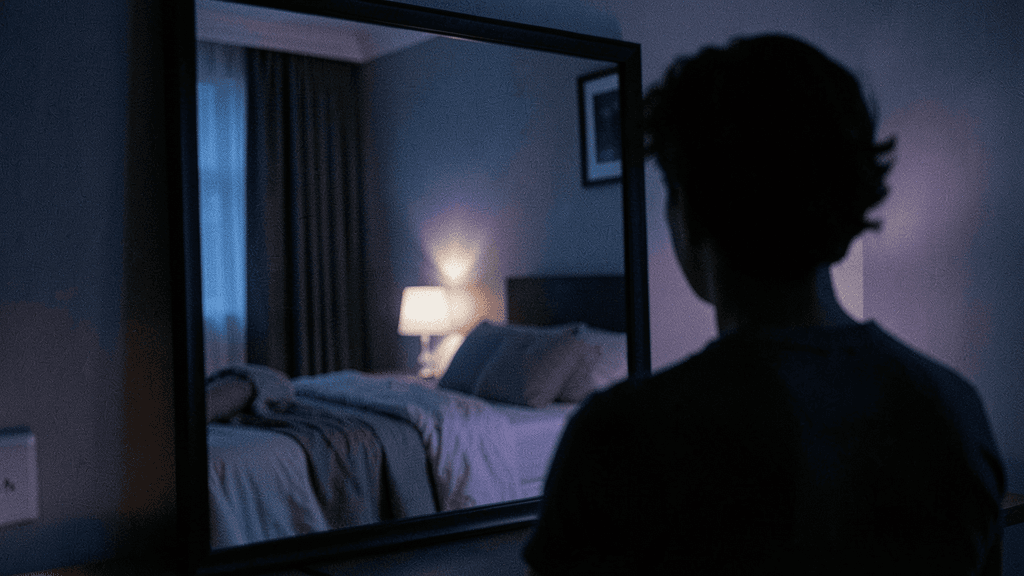
False awakening: dreaming that you woke up
The dream in which you get up, make coffee and start your day — and then actually wake. Why it repeats, how it relates to lucid dreams, and what helps.
Somnovis editorial team
- A false awakening is a dream of waking up, convincing precisely because its content is mundane and familiar.
- It often repeats several times in a row before the real awakening.
- False awakenings are frequently reported alongside lucid dreams and sleep paralysis, and are common in fragmented sleep.
- Celia Green distinguished a mundane type from an anxious, charged type with an atmosphere of unease.
You wake up, get out of bed, and start the morning. You shower, dress, make coffee. Something is slightly off — the light is wrong, or a door leads somewhere it should not — and then you wake up again, in bed, having done none of it. Sometimes this repeats several times before the real waking, each layer as convincing as the last.
A false awakening is a dream about waking up, and it is unusually convincing because it is so ordinary. Most dreams contain something that would give them away if the dreamer were checking. A false awakening usually contains nothing of the sort: it depicts the most familiar and least eventful part of the day, in the most familiar setting, doing exactly what you would be doing. There is no impossible element to notice. That is precisely why the state deceives so effectively, and why the experience is disorienting in a way that a stranger dream is not.
The repetition is a widely reported feature. People describe waking four or five times in sequence, sometimes with growing suspicion, sometimes with the specific frustration of trying to get up and failing over and over. This nested quality is what makes false awakenings a recurring device in film and fiction, but it is a genuine experience with a plainer explanation than any of those treatments suggest.
False awakenings cluster with two other states covered in this section, and that clustering is the most informative thing about them. They are frequently reported alongside lucid dreams — noticing that you have falsely awakened is one of the more common routes into lucidity, since the discrepancy prompts the question of whether this is real. They also occur alongside sleep paralysis, sometimes in sequence, where a person believes they have woken, finds they cannot move, and may then wake for real. And they are more common in fragmented sleep, when the boundary between sleeping and waking is being crossed repeatedly through the night rather than cleanly at the end of it.
Celia Green drew a useful distinction between two types. The first is mundane: the dream simply depicts an ordinary morning, and the only remarkable thing about it is that it did not happen. The second is charged — an atmosphere of tension, apprehension or unease, a room that feels subtly wrong, a sense of anticipation or of something present. The second type is the one people describe as genuinely unpleasant, and it is more likely to be associated with sleep paralysis or with an awareness that something is not right.
These are not the same as the other frightening night experiences, and the differences are worth keeping straight. In sleep paralysis you have really woken and cannot move. In a night terror you are in deep sleep, behaving dramatically, and will not remember it. In a nightmare you are having a frightening dream and will wake from it alert. In a false awakening you have not woken at all — the room is a dream, and there is usually nothing frightening in it beyond the eventual realisation.
The practical handle people use is the reality check, borrowed from lucid dreaming practice: a habitual small test performed during the day, on the theory that a well-worn habit will eventually get performed inside a dream too. The specific tests vary — looking at text twice, checking a clock twice, trying to breathe with the nose pinched — and what they have in common is exploiting the dreaming brain's poor grip on stable detail. Evidence for reality checks as an induction method is mixed, as the lucid dreaming article notes, but as a response to repeated false awakenings they are at least aimed at the right thing.
For most people none of this is necessary. False awakenings are common, harmless and occasional, and they mostly happen during periods of light or broken sleep. If they have become frequent, the more useful lever is usually the sleep itself — regular timing, and fewer of the fragmented nights that produce them — rather than anything done inside the dream.
Frequently asked
Dream symbols on this topic
Was your dream different?
Tell us exactly what you saw — our deeply trained AI will work through every detail and nuance of your specific dream.
Get a personal readingSources
- Celia Green's descriptions of false awakening types
- Research on the co-occurrence of false awakenings, lucid dreams and sleep paralysis
- Lucid dreaming literature on reality testing
This article is for information only and is not a substitute for medical advice.