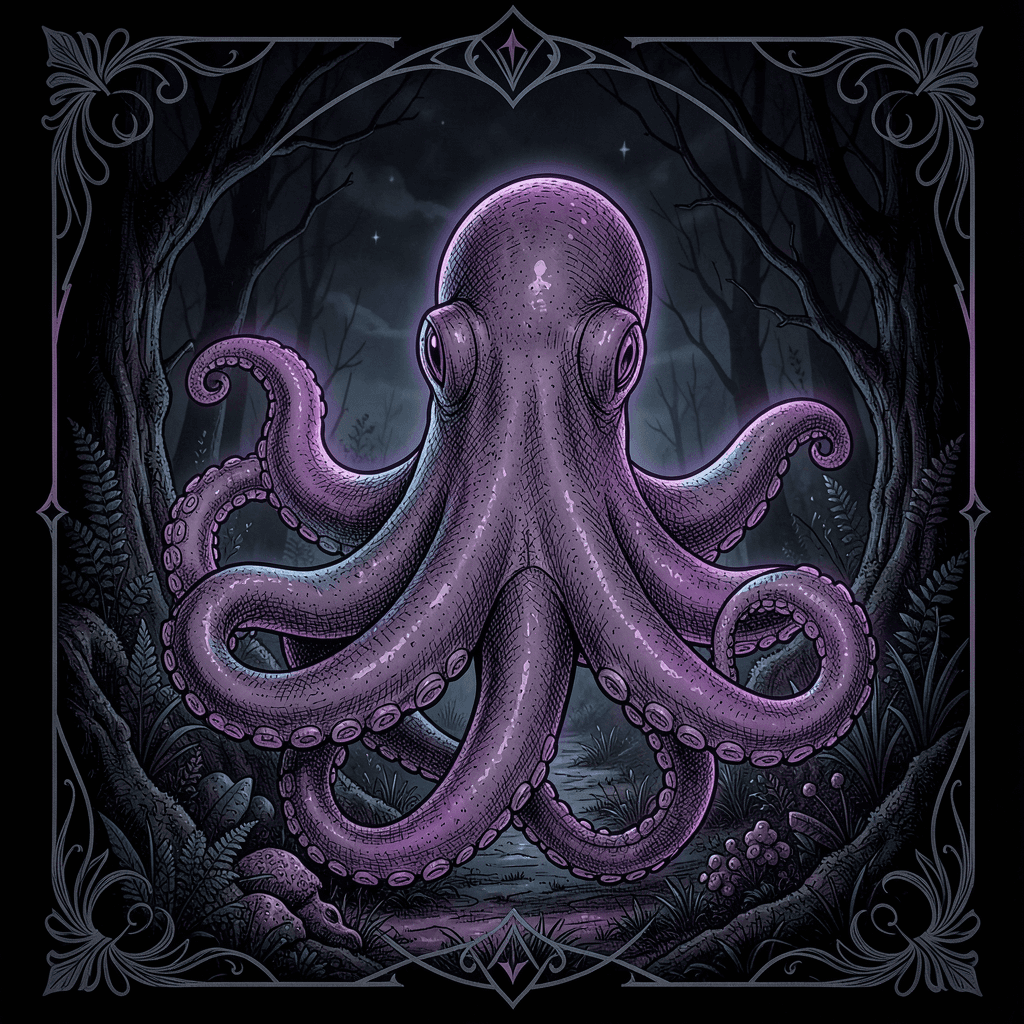
Octopus dream meaning — interpretation
What it means to dream about an octopus: distributed intelligence, multi-attention, or entanglement from every side.
Somnovis editorial team
The octopus in a dream is defined by two things a person cannot easily hold together at once: it has eight arms, and each of them carries a real share of the animal's intelligence. The image is not simply of a creature with many limbs; it is of a creature whose central seat of decision is much less centralised than the dreamer's own, and the dream that stages this often turns on the specific unease of encountering a mind organised differently from one's own.
Many-armed motion as capacity. An octopus moving fluidly through the water — arms independent, colour shifting to match the surroundings — belongs to a dream about competent multi-attention: several demands being met at once by a psychology the dreamer has quietly learned to trust.
Many-armed motion as entanglement. An octopus that wraps around the dreamer belongs to the opposite case: demands multiplying past the point where any one of them can be attended to on its own, and the pressure now coming from every direction at once.
Watched at a distance. In an aquarium, at the bottom of a still pool — a different image from the one that has already made contact, and reads for a dreamer becoming aware of something in themselves or in a situation that is more sophisticated than they had been giving it credit for. The dream is often working on the recognition itself.
Perspectives across traditions
The octopus is not one of the classical corpus's own creatures. The tradition was compiled in a region whose seas hold cephalopods, but the dream manuals concentrate on animals more frequently encountered by their compilers, and the specific octopus reading is not among them. The section extends from attested categories and says so.
Two categories carry most of the reading. The tradition reads creatures of the sea (دَواب البحر, dawābb al-baḥr) as figures of hidden provision or hidden trouble, depending on whether they are still or agitated; a dream of a peaceful octopus reads within the favourable half of that category. And the tradition reads a creature with many limbs, or many faces, as an image of a matter with several parties or several interests moving at once — the dreamer's dealings currently involving more than one direction. The specific octopus reads inside the intersection of the two categories: a sea-creature whose difficulty is precisely that it moves in multiple directions at once, and the reading follows what the animal is doing in the dream rather than what it is. No named compiler is cited for an octopus entry (أخطبوط, akhṭabūṭ).
Analytical psychology reads the octopus as one of the more striking natural images available for the specific psychological condition the school has spent substantial energy describing: a psyche not centralised in a single seat of ego. The image is unusually apt and it is worth stating why rather than leaving the correspondence to gesture.
Three facts about the animal make the dream image more precise than it would be from the many-limbed shape alone. The octopus has roughly two thirds of its neurons outside its brain, distributed across its arms, so that each arm carries a genuine share of the animal's decision-making — a real biological fact about an intelligence that is not seated where a vertebrate would put it. Its skin senses light and shifts colour to match its surroundings, which means the animal effectively perceives its environment through the whole of its outer surface rather than through its eyes alone. And the animal is unusually adept at solving problems by combinations of arm-actions that seem to emerge without a visible executive coordinating them. A dream that stages an octopus is, in this school, often working on the dreamer's own condition of doing things they had not consciously planned and afterwards recognising as having been the right thing to do.
The reading is compensatory in a specific direction. To a person who has been over-organising their inner life around a single central decider — the ego insisting that nothing gets done unless it has authorised it — the dream that supplies an octopus is the psyche returning to them the fact of their own distributed competence. The tentacles are not the threat; the belief that competence has to be centralised is. When the same image is projected onto another person — a relationship that feels tentacular, reaching, insinuating — the school reads it carefully: some dreams of an octopus around the dreamer are portraits of a particular kind of pressure a specific person is exerting, and the outward reading is often the truer one.
The Chinese folk register on the octopus is thin, and the honest account of it is short. The animal is called 章鱼 (zhāng yú) in modern standard Chinese and 八爪鱼 (bā zhǎo yú, "eight-clawed fish") more colloquially, and neither term carries a classical dream-manual entry of its own. The seafood tradition treats it as one animal among many; the dream tradition does not treat it distinctively.
What a Chinese reader may bring to the dream — and the section should not overreach here — is the general favourable reading of sea creatures within the water category (water read toward provision and toward wealth in motion). A dream of an octopus in clear water reads within that favourable frame, without a compilation entry attached; a dream of an octopus in troubled or grasping water reads with more reserve. The article does not attach a specific dream ruling to the animal, and does not read the number eight as a ruling — the auspicious eight belongs to numbers and decoration, not to a dream reading of a specific animal. Where the corpus is genuinely silent, saying so plainly is the accurate sentence.
Sources
The tradition sections draw on these works. That is not a claim that every sentence is a quotation from them. Authorship of the treatise attributed to Ibn Sirin is disputed. The Chinese dream manual is paraphrased: its wording differs by version, so no edition, chapter, or date is named.
- Artemidorus of Daldis, Oneirocritica (2nd century).
- Muntakhab al-Kalām fī Tafsīr al-Aḥlām, the dream book attributed to Ibn Sirin.
- Zhou Gong Jie Meng (周公解梦).
- C. G. Jung, Man and His Symbols (1964), and the Collected Works.
Was your dream different?
Tell us exactly what you saw — our deeply trained AI will work through every detail and nuance of your specific dream.
Get a personal reading