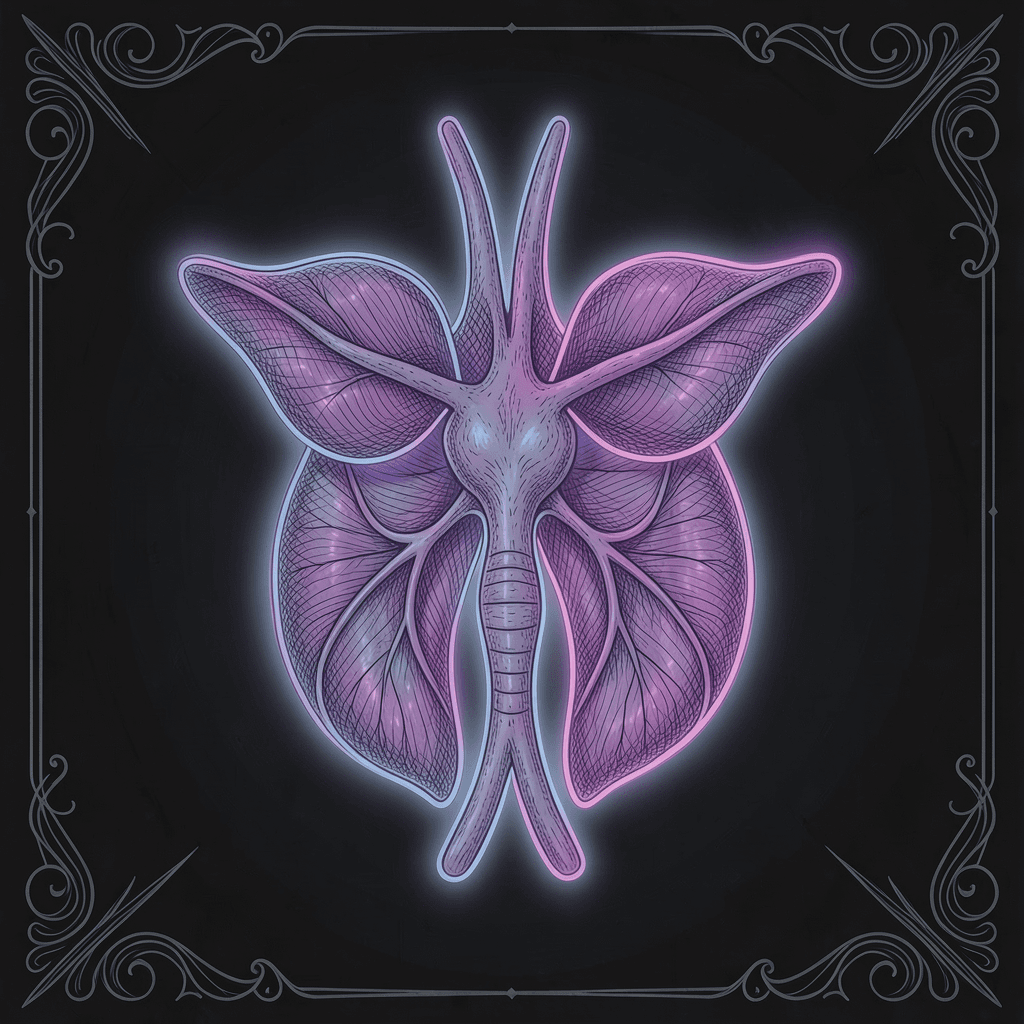
Navel dream meaning — interpretation
What it means to dream about your navel: the mark of original connection, distinct from the stomach's instinct and digestion.
Somnovis editorial team
Distinct from the stomach, tied to instinct and ongoing digestion, the navel carries no active function of its own at all — a scar rather than an organ, the single permanent mark of an original connection now long since severed, so a dream centered on the navel usually turns on whether that origin still feels like solid ground to stand on or like a tie the dreamer has actually outgrown.
Looking down at the navel with a settled, grounded sense of where the dreamer actually came from, origin fully at peace. A settled, grounded sense of the navel often reflects the dreamer's own confidence that their origin is one they've genuinely made peace with.
Staring at the navel unable to place any real sense of where it actually connects back to, origin oddly unfamiliar. An origin that feels oddly unfamiliar when the dreamer looks for it tends to point to a fear of disconnection from where they actually began.
The navel exposed, or looked at by somebody else. A different dream from looking at it oneself. This is where the Islamic material below is most specific, because in that tradition the navel is not a neutral piece of anatomy but a boundary line.
Something coming out of, or going into, the navel. Uncommon and vivid. The cord that was there is the obvious reference, but the Chinese material below supplies a second one — a place where something is understood to be stored rather than to pass through.
A navel that is wrong: absent, doubled, deeper than it should be. Usually about origin being unaccounted for rather than about the body, and generally the strongest form of the second scenario above.
What changes the reading. Whether the dream treated the navel as a mark or as an opening. Almost everything below divides along that line, and the traditions disagree about which it is.
What it does not mean. A navel dream is not a message about the dreamer's health or about their mother, and nothing below should be read as one.
Perspectives across traditions
There is no manual entry for the navel on its own, and rather than invent one it is worth naming the two real bodies of material that meet at it. The first is a boundary. In Islamic jurisprudence the area a man must keep covered runs from the navel to the knee — the navel is the line itself, the point at which the body becomes private. That makes it a marker of modesty rather than neutral anatomy, and a dream in which it is exposed, or stared at, engages that boundary directly rather than by analogy.
The second is kinship, and it runs through a word. رحم (raḥim) is the womb, and the same word is kinship: صلة الرحم, keeping the ties of kinship intact, is a major obligation, and a well-known report describes the womb-tie as taking its name from the name of the Merciful himself. The navel is where that tie was physically attached and where it was cut. A tradition that treats kinship as an obligation with a bodily name reads the mark of the original attachment as that obligation's visible sign.
Both readings are attested, and they are not the same reading. One makes the navel a limit and the other makes it a link, so a dreamer for whom the dream was about being seen and a dreamer for whom it was about where they came from are working with different material here. The favourable-when-settled, cautionary-when-unfamiliar reading that circulates is an extension from the kinship half, and it is worth marking as an extension rather than as a classical entry for the navel.
Analytical psychology reads the navel as the mark of a bond that preceded any separate self — a connection to the mother, and behind her to whatever the person came out of, severed deliberately at the start of an independent life and never erased. That is why the dream so often has less to do with the mother as a person than with the fact of having been continuous with something before being oneself.
Two things make the image sharper than the obvious reading. It is the one scar every person carries, and it is the only scar that is evidence of a bond rather than of an injury — every other mark on a body records damage, and this one records attachment. And the navel is a centre in a very old and very literal sense: the omphalos at Delphi was a stone marking what the Greeks called the navel of the world, the Quechua name of Cusco is commonly glossed as navel, and the Rapa Nui name for Easter Island is commonly glossed as the navel of the world. Those last two glosses are widely repeated and contested by some linguists, and are given here as glosses rather than as settled etymologies.
What the convergence is worth is the reason analytical psychology bothers with comparative material at all: cultures with no contact between them reaching for the same body part when they want to name a centre is the kind of evidence this school takes as showing that an image is doing structural work rather than decorative work. A dream that puts the navel at the middle of everything is using a figure much older than the dreamer.
Chinese medicine has a name for this exact spot. 神阙 (shénquè) is the point at the navel itself, and it is treated distinctively: it is not needled, and the standard traditional application is moxibustion over a layer of salt packed into the hollow. It is worth being careful about what that rule means, because it is easy to make poetry out of it. The abdominal wall is thin there and the navel is a scarred fold that will not close cleanly, so the prohibition is about infection and injury — it is anatomical caution, not a statement about the place being sacred. The practice is worth naming because it is particular and checkable; the meaning must not be read out of it.
Below the navel, and separately, sits the lower 丹田 (dāntián), the field where internal-cultivation theory holds that 元气 (yuánqì) — the original or prenatal qi a person receives before birth, as distinct from what is acquired afterwards from food and air — is stored and nurtured. The navel is therefore, in this material, the outward mark of the reserve a person is born with rather than of the store they build. These are two different locations, the point at the navel and the field beneath it, and merging them into one place is the error to avoid.
One qualification belongs with all of that. Cultivating the dantian is a discipline with its own long training, and a dream is not an attainment in it. What this material gives a dreamer is a frame — that the navel marks something inherited and finite rather than something earned — and not a claim that the dream has done anything to it.
Sources
The tradition sections draw on these works. That is not a claim that every sentence is a quotation from them. Authorship of the treatise attributed to Ibn Sirin is disputed. The Chinese dream manual is paraphrased: its wording differs by version, so no edition, chapter, or date is named.
- Artemidorus of Daldis, Oneirocritica (2nd century).
- Muntakhab al-Kalām fī Tafsīr al-Aḥlām, the dream book attributed to Ibn Sirin.
- Zhou Gong Jie Meng (周公解梦).
- C. G. Jung, Man and His Symbols (1964), and the Collected Works.
Was your dream different?
Tell us exactly what you saw — our deeply trained AI will work through every detail and nuance of your specific dream.
Get a personal reading