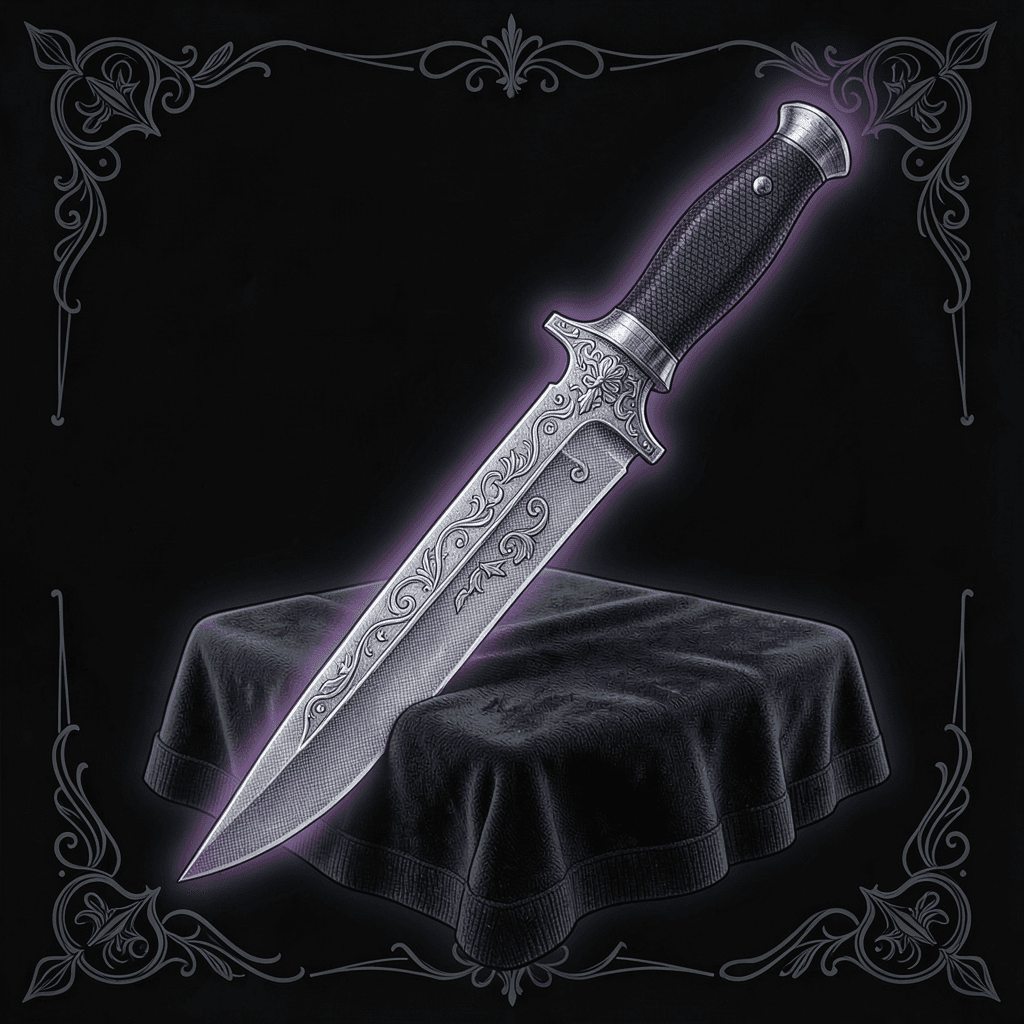
Knife dream meaning — interpretation
What it means to dream about a knife: a cutting decision, aggression, or a severed tie — and how traditions interpret it.
Somnovis editorial team
A knife in a dream is a tool before it's a weapon, and that duality shapes its meaning: it can represent a precise, necessary decision to cut something away, or a threat of harm, depending on who holds it and how it's used.
Using a knife deliberately, to cut or prepare something. A knife used with purpose and control is often read as a sign that the dreamer is ready to make a difficult but necessary decision — cutting away something that no longer serves them.
Being threatened with a knife, or one used violently. A knife used as a weapon, especially against the dreamer, more often points to a fear of betrayal or a conflict that feels dangerously close to becoming irreversible.
What changes the reading. Who holds the blade, and what is actually being cut, decide most of the dream: a knife used to free something, one turned on a figure, and one held by a stranger are three different images. The blade's condition matters too — a blunt or broken knife is its own reading in more than one tradition below — and a knife received or given carries a charge the traditions treat with particular care.
What it does not mean. A knife dream is not a violence forecast and not evidence of anyone's intentions, the dreamer's included. All three traditions below read the blade first as the capacity to separate — to decide, to end, to cut away — and treat harm as one use of that capacity rather than its meaning.
Perspectives across traditions
The classical Islamic dream-interpretation tradition reads bladed instruments through decisiveness and authority, and the sword is the major category: the corpus reads a sword as standing for authority, for a son, or for the tongue and what it does. The knife is a smaller, domestic member of the same family, and it inherits the family's function without the rank — the cutting and the separating. Used for its purpose, a knife is read practically; turned on a person, it is read as a severing of a relation or a decisive act against them; blunt or broken, as an instrument that will not do what it is for — a decision that cannot currently be carried out.
It is worth being clear that this is not a violence reading. What the tradition is reading in an edge is its function — separation, the making of two where there was one — and the strong symbolic assignments belong to the sword by name, not to every blade. A dreamer's kitchen knife carries the function; it does not carry the rank.
In a Jungian reading a blade is discrimination in the exact sense — the capacity to separate one thing from another, to decide, to end. That is a necessary psychological function, and analytical psychology does not read it as aggression by default: a psyche that cannot cut cannot choose, and plenty of knife dreams arrive precisely when a separation is overdue. What the reading turns on is who holds it and what is being cut. A knife used to free something — cutting a rope, opening what was sealed — and a knife turned on a figure in the dream are different images entirely.
A knife in an unknown figure's hand moves the material towards the shadow: the capacity to decide and to end, disowned by the dreamer and now encountered as if it belonged to someone else. That is usually the more useful question than any about danger — not who is threatening the dreamer, but which of the dreamer's own capacities has been handed to a stranger in the dream because it was not being exercised in waking life.
The organising association is 「快刀斩乱麻」 (kuài dāo zhǎn luàn má, a sharp knife cuts through tangled hemp) — decisive action resolving a snarled situation, entirely positive in tone — and a dream knife that cuts cleanly lands on it at once. That is an association the folk reading draws on rather than a dream ruling in itself, and the distinction is worth keeping: what the phrase supplies is the value the culture sets on decisiveness, which is what a clean cut in a dream borrows.
Against it stands the gift taboo. Giving a knife is avoided because it suggests 「一刀两断」 (yī dāo liǎng duàn, one cut, two pieces) — the severing of a relationship. The taboo is related to the one on gifting shoes but not the same: shoes carry an unlucky homophone, knives carry severance itself. And there is a third pole, easy to miss: the blade as authority — the instrument of someone's power to decide, which is where this material meets the Islamic reading of the sword. A dream knife can therefore be read along three lines rather than two — decisiveness, rupture, and power held or lost — with the dream's own details, who holds it, what it cuts, whether it was given, deciding among them.
Sources
The tradition sections draw on these works. That is not a claim that every sentence is a quotation from them. Authorship of the treatise attributed to Ibn Sirin is disputed. The Chinese dream manual is paraphrased: its wording differs by version, so no edition, chapter, or date is named.
- Artemidorus of Daldis, Oneirocritica (2nd century).
- Muntakhab al-Kalām fī Tafsīr al-Aḥlām, the dream book attributed to Ibn Sirin.
- Zhou Gong Jie Meng (周公解梦).
- C. G. Jung, Man and His Symbols (1964), and the Collected Works.
Was your dream different?
Tell us exactly what you saw — our deeply trained AI will work through every detail and nuance of your specific dream.
Get a personal reading