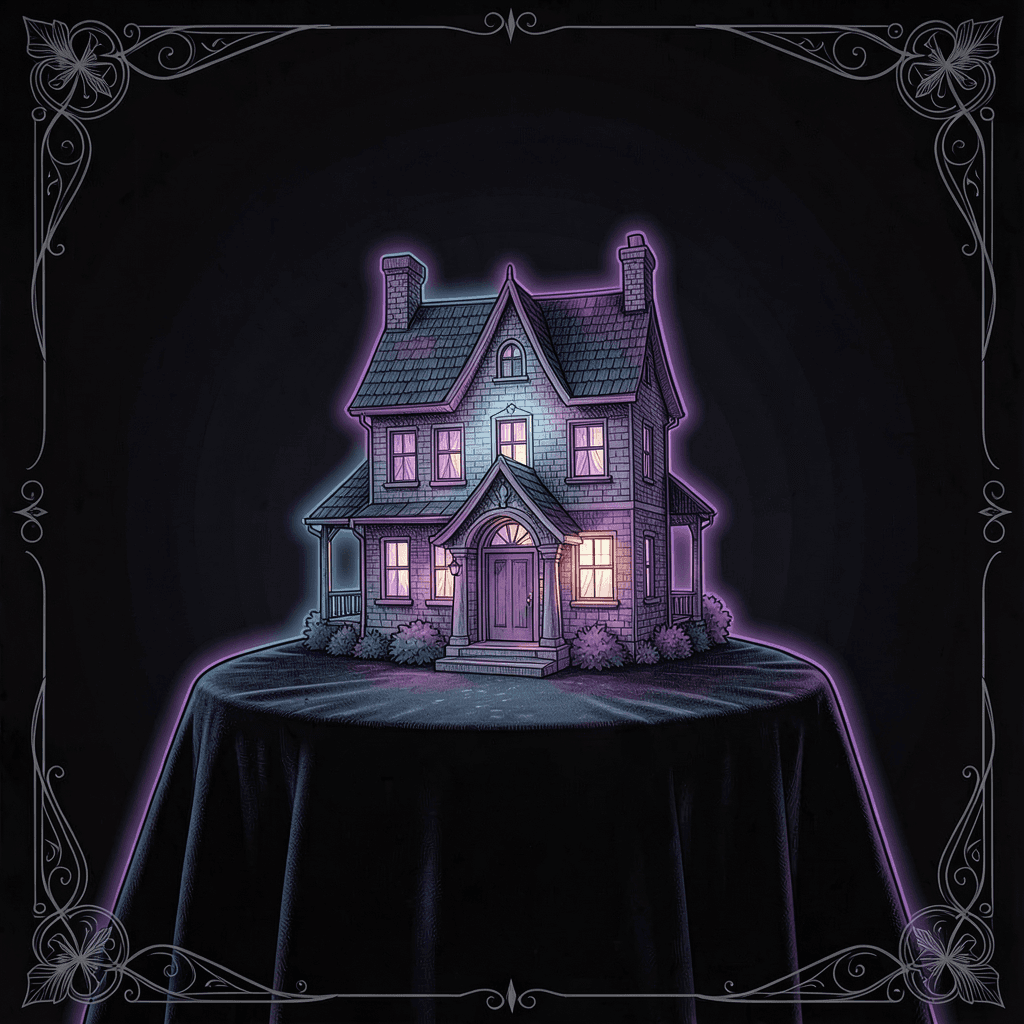
House dream meaning — interpretation
What it means to dream about a house: exploring unknown rooms, a house on fire, and different traditions' perspectives.
Somnovis editorial team
A house in a dream is one of the most reliable symbols for the self: not a specific building from waking life but a kind of floor plan of the dreamer's own mind, where each room can stand for a different part of who they are — public rooms for what's shown to others, hidden or locked rooms for what isn't.
Finding a room that wasn't there before. This is one of the most common house-dream motifs, and it's usually read as a sign of an unexplored capacity or a part of the self the dreamer hasn't yet gotten around to using — rarely something threatening, more often something waiting.
A house that is damaged, flooding, or on fire. A house under threat tends to point to a sense of instability in the dreamer's actual foundation — health, home life, or identity — rather than to any literal building.
What changes the reading. Which part of the house the dream lingers on is the detail worth recovering: the entrance, the roof, the stairs, the cellar, the room that is always locked. Whether the house is the dreamer's current home, a childhood home, or somewhere never seen before shifts the reading substantially. So does the light: many house dreams turn on how dark a familiar place has become.
What it does not mean. A house dream is not a message about property, a move, or a building the dreamer actually owns, and a collapsing house in a dream says nothing about a real one. Dreams frequently rebuild childhood homes with wrong dimensions and impossible rooms — that distortion is normal, and is usually where the meaning is, rather than a sign that something is wrong.
Perspectives across traditions
The classical Islamic dream-interpretation tradition reads the house as the dreamer's own person, life and circumstances — its condition is understood to be their condition. A spacious, sound or well-lit house reads as ease and expansion in the dreamer's affairs; a cramped, dark or collapsing one reads as constriction and difficulty. The correspondence is close enough that the tradition attends to the building in some detail.
Specific parts carry specific readings. The door stands for access and for the dreamer's dealings with the outside world; the roof stands for protection and for the head of the household. Building a house is read as establishing something durable in one's affairs — a matter set on foundations rather than improvised. A house collapsing is read severely, as the loss of what holds a life together, and it is one of the images the tradition treats with the most weight rather than as a general warning.
The house is among the most direct images of the psyche itself in analytical psychology, and a multi-storey house maps onto its layers: upper floors as conscious life, cellar and foundations as the personal and then the collective unconscious beneath. This is one of the few images where naming Jung is safely specific — he described exactly such a house dream of his own as formative in developing the idea of the collective unconscious.
The practical readings follow from the architecture. Discovering unknown rooms is read as encountering undeveloped parts of the personality, and the surprise the dreamer feels is part of the point: the rooms were always in the house. The state of the cellar is read as the state of what has been buried — not as a threat, but as an account of how the dreamer has been storing what they would rather not look at. A house dream in this tradition is less an omen than a survey.
Folk interpretation reads the house as family fortune and as the standing of the household as a whole, rather than as an image of the individual. A bright, well-kept or newly built house is auspicious for the family's prospects; cracks, leaks and collapse are read as warnings about family stability, and about the health of elders in particular, which is a recurring emphasis across this material.
Feng shui thinking colours the folk readings throughout. Orientation, light and the state of the entrance all carry weight, with a blocked or dark entrance read as fortune unable to enter the household — a reading that treats the house as something with an inside and an outside, and treats good fortune as something that has to be able to find the door. That is a genuinely different frame from the psychological one alongside it, where the house has no outside at all.
The manual register attaches the readings to specific damage rather than to the house in general. The folk dream books give readings of the shape: a leaking house portends illness for the head of the household, a house collapsing portends the ruin of the family, and building or repairing a house portends great good fortune — a set that treats the building as a direct account of the family's condition, and not a claim that a dream reports on anyone's health. The phrases run the same way. 「家宅不安」 (jiā zhái bù ān), the household is unsettled, is what cracks and leaks are glossed with, and 「上梁不正下梁歪」 (shàng liáng bù zhèng xià liáng wāi), when the upper beam is not straight the lower beam goes crooked, is the saying about an elder whose conduct bends the whole family — which is why a beam in trouble is read upwards, at whoever is responsible.
Sources
The tradition sections draw on these works. That is not a claim that every sentence is a quotation from them. Authorship of the treatise attributed to Ibn Sirin is disputed. The Chinese dream manual is paraphrased: its wording differs by version, so no edition, chapter, or date is named.
- Artemidorus of Daldis, Oneirocritica (2nd century).
- Muntakhab al-Kalām fī Tafsīr al-Aḥlām, the dream book attributed to Ibn Sirin.
- Zhou Gong Jie Meng (周公解梦).
- C. G. Jung, Man and His Symbols (1964), and the Collected Works.
Was your dream different?
Tell us exactly what you saw — our deeply trained AI will work through every detail and nuance of your specific dream.
Get a personal reading