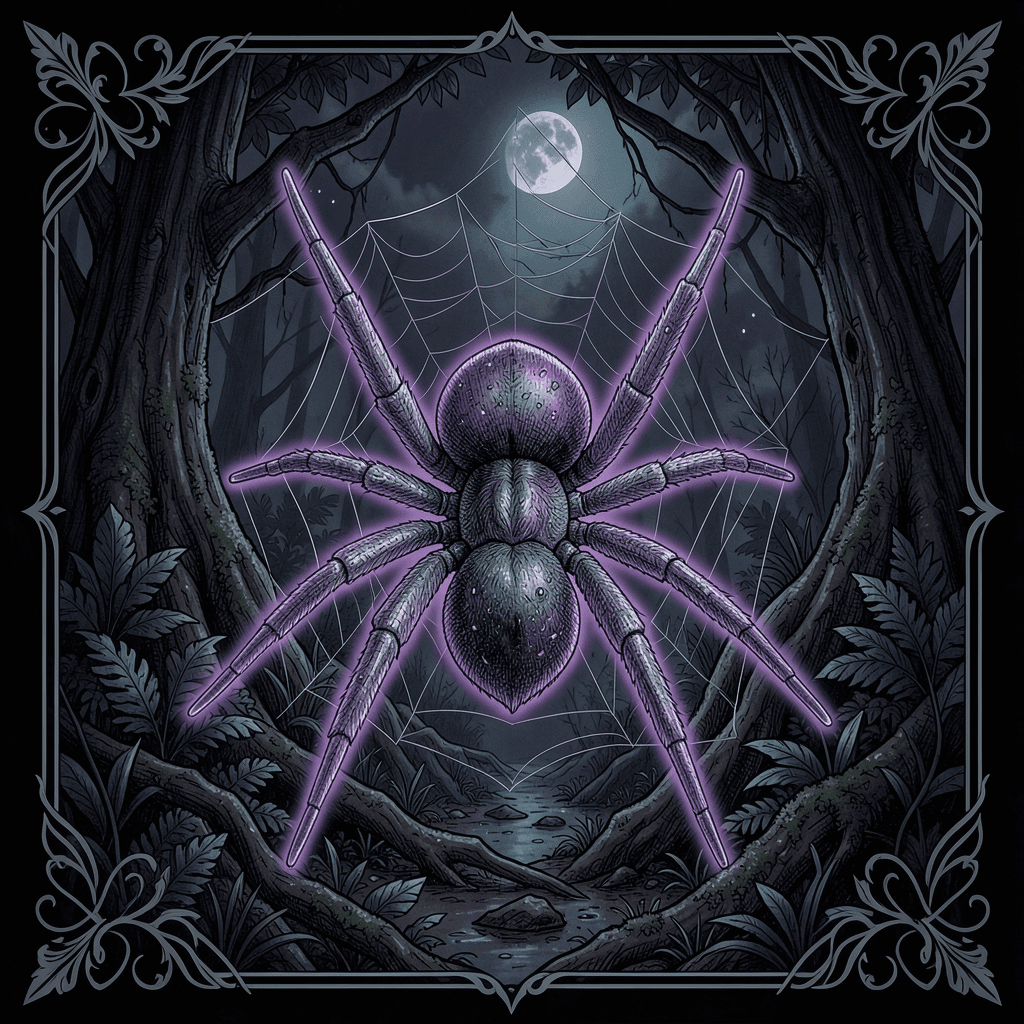
Spider dream meaning — interpretation
What it means to dream about a spider: the web, the fear response, and how different traditions interpret this symbol.
Somnovis editorial team
The spider rarely leaves a dreamer indifferent: for some it's an image of dread, for others of patience and craft. Unlike the snake, a spider is less about danger than about waiting and weaving — something being built quietly, one strand at a time.
What the web means. When the dream centers on the web rather than the spider itself, it often points to a situation the dreamer has been slowly weaving themselves: a network of obligations, a set of relationships, or a story that has become harder to step out of than to keep going. A spider calmly spinning tends to suggest patient preparation rather than a threat. Walking into a web, or finding one strung across a doorway, adds a different note — an entanglement encountered rather than chosen.
When the spider is frightening. A sharp, panicked reaction to a spider in a dream more often reflects an actual phobia carried across into sleep than a symbolic message — and in that case it's worth reading the dream more cautiously, without hunting for hidden meaning where there is simply fear.
What changes the reading. Scale and position do a lot of work here. A spider above the dreamer, descending, reads differently from one underfoot; a single spider differs from a room full of them; and a spider merely watched differs from one that touches the dreamer. Whether the dreamer kills it is worth noting too, since the traditions below disagree sharply about what that act means.
What it does not mean. A spider dream is not an omen of illness, and it does not identify a manipulative person in the dreamer's life. Where the traditions diverge most — one reading the spider as fragility, another as luck arriving — that disagreement is itself the useful information: the image is genuinely open, and the dreamer's own feeling in the dream is the better guide to which sense it carried.
Perspectives across traditions
The classical Islamic dream-interpretation tradition reads the spider through weakness and entrapment. The association is not an invention of the dream literature: it comes from the Qur'an itself, from the surah named for the spider, al-'Ankabut, where the spider's house is described as the frailest of houses. That image is strong enough that a web in a dream is read as a plan or an arrangement that has the appearance of shelter and will not hold under any real weight. Readings therefore point towards schemes, unreliable alliances, and situations the dreamer has invested in more heavily than they can comfortably afford to.
The spider itself is read at a smaller scale than its web. It more often stands for a person who is weak but persistent — troublesome rather than genuinely dangerous, someone whose capacity for harm lies in nuisance and entanglement rather than in force. That distinction matters practically: the tradition is not warning of an adversary to be confronted, but of an arrangement to be examined before more is committed to it. Where the dreamer clears the web away, the reading softens towards a matter the dreamer can still extricate themselves from.
Analytical psychology commonly reads the spider as an image of the entangling or devouring aspect of the maternal archetype — the pull towards being held and contained, and towards being unable to individuate. The web is the operative symbol, and its particular sting is that it is a structure the dreamer is caught in which was, on some level, spun by the dreamer. The dream presents not so much an external trap as a self-made one.
There is a second and quite different strand. Jungian readings also connect the spider to patient, unconscious creativity — something being built out of sight, slowly and methodically, that will only be recognised once it is finished. Which strand applies is usually settled by the dreamer's own emotional response: fear tends to mark the material as shadow, while curiosity or a kind of reluctant admiration points towards the creative reading. As always in this tradition the image is not decoded to a fixed meaning; it is used as a question about where the dreamer's energy has quietly been going.
Folk interpretation in the Zhou Gong Jie Meng tradition is markedly more positive here than most Western readers expect. The spider is associated with incoming good fortune and with visitors or news, and a spider descending on its thread is a well-known auspicious image — luck coming down towards the dreamer. Webs are read as accumulation, including of wealth, so a large and well-made web is a welcome rather than an ominous sight.
The best-known saying in this material (早蜘蛛报喜,晚蜘蛛报忧) turns on the time of day at which the spider appears: a spider seen in the morning announces good news, while one seen in the evening announces sorrow. For a reader raised on this tradition it is the first thing that comes to mind on the subject, and it gives the dreamer a practical detail to check — not what the spider did, but when in the dream it was seen. The saying sits comfortably alongside the descending-thread image rather than competing with it, since both treat the spider as a messenger whose news the surrounding circumstances colour.
The corollary is that killing a spider is treated as cutting off that incoming fortune, which reverses the instinct most dreamers arrive with. This is one of the clearest cases anywhere in dream tradition of two bodies of material reading the same small animal in opposite directions: what one treats as a frail and untrustworthy structure, the other treats as fortune accumulating. Neither is a fact about spiders. Both are cultural documents, and holding them side by side is more honest than choosing between them.
Underneath the sayings runs the manual register, and it is more granular than the general association suggests. The folk dream books give readings of the shape: a spider in front of the bed portends a guest arriving, a spider on a roof beam portends great joy, a spider coming down on its thread portends a happy event descending from above. The name the material uses does the same work. A spider met in the house is called 「喜蛛」 (xǐ zhū), the joy spider, and the word for spider, 蜘 (zhī), sits a homophone away from 知 (zhī), to know — so the creature is filed as something that knows the news before the household does. That is the logic the readings run on, and it is why what a spider portends here is nearly always something arriving rather than something threatening.
Sources
The tradition sections draw on these works. That is not a claim that every sentence is a quotation from them. Authorship of the treatise attributed to Ibn Sirin is disputed. The Chinese dream manual is paraphrased: its wording differs by version, so no edition, chapter, or date is named.
- Artemidorus of Daldis, Oneirocritica (2nd century).
- Muntakhab al-Kalām fī Tafsīr al-Aḥlām, the dream book attributed to Ibn Sirin.
- Zhou Gong Jie Meng (周公解梦).
- C. G. Jung, Man and His Symbols (1964), and the Collected Works.
Was your dream different?
Tell us exactly what you saw — our deeply trained AI will work through every detail and nuance of your specific dream.
Get a personal reading