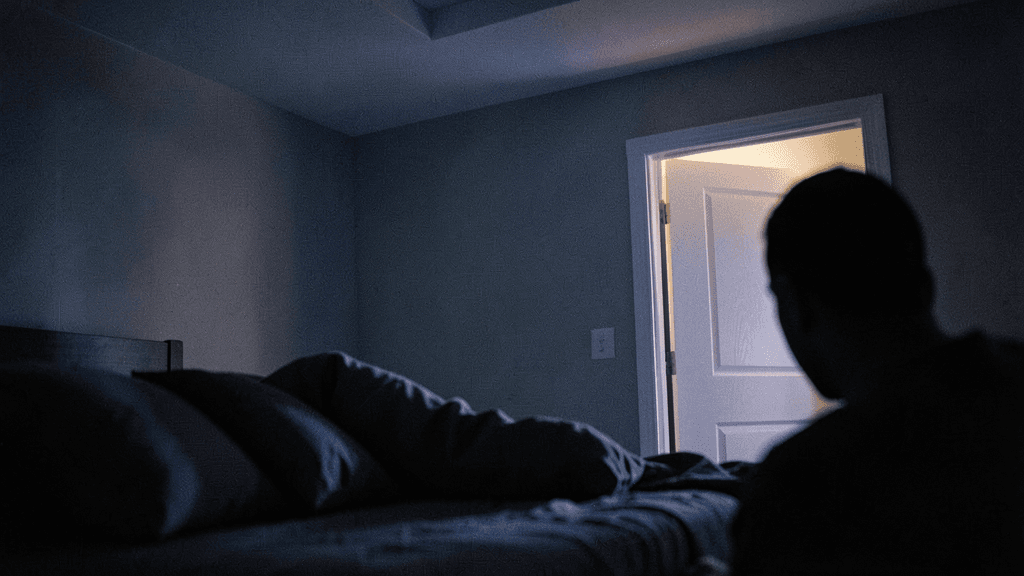
Sleep paralysis: awake and unable to move
Why REM muscle paralysis sometimes persists into waking, the hallucinations that accompany it, how common it is, and the folklore built around it.
Somnovis editorial team
- Sleep paralysis is REM muscle atonia persisting into wakefulness; episodes typically last seconds to a couple of minutes and end on their own.
- Around 8% of the general population has experienced it at least once, with higher rates among students.
- J. Allan Cheyne described three hallucination clusters: a sensed presence or intruder, chest pressure, and floating or falling sensations.
- Risk factors include sleep deprivation, irregular schedules, stress and sleeping on the back.
You wake up and cannot move. Not a limb, not your head; often you cannot speak or call out either. You are aware of the room, aware that you are awake, and completely unable to act. It typically lasts seconds to a couple of minutes, ends on its own, and leaves no physical trace. It is also one of the most frightening experiences a healthy person can have.
The mechanism is well understood, which is the most reassuring thing about it. During REM sleep, voluntary muscles are actively inhibited — the atonia described in this section's article on REM sleep — so that dreams are not physically acted out. Normally that inhibition lifts as you wake. In sleep paralysis, consciousness returns first and the paralysis lags behind by a few moments. Nothing is wrong with the machinery; two normally simultaneous processes have come apart briefly. It is harmless in itself, and it resolves without intervention every time.
What makes it terrifying is not the immobility but what often comes with it. Because the brain is still partly in a REM state, dream imagery can intrude into the waking room, and it is experienced as being genuinely present. J. Allan Cheyne's research described these hallucinations in three broad clusters. The first is the sensed presence — an overwhelming conviction that someone or something is in the room, frequently accompanied by fear, and sometimes by a visible figure, footsteps or breathing. The second is pressure, especially on the chest, often with a sense of suffocation or of being held down. The third involves the body itself: floating, falling, spinning, or feeling as if you have left your body.
These are not idiosyncratic. The same three clusters recur across individuals who have never heard of each other, which is the strongest evidence that they arise from the physiology of the state rather than from a person's expectations.
Around eight percent of the general population has experienced sleep paralysis at least once, with higher rates reported among students and in some clinical groups. It is not rare, and having it does not indicate a disorder by itself. Known risk factors are ordinary: sleep deprivation, irregular or shifting schedules, jet lag, stress, and sleeping on the back, which is associated with episodes more often than other positions.
The cultural material around it is the part that belongs on this site. The same physiology has been interpreted through local frameworks everywhere it occurs, and the interpretations are strikingly consistent in shape. In Japan it is kanashibari, from an expression meaning to be bound with metal. Newfoundland folklore has the Old Hag, a figure that sits on the sleeper's chest — the same image as Henry Fuseli's painting The Nightmare, and the source of the word itself, from a night creature that presses down. Similar accounts of a pressing, sitting, or binding night visitor appear across cultures with no contact between them. That convergence is a clean demonstration of how folklore works: a real and specific bodily experience, explained through whatever figures a culture has available.
Practically, there is little to do during an episode beyond wait. It ends on its own, always. Many people find that trying to move a small extremity, or focusing on breathing, shortens the experience or at least makes it more bearable, though this is reported rather than demonstrated. Knowing what it is helps more than anything else — the terror comes largely from the interpretation, and the interpretation changes once you know the mechanism.
Sleep paralysis is distinct from the other frightening night experiences covered in this section. Unlike a nightmare, you are awake and the room is real. Unlike a night terror, you remember it clearly and in detail afterwards. Unlike a false awakening, you have genuinely woken up.
Occasional episodes are common and not a cause for concern. If they are frequent, distressing, or accompanied by severe daytime sleepiness or sudden loss of muscle tone while awake, that combination is worth raising with a doctor — as is any sleep problem that is affecting your daily life.
Frequently asked
Dream symbols on this topic
Was your dream different?
Tell us exactly what you saw — our deeply trained AI will work through every detail and nuance of your specific dream.
Get a personal readingSources
- J. Allan Cheyne's research on sleep paralysis hallucination clusters
- Sleep-medicine literature on REM atonia intruding into wakefulness
- Cross-cultural accounts of sleep paralysis, including kanashibari and the Old Hag tradition
This article is for information only and is not a substitute for medical advice.